
Ceptics 35W Universal Travel Adapter Kit
4.5Editor score
Type C and Type I support
Built-in surge protection
35W USB-C Power Delivery
Our expert guide compares 10 power adapters for Chile and Argentina travel, covering plug types, USB charging, voltage, portability, and safety.
Traveling to Chile or Argentina requires more than remembering the right plug shape. A useful power adapter should match local sockets, support your charging setup, and clearly separate plug compatibility from voltage conversion. The right travel adapter can simplify a long itinerary while helping prevent damaged electronics.
This guide compares ten adapters using the available product details, including supported plug types, outlet layouts, USB ports, charging outputs, safety features, physical dimensions, and intended destinations. It covers dedicated Argentina-compatible options, Chile-capable kits, and universal designs suited to travelers visiting both countries and additional international stops.
Each pick highlights a different practical approach, from a compact two-adapter set to a multiport universal charger with surge protection. Ratings provide one point of comparison, but plug fit, voltage compatibility, charging needs, and packability should carry more weight. Product availability and prices can change, so check current listings before buying.
4.5Editor score

4.8Editor score

4.3Editor score
The comparison below highlights outlet coverage, charging capacity, safety features, and portability to help travelers find the most practical adapter for Chile, Argentina, or both.




This two-piece adapter set receives a 4.3 rating and stands out for its broad approach to South American sockets. It includes Type I and Type E/C/F-style coverage, making it especially relevant to Argentina, where different outlet formats may be encountered. The universal input accepts common US plugs and gives travelers a simple physical way to connect compatible chargers.
We may earn a commission when you buy through this link, at no additional cost to you.
Its strongest feature is destination flexibility. Type I support is useful in Argentina and Uruguay, while the Type E component can serve travelers heading toward Chile, Peru, Bolivia, Paraguay, Brazil, and other locations using compatible sockets. Because the set contains two adapters, it also provides a backup for a trip involving hotels, rental properties, or offices with different outlet arrangements.
The important limitation is that this is a plug adapter, not a voltage converter. Phones, tablets, laptops, cameras, and other modern electronics commonly support broad input voltage, but a 110V-only hair dryer or other high-powered appliance may require separate voltage conversion. The absence of USB ports also means travelers must bring their own charging cables and wall chargers rather than using this set as a centralized charging hub.
This is a strong choice for travelers who prioritize simple plug compatibility, carry separate wall chargers, and may visit more than one South American country. It is less convenient for a group that wants to charge several USB devices from a single compact unit, but its two-adapter format and broad regional coverage make it a practical Argentina and Chile travel solution.
Argentina uses more than one outlet configuration, and this set is designed to address that variation. Type I and Type E coverage also improves its usefulness when a route crosses into Chile or nearby countries without requiring another basic plug adapter.
The adapters work best with chargers that already support the voltage used in the destination. It is a straightforward setup for universal electronics, but it offers no built-in USB ports or automatic voltage conversion.
We may earn a commission when you buy through this link, at no additional cost to you.
The Ceptics 35W kit earns a 4.5 rating by combining plug versatility with one of the strongest charging specifications in this group. It offers two US-style socket inputs, a USB-A port, a USB-C port, a 35W Power Delivery USB-C port, and a USB-C cable. The included adapters cover Type C, Type G, Type B, Type I, Type E/F, and Type A outlets used across Europe, Asia, and elsewhere.
We may earn a commission when you buy through this link, at no additional cost to you.
Type C coverage makes this a natural match for Chile, while Type I expands its usefulness for Argentina. More importantly, the universal unit is designed as a charging hub rather than merely a passive plug converter. Its 35W USB-C output is useful for compatible phones, tablets, and other USB-C devices, while the additional sockets can handle conventional power adapters.
Built-in surge protection and a voltage indicator distinguish it from several smaller alternatives. The indicator helps travelers understand whether the local outlet is 110V or 220V, though it does not change the incoming voltage. The unit also carries a two-year limited warranty, and the included pouch makes it easier to pack the main body and separate plug attachments securely.
The trade-off is complexity and size. There are multiple attachments to keep together, and the stated 100-240V compatibility excludes 110V-only appliances such as some hair dryers, clippers, and curling irons. Travelers with a broad device mix and a need for high-output USB-C charging will find this kit more useful than a simple two-plug set.
The dedicated 35W USB-C output gives compatible devices more headroom than the lower-powered USB options in several alternatives. Two US-style inputs add flexibility for travelers who still rely on conventional wall plugs.
Surge protection provides a useful layer of defense for connected devices. The voltage indicator also helps users make better decisions, although a separate converter remains necessary for single-voltage appliances.
We may earn a commission when you buy through this link, at no additional cost to you.
This Ceptics set holds a 4.6 rating and directly addresses travelers heading to Chile. It includes Type C and Type L SWadAPt attachments, two US-style outlets, one USB-A port supporting up to 18W, and one USB-C port supporting up to 20W. That combination allows it to work as both a plug adapter and a compact charging hub.
We may earn a commission when you buy through this link, at no additional cost to you.
The product is particularly well suited to phones, tablets, cameras, laptops, power banks, Kindles, and similar electronics. Its stated capacity of 1,250 watts at 250V and 10A is ample for many personal travel devices, although it is not intended for high-powered household appliances. The voltage indicator helps travelers distinguish local 110V and 220V conditions before connecting equipment.
The title combines Chile and Italy terminology because the attachment set supports Type C and Type L formats used in different regions. That can make the listing feel less focused, but it also increases its value for a broader itinerary. Uruguay and other countries using compatible outlets may also benefit from the included attachments. As with the other Ceptics options, the unit does not convert voltage.
This is a particularly good fit for a traveler spending most of the trip in Chile who wants a purpose-built Type C solution and convenient USB charging. It is less ideal for a high-wattage appliance or for someone whose destination requires a different plug format not represented in the included set. For ordinary travel electronics, however, it offers a clear and versatile package.
The two outlet inputs and two USB charging ports reduce the number of separate wall units a traveler needs. That makes it convenient for a bedside setup where a phone, camera, and laptop charger may be used together.
The adapter works with worldwide-voltage devices such as chargers, phones, tablets, and cameras. Single-voltage hair tools still need a separate voltage converter and should not be connected based on plug fit alone.
We may earn a commission when you buy through this link, at no additional cost to you.
This TESSAN two-pack receives a 4.7 rating and combines Type I plug support with a generous selection of outlets. Although marketed for Australia and New Zealand, the listed compatibility includes Argentina, Uruguay, China, and numerous Pacific destinations. Each adapter turns one Type I socket into four US-style outlet positions and three USB ports, including one USB-C port.
We may earn a commission when you buy through this link, at no additional cost to you.
Its four-sided design is intended to reduce blocking, allowing several devices to charge at once without the crowding associated with a straight power strip. The USB-C output reaches 20W, while two USB-A ports serve additional phones, earbuds, cameras, and other accessories. This makes it more useful than a basic Type I plug for travelers with several devices to recharge.
There is no surge protection, and the unit does not include a voltage converter. Users must confirm that connected equipment supports 100V to 250V or is otherwise suitable for local power. High-wattage hair tools can draw enough current to make a dedicated converter and suitable appliance support important, even when the plug itself fits.
The two-pack arrangement offers a backup and permits simultaneous use in two separate rooms. It is an excellent choice for travelers visiting Argentina alongside Australia, New Zealand, or China, especially when a multiport charging hub is more valuable than minimal size. The two units may take more luggage space than a single adapter, but the charging flexibility is substantial.
Four US-style outlet positions accommodate many standard travel charger shapes. The side-facing layout helps keep adjacent plugs accessible, which is especially helpful in busy hotel rooms.
Type I compatibility makes the pack practical for multi-country trips involving Australia, New Zealand, China, and many Pacific destinations. Two included units provide useful redundancy.
We may earn a commission when you buy through this link, at no additional cost to you.
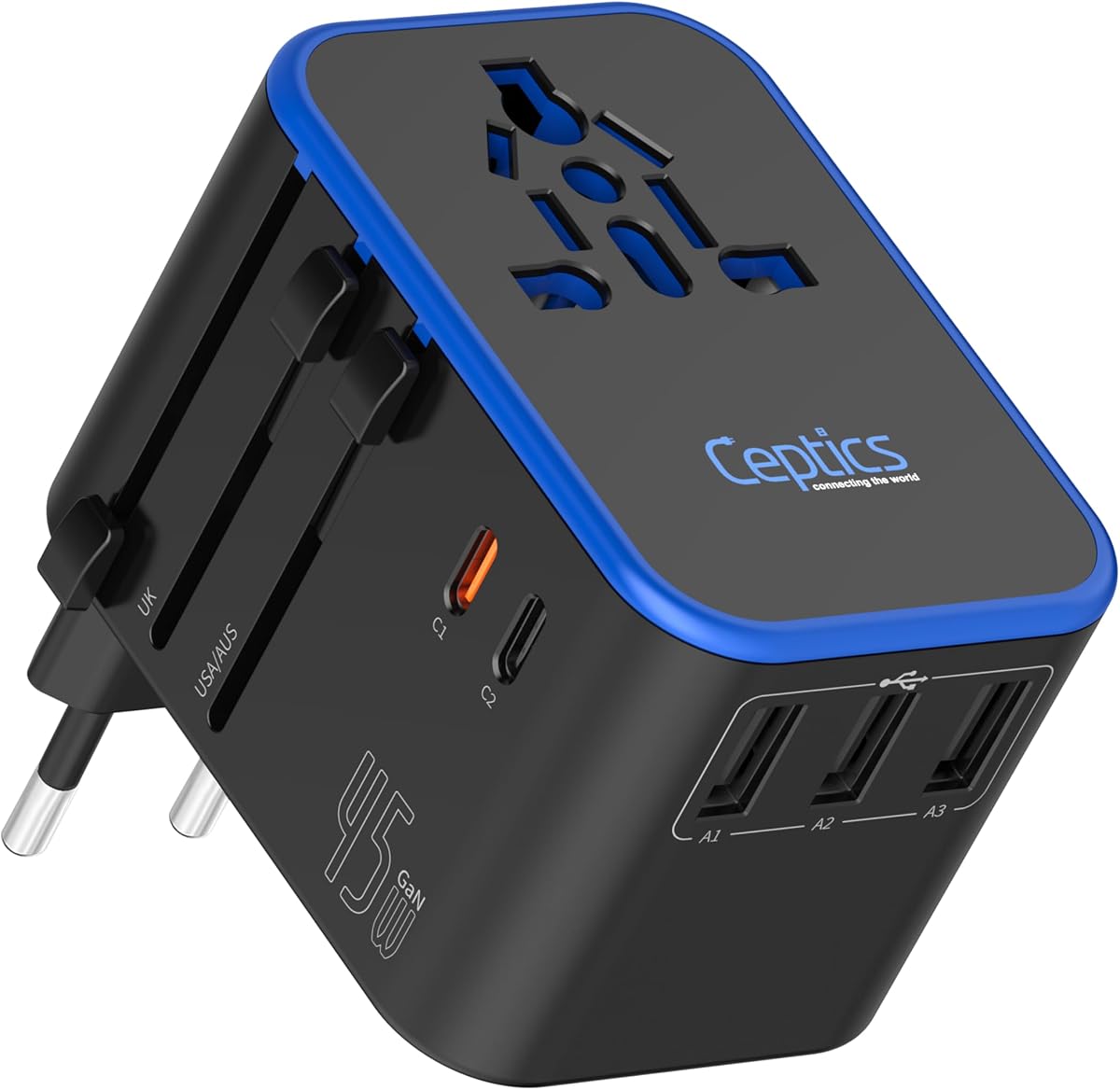
The Ceptics 45W adapter has a 4.6 rating and offers the highest stated combined USB output among the multiport universal options in this guide. A universal AC input is joined by three USB-A ports and two USB-C ports, with one USB-C connection supporting Power Delivery and Quick Charge 3.0. That makes it appropriate for travelers who regularly charge laptops, tablets, phones, and smaller accessories.
We may earn a commission when you buy through this link, at no additional cost to you.
The plug system supports Type C for Europe and much of South America, including Chile, as well as Type I for Argentina, Australia, China, and New Zealand. Type A and Type G outputs broaden its usefulness for routes that cross several regions. Consolidating several connectors into one unit can reduce the number of wall chargers packed for a long trip.
Safety features include an 8A fuse with an extra included, electric-shock protection, a plug lock, safety shutters, and FCC, CE, and RoHS certification. These provisions do not make the device a voltage converter. Connected devices must support 100V to 240V, and the product is explicitly not compatible with 110V-only hair dryers, curling irons, or straighteners.
This adapter is a good match for a device-heavy traveler who wants broad outlet coverage and meaningful USB-C charging in one package. It may be bulkier than compact plug-only models, and users with only a phone and one standard charger may not need its full capability. For a long international itinerary, however, the versatility can justify the added size.
The 45W combined output provides a useful balance for compatible laptops, tablets, and phones. Power Delivery and Quick Charge support make the adapter more versatile than a basic USB-only travel block.
The universal input, replaceable fuse, safety shutters, and plug lock support dependable use across different outlet types. It remains important to verify voltage support for every appliance.
We may earn a commission when you buy through this link, at no additional cost to you.
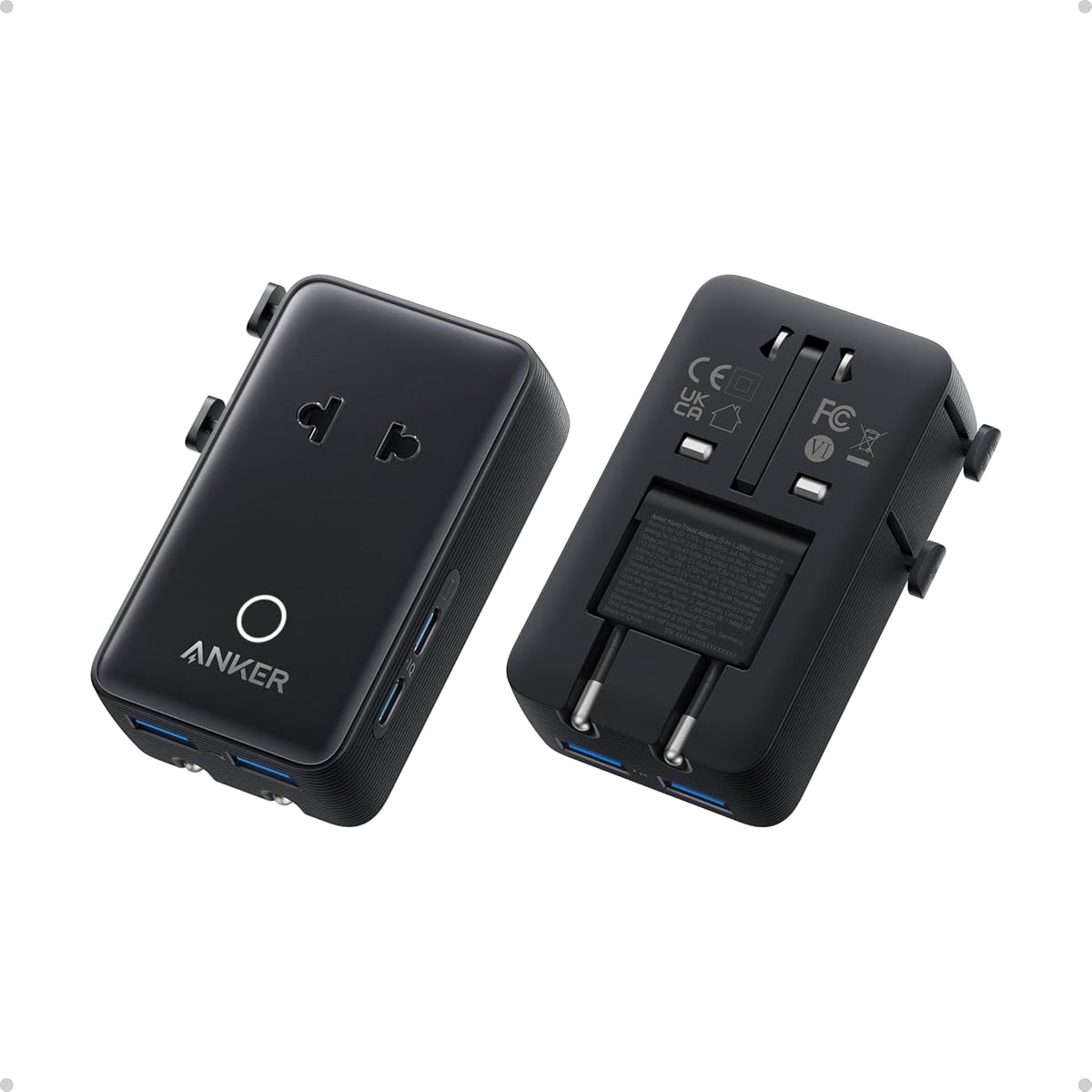
The Anker Nano Travel Adapter receives a 4.5 rating and emphasizes compactness. At 3.39 by 1.97 by 0.98 inches, it has a credit-card-sized form that is easy to fit into a passport holder, laptop sleeve, or small tech pouch. Retractable pins further reduce the chance of catching the adapter on clothing or other items.
We may earn a commission when you buy through this link, at no additional cost to you.
Despite its small size, the unit includes one AC outlet, two USB-A ports, and two USB-C ports. The USB system supports up to 20W in total, or 15W when the output is shared. A single USB-C port can deliver up to 20W, which is suitable for many phones, earbuds, watches, and other compact USB-C accessories.
The two-pin AC design does not support three-prong grounded plugs, including Schuko, UK three-pin, and many grounded laptop chargers. The product also performs no voltage conversion. Those limitations make it less flexible for a traveler with a broad collection of power supplies, even though it remains highly portable.
This is an excellent choice for travelers who carry only a few compatible devices and value every centimeter of luggage space. It covers Type A, C, G, and I plugs, allowing it to handle Chile and Argentina along with several other regions. Users who depend on grounded laptop chargers or need more aggregate charging power should choose a larger unit.
The foldable pin design and low profile make the adapter easy to carry without adding bulk. It is particularly suitable for light packers and short itineraries.
The adapter can charge several USB devices, but its total output is limited when ports share power. One AC outlet and no grounded-plug support narrow its usefulness for heavier electrical setups.
We may earn a commission when you buy through this link, at no additional cost to you.
This basic two-pack has a 4.3 rating and focuses on the essential task of adapting a US-style charger for Argentina, Uruguay, and other compatible destinations. Its compact shape makes it easy to carry, while the two-piece format provides redundancy or allows simultaneous use in different rooms.
We may earn a commission when you buy through this link, at no additional cost to you.
The product is rated for 10A and 250V and uses integrated phosphor copper plug contacts within a durable ABS housing. It is compatible with outlets in Argentina and Uruguay and is also listed for use in Australia, Switzerland, and Brazil, making it a potentially useful addition to a multi-country travel kit.
The adapter does not include USB ports, surge protection, or voltage conversion. Travelers will need their own charging bricks and cables, as with any simple plug adapter. Devices designed for 110V-only operation should not be assumed safe in Chile or Argentina simply because their plug fits.
This is a sensible budget-oriented choice for a traveler who already owns compatible USB wall chargers and wants a small, uncomplicated solution. The pair is less useful for travelers who want a single centralized charging station, but it handles the core plug-format problem with few extra parts. Its straightforward design also makes it easy to explain and use.
The compact construction takes up very little luggage space. Keeping one adapter in a carry-on and another in a checked bag can provide convenient redundancy.
This option works with separate wall chargers that support local voltage. It does not replace the need for USB cables, a charging hub, or a voltage converter for incompatible appliances.
We may earn a commission when you buy through this link, at no additional cost to you.
The HANYCONY Type I adapter earns a 4.7 rating by combining a compact body with two US-style outlets and three USB ports. Its Type I format is suitable for Argentina and a long list of other destinations, including Australia, New Zealand, China, and several Pacific countries. The side-access arrangement allows multiple devices to be connected without one plug completely blocking the others.
We may earn a commission when you buy through this link, at no additional cost to you.
Two USB-C ports and one USB-A port provide up to 15.5W in total, with individual USB-C outputs supporting up to 5V/3A. Combined with two conventional outlets, the adapter can serve up to five connected devices. That makes it a practical one-piece charging station for travelers carrying a phone, tablet, camera, earbuds, and conventional wall charger.
The maximum stated load is 1,875W at 250V, or 15A, though the USB outputs are more restrictive than the AC rating. There is no surge protection or voltage conversion. Appliances such as hair dryers, straighteners, electric toothbrushes, and razors must support the relevant voltage range, and a separate converter may be needed for single-voltage models.
At only 2.4 ounces, this adapter is well suited to travelers who want multiple charging options without carrying a full power strip. It is especially useful for an itinerary combining Argentina with Australia, New Zealand, or China. Travelers who need grounded-plug support or surge protection should consider a larger alternative with more clearly defined electrical protections.
Two outlet positions and three USB ports allow a mixed set of devices to share one wall connection. The compact format preserves that capability without becoming a large travel power strip.
Argentina is only one part of the adapter's regional coverage. Travelers moving among Type I destinations can avoid carrying several nearly identical country plugs.
We may earn a commission when you buy through this link, at no additional cost to you.
The TESSAN Travel Adapter 009 has a 4.6 rating and offers a balanced mix of AC and USB connectivity. It includes one universal AC outlet, two USB-C ports, and one USB-A port, allowing up to four devices to charge from one wall unit. The product's compatibility list includes Type C for Chile and Type I for Argentina.
We may earn a commission when you buy through this link, at no additional cost to you.
One USB-C port can provide up to 20W, while the USB-A port supports up to 18W, with a maximum total USB output of 20W. This is a practical configuration for a traveler who wants fast charging for a primary USB-C device while retaining a USB-A connection for older accessories. The AC outlet also remains available for a standard wall charger.
The adapter does not provide surge protection or convert voltage. Users should confirm that hair tools and other appliances support 100V to 250V dual voltage. Its 2,000W maximum AC rating is suitable for many chargers, but plug fit should not be used as the only safety criterion for high-power equipment.
At 3.33 by 2.01 by 1.24 inches and 3.65 ounces, the adapter maintains a relatively slim profile. It is a strong middle ground for travelers who need more than a passive plug but do not require the output of a 45W laptop charger. The result is a versatile four-device option for both countries.
The mixture of one AC outlet and three USB ports gives travelers flexibility to connect different charger types. It is easier to use than carrying several separate wall units.
The adapter's slim profile supports carry-on packing while offering more ports than a basic Type I or Type C plug. It is a balanced choice for everyday travel electronics.
We may earn a commission when you buy through this link, at no additional cost to you.
The VINTAR Universal Travel Adapter 30W holds the highest rating in this comparison at 4.8. It combines a universal AC outlet with three USB-C ports and two USB-A ports, allowing up to six devices to charge simultaneously. The total USB output reaches 5V/6A, or 30W, and the unit supports Type C and Type I plugs needed in Chile and Argentina.
We may earn a commission when you buy through this link, at no additional cost to you.
Its broad regional coverage is another major strength. The listed plug options include Type C for much of Europe, South America, and other regions; Type G for the United Kingdom and several other locations; Type A for the Americas and Asia; and Type I for Argentina, Australia, China, and New Zealand. The universal AC outlet accepts plugs from the US, EU, UK, Australia, and China.
Safety and portability are also carefully addressed. The adapter uses a double 10A fuse and is certified to CE and FCC standards, while the housing is described as flame retardant and designed for heat dissipation. It measures 2.1 by 2.1 by 2.8 inches, weighs 5.6 ounces, and includes a storage bag. One limitation is that Type D and M plugs are not supported.
This is the most complete general-purpose choice in the guide for someone visiting both Chile and Argentina and carrying several devices. Its 30W output is not designed to replace the highest-powered laptop charger, and it still does not convert voltage. Even so, the combination of outlet coverage, six charging positions, high rating, and protective design makes it an excellent all-around travel adapter.
Three USB-C ports, two USB-A ports, and one universal outlet support a broad mix of devices. The 30W total output is especially useful for phones, cameras, earbuds, Kindles, and power banks.
Type C and Type I support cover Chile and Argentina, while additional plug formats extend usefulness across a wide itinerary. Type D and M destinations, including parts of South Africa and nearby regions, are outside its stated scope.
We may earn a commission when you buy through this link, at no additional cost to you.
The best travel adapter depends on local plug formats, supported voltage, device mix, itinerary, and available space. Reviewing these factors before buying prevents the most common mistake: treating a physical plug fit as proof that an appliance is safe to use.
Argentina commonly uses Type I-style plugs, but the country is also described as having more than one outlet configuration. An adapter should therefore include Type I support and, when possible, another format or universal outlet that accepts the chargers and power supplies brought from the United States. A Type I-only product is convenient for the primary destination, while a universal model offers more flexibility for multi-country travel.
Look for a design that accepts a standard US or universal charger and provides a compatible Argentine outlet. Avoid assuming that a product labeled for Australia or New Zealand is automatically suitable without confirming Type I compatibility in its specifications.
Chile is generally associated with Type C sockets, and many compact travel adapters use round-pin Type C plugs. Because chargers and power cords come in many shapes, travelers should also confirm that the adapter includes the necessary country attachment rather than only a socket for a standard US plug. A Type C attachment is important for direct wall use, while a universal input is convenient when a device already includes a compatible country plug.
Some products marketed around Chile also include Type L attachments for other destinations. That added coverage can be useful, although it does not replace careful attention to voltage and device requirements.
A plug adapter changes the physical connection, not the electrical voltage. Chile and Argentina may present 220V power, while many US appliances are designed only for 110V. A universal or dual-voltage device marked for 100-240V or 110-240V can generally be used without conversion, but an appliance marked for only 110V or 120V requires a suitable step-down converter.
Voltage indicators can help identify the local supply, but they do not transform it. Before departure, check the input label on every hair tool, medical device, small appliance, and other electrical equipment that will be used away from home.
Travelers carrying only phones and standard USB-A accessories may be satisfied with a basic plug adapter, while anyone with a USB-C laptop or several devices benefits from multiple USB ports. Compare total output as well as individual port ratings. A 20W or 30W unit is suitable for many compact devices, but a higher-output model may be necessary for power-hungry laptops and tablets.
Consider the mix of connectors already in the travel bag. Bringing a multiport adapter can consolidate charging, but travelers should still carry a backup cable and a direct charger for critical devices when possible.
Compact adapters are easier to keep in a handbag or personal item, while larger universal kits may offer more sockets, attachment options, and protection. A credit-card-sized model is convenient for a minimalist packing list, and a two-adapter set can provide redundancy or allow simultaneous charging in two rooms. Travelers on long itineraries should balance the value of each feature against the space it consumes.
If the adapter includes detachable country plugs, a small pouch is useful for keeping everything together. The main unit, attachments, and any converter should be easy to identify in a crowded bag.
Fuses, safety shutters, electrical-shock protection, certified construction, and surge protection can improve confidence when using a shared adapter. Products that specifically state surge protection provide a clearer benefit than those that simply imply safety through a generic certification. A replaceable or spare fuse is also useful for travel because it can help extend the useful life of a multi-use adapter.
These features do not make an incorrectly rated appliance safe. The adapter, converter, appliance, and local outlet must all be compatible with the intended load.
A two-country trip through Chile and Argentina benefits from a design that includes both Type C and Type I support. Travelers continuing to Peru, Bolivia, Uruguay, Australia, or New Zealand should investigate those outlet formats as well, since a model that covers only the two headline destinations may be less convenient than a broader universal adapter.
Check the adapter's excluded plug types. Universal does not literally cover every country or socket, so names such as Type D or M may still require another solution.
Some compact universal adapters use a two-pin connection and cannot accept grounded plugs. This matters for certain laptop chargers and other three-prong power supplies. Larger models may support more AC loads, but users should still observe the stated wattage, amperage, and voltage limits, particularly with hair tools, kitchen appliances, and other high-consumption devices.
For frequent use of grounded equipment, choose a model whose AC outlet visibly supports the relevant plug configuration. For occasional low-power charging, a compact two-pin design may be perfectly adequate.
Before leaving, label the adapter, its country attachments, and any voltage converter so they are easy to identify. Confirm the input range printed on every device that will be connected. When using a high-output USB-C port, attach the appropriate cable and let the adapter negotiate the supported charging rate rather than assuming every device receives the maximum advertised wattage.
Attach the correct plug for the local socket before inserting your device charger. When using a detachable universal adapter, select the country attachment only after confirming the outlet type. Do not force plugs, alter prongs, or use an adapter if it becomes cracked, discolored, loose, or excessively hot during normal operation.
Keep the adapter dry and avoid placing it under heavy luggage, bedding, or other heat-insulating materials. Unplug it when it is not needed, particularly in older buildings where sockets may not switch off cleanly. Pack the adapter and its attachments together, and retain a simple direct charger as a backup for essential devices such as a phone, pacemaker, or mobility equipment.
A universal travel adapter that supports Type C for Chile and Type I for Argentina is the most convenient single-device option. The adapter should also accept the charger plugs you already own, particularly North American Type A plugs. Check that your electronics support the local voltage before connecting them.
A Type C adapter may cover the Chilean portion of the trip, but it is not the usual match for Argentina's Type I sockets. For a combined itinerary, look for an adapter that includes both formats or a universal design that can present either configuration.
You need one only if a device accepts 110V or 120V but not the local 220V supply. Most modern phones, tablets, laptops, camera chargers, and power banks support 100-240V input, but some hair tools and older appliances do not. Read the input label rather than relying on the shape of the plug.
Only if the travel adapter supplies enough suitable USB-C power. Adapters offering 20W to 30W may handle smaller devices, while some laptops require 45W or more and their manufacturer-specified charger. A multiport adapter can also become warm if it powers several demanding devices at once.
If your charger uses a three-prong grounded plug, choose an adapter with a compatible grounded outlet. Some compact two-pin universal adapters cannot accept Schuko, UK three-pin, or grounded laptop charger plugs. Verify the socket shape rather than assuming that a universal label covers every ground configuration.
It is useful, particularly for expensive electronics used in unfamiliar buildings, hotels, or shared networks. However, surge protection does not resolve incorrect voltage or excessive load. A traveler should still use compatible devices, observe the adapter's electrical limits, and stop using it if it becomes unusually hot or shows physical damage.
A two-adapter pack can be useful for redundancy, separate hotel rooms, or use in different countries. A single multiport unit is often sufficient for a simpler itinerary. Carrying a second basic plug in case the main adapter is lost is reasonable, but a backup should not replace careful voltage planning.
Often, yes. Type C and Type I combinations cover Chile, Argentina, and several neighboring destinations, while broader universal designs may also support Type A, E/F, and G. Check every planned country because some sockets, particularly Type D and M, may remain outside the adapter's supported list.
The VINTAR Universal Travel Adapter 30W is the strongest all-around option because it combines the highest rating with Type C, Type I, six charging positions, and a protected 30W USB system. The Ceptics 35W kit stands out for travelers who value surge protection, a voltage indicator, and strong USB-C output, while the compact two-pack is a practical budget option for travelers who already carry separate chargers.
Prioritize the adapter that matches your actual device list and itinerary. A basic Type C and Type I set is sufficient for phones and standard wall chargers, whereas travelers with multiple USB-C devices benefit from a multiport hub. Pay equal attention to AC capacity, grounded-plug support, surge protection, and whether the design converts voltage; plug fit alone is never enough.
Prices and product configurations can change, and the details in this guide reflect the supplied product information available for October 2026. Before making a purchase, confirm the current plug types, power ratings, included attachments, warranty terms, and compatibility with every device you intend to use during your trip.