Solar Outdoor Motion Sensor Alarm
4.2Editor score
Thirteen looping sound options
Four intelligent operating modes
IP55 weather-resistant housing
Solar powered with long standby
Compare 10 barking dog alarms for sound, motion detection, range, power options, outdoor use, and features to help you choose the right watchdog deterrent.
Barking dog alarms create the impression of an alert canine without requiring a pet, providing audible deterrence for homes, driveways, yards, offices, farms, and other properties. The best units combine convincing warning sounds, reliable motion detection, useful wireless range, flexible power options, and installation methods suited to the location being protected.
This guide compares ten barking dog alarms using the specifications and feature descriptions supplied for each model. The evaluation considers detection technology, transmission distance, sound choices, loudness, power requirements, weather resistance, indoor or outdoor suitability, and the number of sensors included.
The list includes standalone alarms, multi-sensor systems, solar units, indoor radar detectors, and kits that combine a receiver with remote sensors. Each review highlights the product's strongest use case and relevant limitations, while current product listings and availability may change over time.
4.2Editor score

4.2Editor score

3.4Editor score
The comparison below shows how the ten barking dog alarms differ in detection method, sound output, range, power, weather handling, and system configuration. It is designed to make the trade-offs between standalone units, indoor radar alarms, and multi-sensor kits easier to understand.



The Safety Technology International ED-50 Rex Plus is an electronic watchdog designed to detect indoor movement and respond with barking. It has a 3.9 rating, but its straightforward design remains appealing for households seeking a simple way to create the impression of a dog in an unoccupied room. Unlike multi-component alarm kits, the unit is installed in one location and operates from a standard electrical outlet.
We may earn a commission when you buy through this link, at no additional cost to you.
Its standout feature is the escalating warning behavior. According to the supplied information, the closer an intruder gets, the more frequently the alarm barks. This creates a more convincing impression of an alert animal than a single fixed alert, while the 24-hour operating concept suits rooms, hallways, offices, or other areas that benefit from continuous monitoring. The outlet-based design also removes the need for routine battery replacement.
The trade-offs are equally clear. This product is intended for indoor placement and does not offer a separate receiver, remote sensor, weather rating, or long-distance wireless link. It is therefore less flexible than the three-sensor and two-sensor kits later in the list, and it cannot be positioned across a driveway or at several perimeter points. Buyers seeking a single-purpose room alert should not expect those expanded functions.
This alarm is best for someone who wants an uncomplicated electronic watchdog inside a home or small workplace. Choose it if a standard outlet is available, movement-based deterrence is the goal, and the changing bark pattern adds useful realism. It is less appropriate for remote outdoor monitoring, multi-point perimeter coverage, or users who need a remote control and selectable alarm modes.
The changing bark frequency provides a more dynamic warning than a constant tone. It can help a visitor or intruder perceive that an animal is reacting as someone approaches.
Because the alarm plugs into a standard outlet, it avoids the battery-maintenance demands associated with remote sensors. This makes it a practical choice for occupied rooms with convenient access to power.
We may earn a commission when you buy through this link, at no additional cost to you.
This wireless barking dog alarm kit combines a motion detector with an indoor receiver and carries a 4.0 rating. It is aimed at users who want to hear an alert when movement occurs somewhere else, such as near a driveway, side entrance, garage, or yard. The stated wireless transmission range of up to 1000 feet makes it a potentially flexible option for properties with separated monitoring points.
We may earn a commission when you buy through this link, at no additional cost to you.
Sound customization is one of the kit's main strengths. It offers six realistic sound options, including a general alarm, ding-dong, welcome chime, and two melodies, along with barking-dog audio. The receiver has four volume levels and a high-audio-amplifier megaphone. Both the receiver and detector can be powered in different ways, including USB use indoors and battery operation for more flexible placement outdoors.
Some important limitations come from the package and operating environment. Batteries are not included, and the listed power adapter is also not included, although a USB wire is supplied. The description notes that outdoor range and detection can be affected by temperature, humidity, obstacles, and other environmental conditions. There is only one sensor, so additional coverage would require another compatible detector and receiver arrangement.
This kit is best for a homeowner who wants one remote detection point and values a long stated transmission distance along with selectable sounds. It is particularly useful when an indoor receiver is more convenient than placing the alarm directly beside the monitored area. People seeking immediate coverage at several locations, or who do not want to add their own batteries, may find a multi-sensor system more practical.
The receiver-and-sensor arrangement lets users hear a warning without depending on sound traveling from the detection point alone. That can make a porch, garage, or driveway installation easier to monitor from inside.
The receiver can shift between dog-inspired sounds, chimes, melodies, and a general alarm. This flexibility lets owners choose a more welcoming sound for visitors or a stronger warning mode for security.
We may earn a commission when you buy through this link, at no additional cost to you.
The Dog Barking Alarm with Motion Sensor & Remote offers the most balanced combination of useful detection, flexible installation, and responsive controls in this roundup. Its 4.2 rating is tied for the highest listed score. The package is designed for monitoring movement near doors, windows, walls, trees, fences, and other points while receiving audio alerts through a separate indoor unit.
We may earn a commission when you buy through this link, at no additional cost to you.
The infrared sensor captures movement from as far as 23 feet away and provides a wide detection angle. The receiver communicates with the sensor over a stated distance of up to 656 feet in open spaces. Six sound options cover realistic dog barking, a loud siren, a welcome greeting, a classic ding-dong, and two melodies, while four volume levels allow the owner to tune the response to the environment.
The remote control is particularly useful because it allows the user to manage the alarm without walking to the receiver. The receiver supports a USB connection or AAA batteries for temporary use during an outage, although those receiver batteries are not included. The remote sensor arrives with a preinstalled 12V 23A alkaline battery, and its IP43-rated housing is intended to handle everyday outdoor conditions.
This is the strongest general recommendation for a property owner who wants more than a single-room alarm but does not need several sensors. It works especially well for a front approach, garage, side yard, or entrance monitored from inside. It is less suitable for widely separated points beyond its stated open-space range or for a buyer who insists on the longest transmission distance available in the list.
The sensor's stated 23-foot detection distance is suited to many entrances and paths, while 656 feet of transmission gives the receiver room to sit away from the monitored point. This combination offers useful flexibility without requiring a property-wide network.
A dedicated remote makes it easier to change settings or manage the alarm from another room. It also reduces the need to approach the receiver whenever an owner wants to acknowledge or adjust a warning.
We may earn a commission when you buy through this link, at no additional cost to you.
The Three-Detector Barking Alarm Kit is built for buyers who want more than one detection point from the start. It includes three outdoor motion detectors and one receiver, earning a 4.0 rating. That configuration can cover separate entrances, walkways, garage doors, or sections of a yard without requiring the owner to purchase individual sensors one at a time.
We may earn a commission when you buy through this link, at no additional cost to you.
The receiver offers six realistic dog-bark sounds, a high-volume amplifier, and four volume levels, with the maximum output listed at 110dB. The sensors are programmed before shipment and can be mounted on doors, windows, walls, fence posts, trees, and other surfaces. Sticker or screw attachment provides two installation routes, while the stated wireless transmission range reaches up to 1000 feet under favorable conditions.
The system uses three AA alkaline batteries in each detector, but the batteries are not included. The receiver is powered through a USB cable and an outlet, which is useful for a central indoor listening point. As with the one-sensor version, actual detection and transmission can vary because of obstacles, humidity, temperature, and other environmental influences.
This kit is a logical fit for larger properties or anyone seeking coverage at three distinct points. It offers a strong balance of output, sound variety, and installation flexibility. It may be unnecessary for a small apartment or single monitored doorway, where fewer components would be easier to position and maintain. It is also worth considering only if three sensors are genuinely useful in the intended installation.
The included detectors can be separated to watch different approaches, giving the system broader awareness than a single-sensor kit. Users can also pair multiple receivers and sensors where needed to identify the source of movement.
The detectors' waterproof construction supports use on exterior doors, fence posts, and trees. Mounting hardware options help accommodate both temporary and more permanent installations.
We may earn a commission when you buy through this link, at no additional cost to you.
The ChunHee Solar Motion Sensor Alarm combines a 130dB warning sound, a flashing light, and solar power in a weather-resistant outdoor unit. Its 4.1 rating reflects a versatile design for yards, farms, barns, gardens, camps, and other areas where a wired alarm or frequent battery changes would be inconvenient. The motion sensor covers a 110-degree area and detects movement from approximately 5 to 8 meters.
We may earn a commission when you buy through this link, at no additional cost to you.
One of the most useful features is the ability to record a custom alarm sound or select defaults that include a barking dog and gunshots. Adjustable volume helps owners avoid unnecessarily disturbing neighbors. The unit also offers three operating modes: continuous sound and flash, night-only sound and flash, and a timer mode, allowing the alarm to follow a schedule that suits the property.
Solar operation requires planning. The manufacturer advises charging the panel in sunlight for at least one day before installation. The IP65 housing is designed for storms, snow, and extreme heat, but remote standalone units still need suitable sunlight and careful placement. The description also notes that some animals may not respond immediately, and it can take several weeks for the deterrent effect to become apparent.
This alarm is best for owners seeking a self-contained outdoor deterrent with no receiver or long wireless link. It is especially appealing for agricultural properties, remote outbuildings, and gardens where a loud, visible warning is desired. People wanting to monitor the site from inside, customize more elaborate multi-point notifications, or rely on an alarm that works consistently in prolonged low light should consider a receiver-based alternative.
The integrated solar panel removes the need to run wiring or regularly replace remote batteries. The unit can therefore be placed where a conventional mains-powered alarm would be difficult to install.
Continuous, nighttime, and timer operation let owners select when sound and light should activate. Adjustable volume provides another layer of control in areas where a full-output alarm could be disruptive.
We may earn a commission when you buy through this link, at no additional cost to you.
This 120dB barking dog alarm uses radar rather than a conventional passive infrared sensor, giving it a 360-degree detection field and a stated maximum range of 12 meters. It has a 3.4 rating, the lowest in this group, but offers one of the most specialized feature sets. Its ability to sense movement through glass and certain interior walls makes it particularly interesting for indoor warning systems.
We may earn a commission when you buy through this link, at no additional cost to you.
The unit includes a three-dimensional sound-effect speaker, eight volume settings from 70dB to 120dB, and three selectable sounds: barking dog, siren, and doorbell. Radar sensitivity can be adjusted across three levels. Because the alarm can sit inside a property while still detecting outdoor movement, it can warn occupants without forcing a sensor to be mounted directly beside a window or door.
The product has clear environmental limits. It is not waterproof and cannot be used outdoors. Radar waves cannot pass through metal front doors, and performance through other walls varies with thickness and material. Eight AA batteries provide roughly three days of operation where no outlet is available, while the included power adapter is the more convenient choice for permanent use.
This alarm is best for homeowners who want an indoor unit that can detect approaching movement around a doorway, window, or glass partition. It is a premium choice because of its radar technology, broad coverage, high output, and fine volume adjustment. It is unsuitable for direct outdoor exposure and less useful when the monitored area is separated by a metal barrier.
The ability to detect through glass and selected walls allows the alarm to be positioned inside while still monitoring an approach. This can provide more discreet coverage than a sensor mounted on the exterior surface.
Eight volume settings create a broader adjustment range than most competing units. Owners can select a moderate alert for routine movement or the maximum 120dB setting when a stronger deterrent is desired.
We may earn a commission when you buy through this link, at no additional cost to you.
The Two-Detector Barking Alarm Kit offers a middle ground between a single-sensor arrangement and a larger three-sensor system. It includes two motion detectors and one receiver, with a 3.8 rating. Homeowners can monitor two approaches, such as a front entrance and garage, from a shared indoor receiver without buying the components separately.
We may earn a commission when you buy through this link, at no additional cost to you.
The receiver has a high-volume amplifier, four volume levels, and a listed maximum output of 110dB. Six sound options include a general alarm, a welcome tone, a ding-dong, and two melodies, along with realistic dog-bark audio. The sensors can be mounted on doors, windows, walls, fence posts, trees, and other surfaces using included double-sided stickers or screws, and the stated wireless transmission range reaches up to 1000 feet.
Each sensor requires three AA alkaline batteries, which are not included, while the receiver uses a USB cable and an outlet. The description clearly warns that temperature, humidity, and physical obstacles can influence detection and wireless range. Although the sensors are described as waterproof for indoor or outdoor use, their actual performance still depends on placement and local conditions.
This kit is most appropriate for a home with two important exterior points to watch. It offers a practical balance between coverage and component count, particularly for owners who want a receiver-based system but do not need three detectors. Buyers with a single monitored location may prefer the one-sensor version, while those with several entrances can consider the three-detector kit.
Two detectors are enough to cover a primary entrance and a secondary path while keeping the installation manageable. A shared receiver keeps alerts audible in one convenient location.
The receiver combines a stated 110dB maximum with four adjustment levels and several sound styles. Owners can use barking audio for deterrence or a chime when a gentler notification is preferable.
We may earn a commission when you buy through this link, at no additional cost to you.
The Solar Outdoor Motion Sensor Alarm is a standalone unit that delivers a 130dB warning and draws power entirely through its integrated solar system. Its 4.2 rating is tied for the highest score in the roundup. It is built for owners who want a conspicuous, audible deterrent at a driveway, yard, orchard, farm, or warehouse without installing a receiver or running electrical cable.
We may earn a commission when you buy through this link, at no additional cost to you.
Its most distinctive feature is the selection of 13 looping sounds, including dog barking, gunshots, an eagle cry, and a police siren. The continuous loop is intended to prevent the audible pattern from becoming predictable. Infrared sensing detects body-temperature movement from approximately 5 to 8 meters, with a stated 110-degree horizontal and 60-degree vertical angle. The alarm also includes a light that works with the sound in the relevant modes.
Four operating modes provide meaningful control. Owners can choose continuous sound and light, continuous light only, night-only sound and light, or night-only light. The IP55 casing is rated for operation in rain, snow, and temperatures from -10°C to 50°C. The solar system is said to charge fully in eight hours and provide up to 300 days of standby, depending on operating conditions and sunlight exposure.
This alarm is an excellent choice for standalone outdoor warning and one of the most approachable options in the list. It is easy to reposition because it includes a wall mount, ground stake, and pole strap. It is less appropriate for owners who need to hear alerts in a distant room, distinguish among several sensors, or operate through a prolonged period without adequate solar exposure.
A broad library of continuous audio patterns makes the warning less repetitive than a single looping bark. The included dog, gunshot, siren, and wildlife sounds offer several distinct deterrent options.
Owners can preserve solar energy with light-only or night-only settings while retaining the full sound-and-light response when continuous deterrence is needed. This is useful in residential areas where constant noise would be inappropriate.
We may earn a commission when you buy through this link, at no additional cost to you.
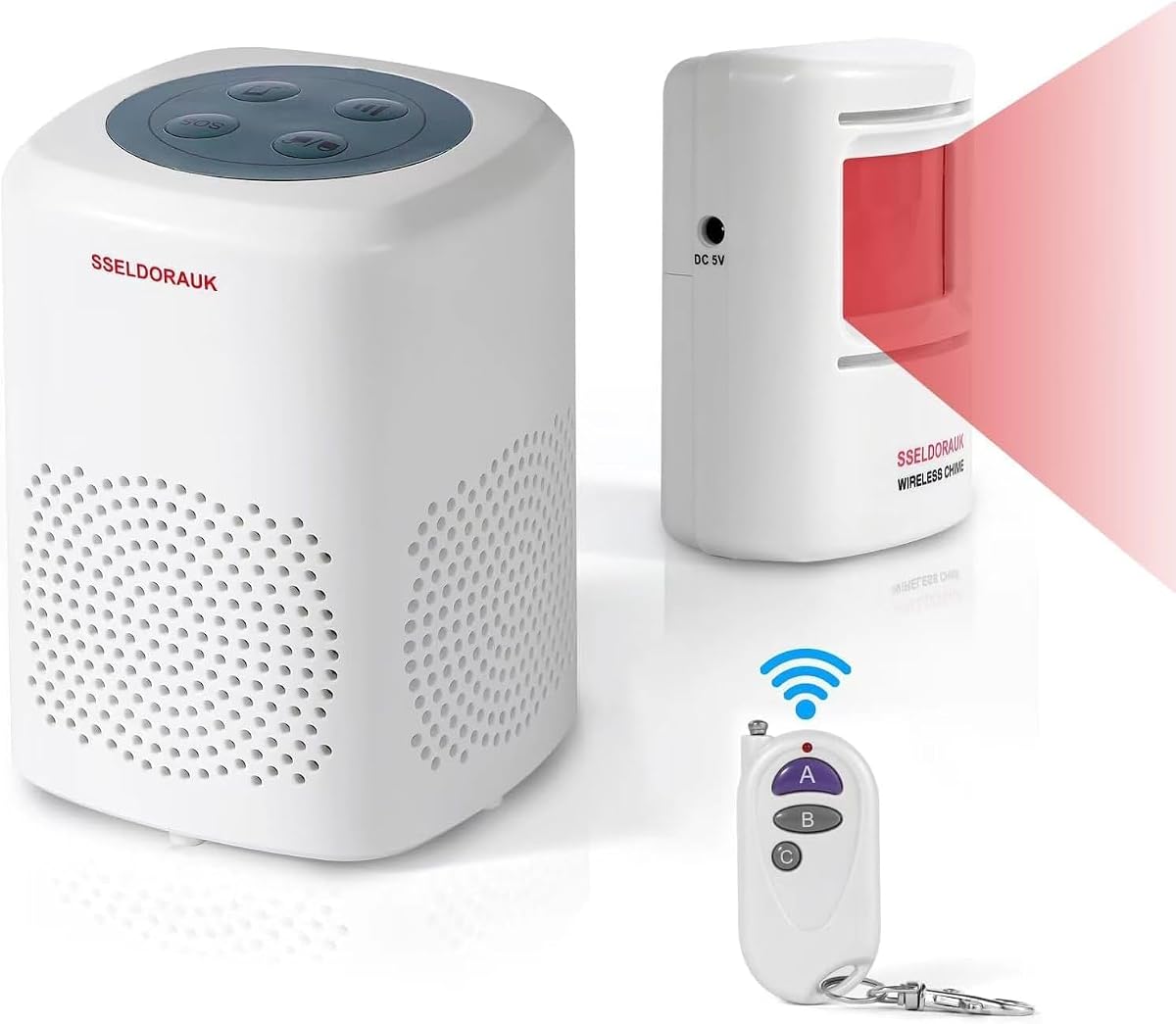
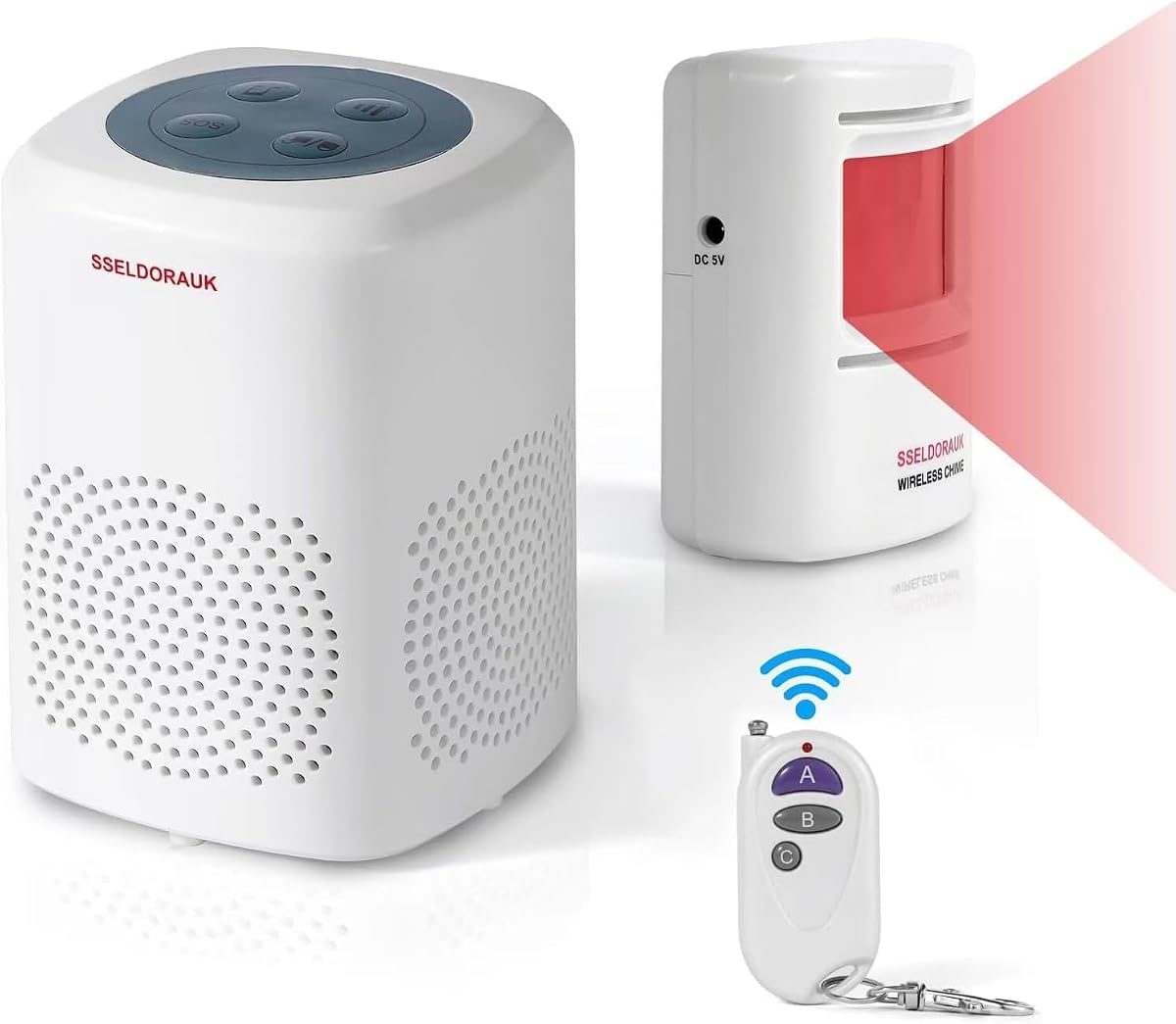
The S SELDORAUK Motion Sensor Kit combines one infrared detector, one receiver, and a remote control. It has a 4.0 rating and is aimed at users who want both a security warning and a conventional entry notification. The receiver supports 11 sound modes in total, including six electronic recordings of real dogs barking, a general alarm, two ding-dong sounds, a melody, and a welcoming tone.
We may earn a commission when you buy through this link, at no additional cost to you.
The barking recordings are intended to deter intruders and animals such as squirrels, raccoons, boars, and foxes. Maximum stated output is 110dB with four adjustable levels, allowing the owner to account for outdoor wind, distance, and obstacles that can reduce perceived volume. The wireless range reaches up to 200 meters in an open area, while the passive infrared detector covers movement from zero to seven meters at a 110-degree horizontal and 30-degree vertical angle.
The receiver can use a USB connection or three AA alkaline batteries, though neither batteries nor a power adapter are included. Passive infrared cannot detect living movement through obstacles such as glass, so placement should account for the field of view. The system is described as waterproof for indoor or outdoor use and includes double-sided stickers and screws for mounting. A knob inside the battery compartment allows frequency pairing with multiple receivers and sensors.
This kit is well suited to a home entrance, garage, or yard where users want bark recordings, a friendly door chime, and a traditional alert tone. The remote and broad sound library make it adaptable to different visitors. It is less appropriate for a property requiring very long wireless separation, and owners should account for the need to supply their own power adapter or batteries.
Six dog-bark recordings give the deterrent a broader vocal palette than a product with one repeated bark. The additional chimes and welcoming tones also make the receiver useful for ordinary entry announcements.
A remote, four volume levels, and eleven sound modes let owners adapt the same receiver to warning, deterrence, or visitor notification. The frequency-adjustment control can also support more advanced multi-sensor positioning.
We may earn a commission when you buy through this link, at no additional cost to you.
The Safety Technology ST-BARKINGDOG is an electronic watchdog with microwave motion detection, a 3.2 rating, and a compact indoor design. The microwave signal can detect someone approaching from more than 10 feet away and can see through walls. This makes it useful in homes where an interior unit needs to recognize movement beyond a direct line of sight.
We may earn a commission when you buy through this link, at no additional cost to you.
The alarm includes three sound modes: barking dog, chime, and a general alarm. A wireless remote can arm or disarm the unit, change the sound mode, and activate the panic function. The stated remote range extends beyond 50 feet and can also work through walls, so the unit can be adjusted from another part of the home without direct line of sight.
Power comes from the included AC adapter or from eight AA batteries for temporary use. The batteries are not included, and the product's description frames battery operation as a backup rather than the primary setup. It is also more limited in sound customization and detection flexibility than the multi-sensor or solar products, particularly because it does not offer selectable volume levels in the supplied information.
This alarm is best for an indoor homeowner who values a compact unit, simple remote operation, and the ability to sense through walls. It can serve as an approachable warning in a hallway, near a living area, or in a room overlooking an entrance. It is less appropriate for outdoor use, precise multi-zone monitoring, or users who want numerous sound choices and detailed output control.
The microwave sensor is not dependent on a direct view of the monitored area. It can detect approaching movement from beyond 10 feet and provide indoor coverage where a line-of-sight sensor would be less effective.
The included remote can operate through walls beyond the stated 50-foot distance, allowing convenient arming, disarming, sound selection, and panic activation from another room.
We may earn a commission when you buy through this link, at no additional cost to you.
Choosing an effective barking dog alarm means balancing detection technology, sound, range, power, and placement. The most important first step is deciding exactly where the warning must originate and where the owner needs to hear it.
Passive infrared sensors respond to movement and heat signatures and are common in outdoor kits. Radar or microwave sensors can detect movement through walls or glass and may work better for broad indoor monitoring, but they are less suitable for many exposed outdoor positions. Consider the environment around the alarm: an unobstructed outdoor path favors infrared, while an interior unit watching a doorway or window may benefit from radar penetration.
Output levels among the products range from a listed 110dB to 130dB for many systems, while the radar alarm offers eight adjustment levels and a 120dB maximum. Higher maximum output is not automatically the best choice in every location, because nearby neighbors and repeated alerts can make a system irritating. Look for adjustable volume and several sound modes so barking can be reserved for security while chimes handle visitors or routine movement.
Some kits advertise transmission distances up to 1000 feet, while one receiver-based product specifies up to 200 meters in open areas. These figures describe ideal conditions rather than guaranteed performance through buildings, trees, or uneven terrain. Map the receiver and sensor locations, identify the obstructions between them, and verify that the stated range comfortably exceeds the separation. The 656-foot model may be sufficient for many properties without reaching the highest advertised figure.
Outlet-powered receivers are simple to operate continuously, while battery-powered sensors are easier to place near gates, sheds, trees, and other areas without wiring. Solar standalone alarms remove routine battery changes but need adequate sunlight and an initial charge. Some receiver kits support both USB and battery power, which is valuable during outages, although several packages do not include batteries or a wall adapter. Verify every included and required power component before installation.
A weather-resistant enclosure is essential for sensors mounted outside, but an indoor alarm cannot necessarily be moved outside simply because it has a receiver and remote sensor. The 120dB radar model is explicitly not waterproof, while the solar units and several multi-sensor kits are designed for exposed placement. Check the stated IP rating, operating-temperature range, housing material, and mounting method before selecting a unit for a driveway, fence, garden, or agricultural building.
A one-sensor kit is usually easier to install and may be sufficient for a single door or path. Two- and three-detector systems are more useful when several approaches need coverage, but they also require careful placement and battery maintenance. Pairing controls can help distinguish where motion occurred, although the exact operation depends on the compatible receiver and sensor combination. Count the meaningful entrances or perimeter points before deciding how many sensors are needed.
A powerful alarm will not help if it is mounted poorly, cannot be heard, or creates constant false alerts. Check whether the product includes stickers, screws, wall mounts, ground stakes, or pole straps, and ensure the sensor has a clear view of the intended approach. Receiver placement matters too: the unit should be loud enough to be heard but positioned so frequent alerts do not disturb sleeping areas. Mounting stability and access for battery or mode adjustments deserve equal attention.
A barking alarm is meant to discourage unwanted activity, but repeated false triggers can create noise problems and quickly train household members to ignore the device. Look for night-only or timer modes, adjustable output, and sensors designed to reduce responses to environmental changes. Owners should also consider whether guests, delivery workers, pets, or neighboring properties will trigger the sensor. The most successful setup is targeted enough to remain credible without becoming a constant nuisance.
Begin by identifying the exact approach the alarm should monitor, then position the sensor so it has an unobstructed view of that area. Mount it at a height appropriate to its detection pattern, test the trigger from several directions, and adjust the angle before securing the unit. For receiver-based systems, place the receiver where the warning can be heard clearly without becoming a constant disturbance in nearby rooms.
Read the included instructions before pairing sensors, changing sound modes, or selecting operating schedules. Program each receiver and detector, test the remote if one is included, and confirm that every sensor produces the intended chime or bark. Solar units need meaningful direct sunlight and the recommended initial charging period, while battery-powered sensors should be installed only after their battery compartments are secure and protected.
Perform routine checks by walking through the monitored area and confirming that the alert activates as expected. Clean the sensor lens or protective face according to the manual, keep the receiver vents and speaker openings clear, and replace batteries before they weaken reception or sound output. After weather, wind, or seasonal changes, revisit the angle and sensitivity. Never rely on the alarm as a substitute for locks, cameras, lighting, or other appropriate security measures.
They can be effective as a visible and audible deterrent, especially when the warning is unexpected and the sensor covers a vulnerable approach. Their value is increased when combined with locks, exterior lighting, cameras, and other security measures. They should not be treated as a guarantee that an intruder will leave or as a replacement for a monitored alarm system.
Infrared alarms detect movement and heat within a defined field and generally work best when the monitored route is clear. Radar alarms can detect movement through some walls and glass and offer wider indoor coverage, but they cannot detect through every material. Radar models are also often intended for indoor use and should not be exposed to weather unless the manufacturer specifically permits it.
Only models designed for outdoor use should be installed in rain, snow, or direct sunlight. Look for a stated IP weather-resistance rating and compatible operating temperatures. An indoor receiver can be paired with an outdoor-rated sensor, but the receiver itself should remain in a dry, suitable location.
The stated range depends on the model and is usually achieved under open or favorable conditions. Walls, trees, buildings, weather, and other obstacles can reduce the effective distance. The detector and receiver should be positioned well within the advertised range, and the sound should be tested at the receiver's intended location before installation is considered complete.
Multiple sensors are useful when the property has several distinct entrances, paths, or vulnerable perimeter points. A one-sensor kit may be sufficient for a single monitored area, while two- and three-detector systems provide broader awareness. Each additional sensor also requires secure mounting, batteries, periodic testing, and a plan for identifying which area triggered the alert.
It can if it is left at maximum volume and triggered frequently. Several systems offer adjustable volume, night-only operation, light-only modes, or timer settings that help control noise. Installation should be tested at different times of day, and the owner should consider how often vehicles, pedestrians, pets, or wind-driven movement might activate the sensor.
Solar performance depends on sunlight, charging time, temperature, and the selected operating mode. A unit that operates continuously may consume more stored energy than one using a night-only or light-only schedule. It should be installed where it receives adequate direct sun, allowed to charge as directed, and checked during prolonged cloudy or snowy periods.
Many of the reviewed systems include welcoming tones, ding-dong sounds, melodies, or a dedicated doorbell mode. A remote sensor near an entrance can therefore notify occupants of a visitor as well as warn them of suspicious movement. Owners should select a welcoming mode for expected guests and reserve stronger bark or siren sounds for security events.
The Dog Barking Alarm with Motion Sensor & Remote is the most balanced overall choice because it combines a 23-foot detection range, 656 feet of stated wireless transmission, weather resistance, several sound options, and a dedicated remote. The Solar Outdoor Motion Sensor Alarm is a particularly versatile budget-oriented option for standalone use, while the 120dB radar alarm stands out for powerful, adjustable indoor detection through glass and selected walls.
Prioritize the environment before the sound. Choose a weather-resistant outdoor model for exposed locations, a receiver-based system when alerts must be heard indoors, and radar when detection through interior obstacles is important. For larger properties, count the entrances that need coverage and select a kit with enough sensors to monitor them without excessive complexity.
Before making a final selection, verify the current product details, included components, power requirements, and compatibility of any additional sensors. Product listings and configurations can change, so shoppers should confirm the latest specifications directly on the linked listing and compare the alarm with other security layers rather than relying on it alone.