
Rain Bird TRU6I
4.5Editor score
Six-zone irrigation control
Three independent watering programs
Flexible days and intervals
Manual rain sensor input
Optional WiFi module support
Compare 10 of the best irrigation controllers with rain sensors, including smart, budget, WiFi-ready, and multi-zone options for reliable watering control.
Irrigation controllers with rain sensors help prevent unnecessary watering by coordinating sprinkler schedules with rainfall, freezing temperatures, and sometimes online weather data. A dependable unit should be easy to program, support the required number of zones, and offer reliable ways to pause or resume irrigation.
We compared all ten products by examining their stated zone capacity, rain-sensor compatibility, scheduling features, connectivity, installation needs, and suitability for residential or light-commercial irrigation. The list includes dedicated sensors, rain-ready controllers, and smart models whose weather intelligence can perform similar functions.
Each review identifies the product's strongest benefits, practical limitations, and ideal installation environment. Ratings and specifications reflect the supplied product information, while availability, accessories, and current pricing can change as sellers update their listings.
4.5Editor score

4.6Editor score
4.5Editor score
The comparison covers standalone rain and freeze sensors, conventional multi-program controllers, WiFi-ready models, and app-based smart systems. Important distinctions include whether a sensor is included, how many zones each model supports, and whether automatic weather adjustments operate locally or through an internet connection.



The Hunter Rain-Clik WRCLIK is a dedicated wireless rain and freeze sensor rated 4.6 out of 5. It is designed for one clear purpose: stopping an irrigation system when rain begins or the temperature reaches 37°F, then allowing the system to resume according to the selected reset behavior. That focused design makes it an excellent companion for an existing controller.
We may earn a commission when you buy through this link, at no additional cost to you.
Its strongest feature is the combination of wireless installation and quick-response detection. Because the sensor uses a built-in battery, there is no wire to run from the controller, no trenching, and no complicated wiring connection. The included wall-mount and gutter-bracket hardware also makes placement more flexible, allowing the sensor to sit in an open area where it can detect changing weather conditions.
The adjustable vent is worth considering carefully. It gives the user control over how quickly irrigation resumes after sufficient rain has ended, which can be helpful where soil dries quickly, rainfall is infrequent, or landscape beds retain moisture longer than lawns. Compatibility with controllers using either normally open or normally closed sensor ports broadens its usefulness, although the existing controller should still be verified before purchase.
This is the strongest general-purpose choice for someone who already owns a capable irrigation controller and wants dependable weather shutoff without replacing the timer. It is less suitable for a buyer seeking an all-in-one controller, and it does not manage the entire watering schedule. Within that narrower role, though, it offers straightforward installation, useful rain and freeze protection, and practical reset control.
The sensor's quick-response technology is designed to suspend irrigation as soon as rain begins, rather than waiting for a later weather-based schedule adjustment. This behavior makes it a useful safeguard against watering during active precipitation.
Wireless battery operation eliminates sensor wiring, while the wall and gutter brackets allow placement according to the property. The adjustable vent lets the owner tune the delay before normal irrigation resumes.
We may earn a commission when you buy through this link, at no additional cost to you.
The Rain Bird TM2-6 is a six-station controller rated 4.5 out of 5 for straightforward residential irrigation. It offers the familiar Rain Bird programming approach, an easy-to-navigate interface, and a rain sensor input with bypass capability. It is a practical fit for a homeowner who wants a conventional controller and already understands the value of weather shutoff.
We may earn a commission when you buy through this link, at no additional cost to you.
The controller can be installed indoors or outdoors, giving it flexibility for garages, utility rooms, sheds, and exterior enclosure locations. Its rain sensor input allows an appropriate sensor to interrupt irrigation during wet conditions, while the bypass control is useful for testing or temporarily operating the system without the sensor's input.
The master valve or pump start circuit is another important feature for systems that need a central valve or pump activation. This means the TM2-6 is not limited to simple valve-only layouts. Its main limitation is that it does not offer the app-based controls or automatic internet weather adjustment available in the smart products farther down this list.
Choose the TM2-6 if you need six stations, value uncomplicated controls, and want the flexibility to add a compatible rain sensor. It is less appealing when phone-based management is a priority or when a bundled smart weather system is desired. As a rain-ready six-zone controller, it offers a balanced and approachable feature set.
The familiar interface and straightforward programming layout reduce the learning curve for new users. A homeowner can focus on daily schedule operation while retaining access to rain-sensor and pump-related settings.
Six stations cover many typical residential landscapes, and the master valve or pump-start circuit supports a wider range of system layouts. Indoor and outdoor mounting options improve installation flexibility.
We may earn a commission when you buy through this link, at no additional cost to you.
The Rain Bird TRU6I is a program-based six-zone controller rated 4.5 out of 5. It combines an intuitive programming dial and multifunction display with a broad collection of schedule controls. For buyers who want sophisticated watering logic without immediately committing to a fully smart product, it offers a particularly capable middle ground.
We may earn a commission when you buy through this link, at no additional cost to you.
Three independent A, B, and C programs allow separate schedules for different landscape needs. Each zone can have as many as four start times per program, and watering can be assigned by weekday, odd or even days, or a cycle from every one to 30 days. Manual station operation, season adjustment, and permanent days-off settings add further control for contractors, recurring maintenance visits, or changing seasonal conditions.
The controller can operate a compatible rain sensor for automatic interruption and restart, and its rain sensor bypass can be applied by zone. It also supports optional WiFi operation through the separately sold LNK2 WiFi Module. That distinction matters: TRU6I is WiFi-ready, but the module is not included, and neither is the rain sensor.
This model makes sense for a property with multiple watering needs and an owner who values program organization. It may be more feature-dense than a homeowner needs, but its permanent storage and intuitive interface support dependable use. It is an excellent choice when flexible local scheduling and an upgrade path are priorities, while the AR8 and Rachio 3 are more appropriate when built-in connectivity is essential.
Separate A, B, and C programs make it easier to give lawns, flower beds, and young plantings different schedules. Up to four starts per program provide substantial scheduling flexibility without requiring the controller to be tied to one watering pattern.
The optional LNK2 WiFi Module adds remote access and internet-based weather functionality. Local programming remains available, so the controller does not depend on a connection for its core schedule operation.
We may earn a commission when you buy through this link, at no additional cost to you.
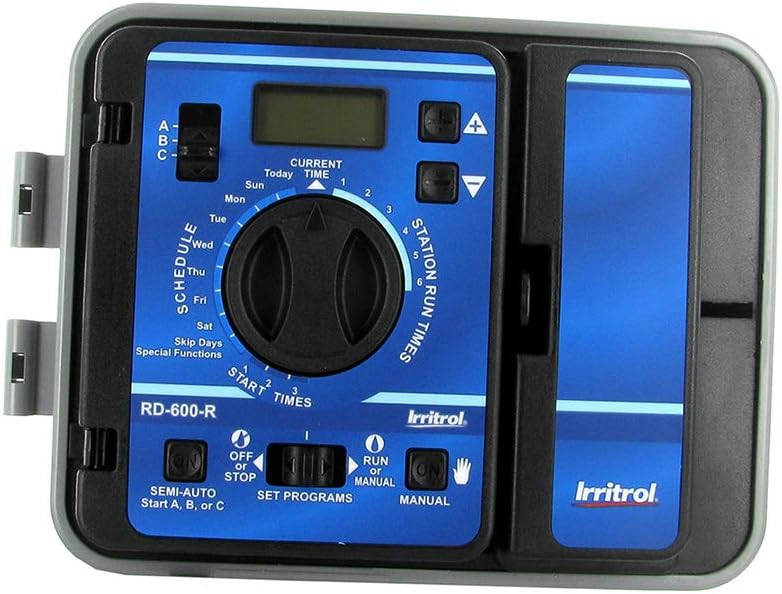
The Irritrol RD600-EXT-R is an outdoor six-station irrigation controller rated 4.5 out of 5. Its defining feature is the Rain Dial interface, which gives the product a distinct identity among the more screen-driven competitors in this guide. It is aimed at users who want local, dial-based control with rain readiness.
We may earn a commission when you buy through this link, at no additional cost to you.
A dedicated rain sensor terminal and bypass switch make it straightforward to integrate compatible weather sensing. Three independent programs offer the flexibility needed for varied plant material, while the pump circuit can be turned on or off as required. The controller is also ready for compatible contractor residential remote systems, which is useful for installations where adjustment without physical access is desirable.
The main strength is its straightforward, dedicated control approach. It does not attempt to imitate a full smartphone platform, but it provides the core features expected from a capable outdoor timer: multiple programs, sensor support, and flexible pumping arrangements. The supplied information does not describe built-in WiFi or automatic internet weather adjustment, so remote features require separate compatible equipment.
The RD600-EXT-R is best for owners seeking an outdoor controller with physical controls and a clear rain-sensor connection. It suits six-zone residential or similarly sized systems, although properties expecting significant later expansion should consider a modular controller. For users who prefer app-based management, one of the smart models is the better direction.
The rain sensor terminal and bypass switch make this controller ready for a compatible weather sensor. The bypass is particularly useful when testing irrigation or temporarily disregarding the sensor input.
Three independent programs let operators separate watering requirements across different plant types. Pump-circuit options and remote-control readiness add flexibility for professionally managed installations.
We may earn a commission when you buy through this link, at no additional cost to you.
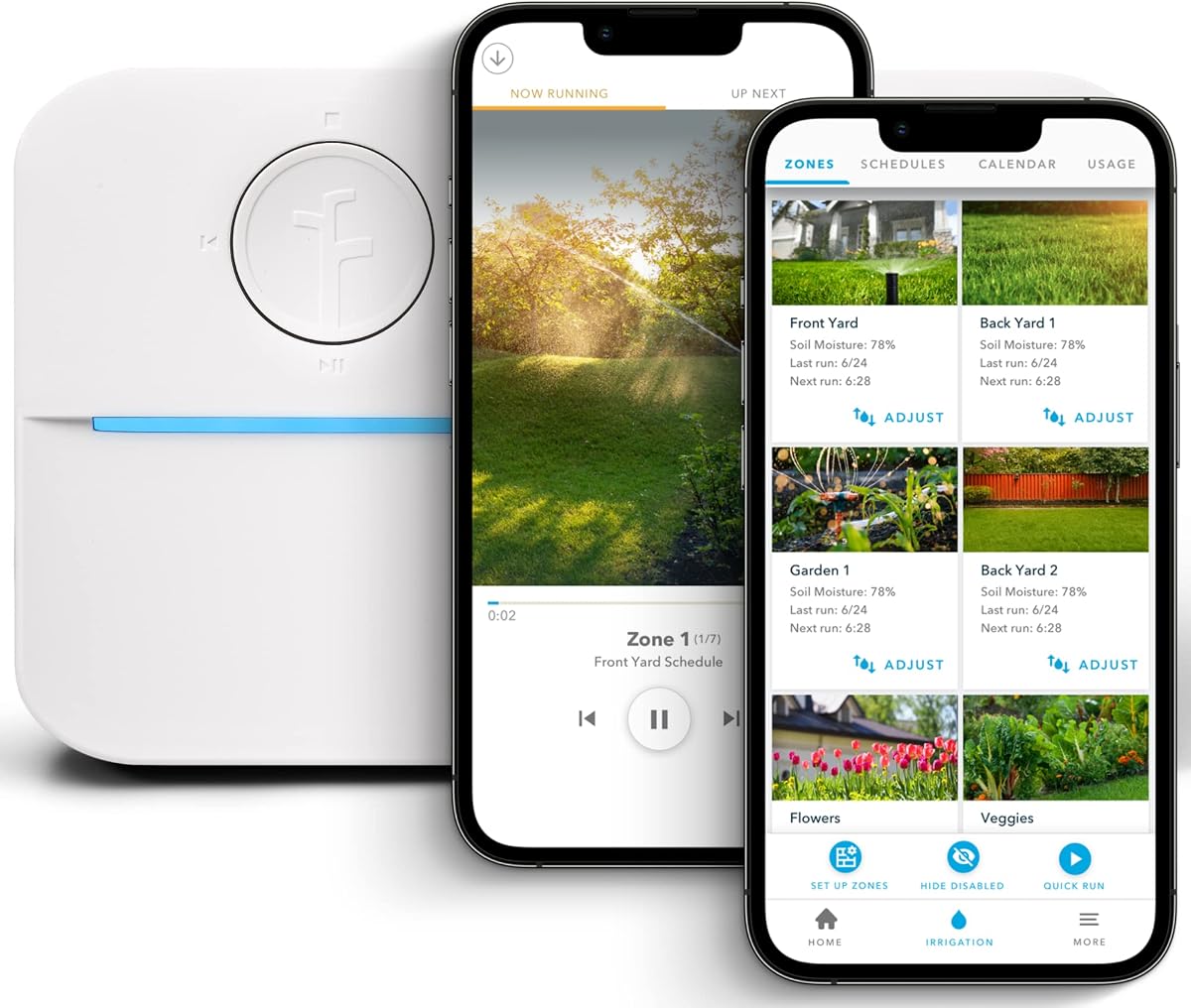
The Rain Bird ARC8 is an eight-zone smart controller rated 3.8 out of 5. Although that is the lowest rating in this group, its defining advantage is convenience: WiFi is built in, so owners do not need to install a separate module before using the Rain Bird app or connecting the system to a compatible smart assistant.
We may earn a commission when you buy through this link, at no additional cost to you.
The app allows users to set, monitor, and adjust schedules, share access with family members or maintenance professionals, start watering manually, and review upcoming schedules. Internet-based weather information can automatically skip or adjust daily watering according to the local forecast and historical averages, a form of rain-aware control that does not require a physical rain sensor.
Compatibility with Amazon Alexa, Google Assistant, Apple devices, and Android devices broadens its appeal in connected homes. The eight-zone capacity is useful for medium-sized residential landscapes, and the ability to share control can make system administration easier for households or service professionals.
Its lower rating and reliance on internet-connected features should be considered if dependable local operation is the priority. The ARC8 is best for users who actively want smartphone management and automatic forecast-based watering. It is less suitable for someone who prefers a dial controller, wants to avoid network dependence, or needs more than eight stations.
Internet-based forecasts and historical averages allow the controller to skip or modify daily watering automatically. This offers a smart alternative to adding a physical rain sensor, especially for owners who do not want to install one.
App-based access supports schedule changes, manual watering, and sharing control with household members or landscaping professionals. Built-in WiFi removes the need for a separate connectivity module.
We may earn a commission when you buy through this link, at no additional cost to you.
The Rain Bird ESP-TM2 8 is a WiFi-ready controller rated 4.6 out of 5. It combines an eight-station capacity with the brand's straightforward programming approach. The result is a versatile option for users who want quick local setup but may later want phone-based access and internet-based weather adjustments.
We may earn a commission when you buy through this link, at no additional cost to you.
Programming is presented as a three-step process, which helps reduce setup time. A large back-lit LCD improves visibility in low-light areas and direct sunlight, while the factory-installed outdoor-rated power cord supports flexible placement. Contractor Default features allow a custom schedule to be saved and restored when needed.
The ESP-TM2 8 also provides a watering delay of up to 14 days and automatically resumes after that delay ends. Adding the separately sold Rain Bird LNK WiFi Module enables remote access, operation, and monitoring. Once connected, internet-based weather information can adjust the irrigation schedule according to local conditions, helping reduce unnecessary watering.
This controller is a good fit for an eight-zone property that prioritizes familiar controls and a large display. It is better suited to owners willing to add a module later than those wanting immediate out-of-box connectivity. Its high rating, simple setup, and optional smart path make it one of the most balanced conventional controllers in the list.
The three-step setup and large back-lit display make the ESP-TM2 8 approachable for routine adjustments. Contractor Default adds a convenient way to protect a carefully configured schedule.
The optional LNK WiFi Module unlocks remote operation and internet-based schedule adjustments. This lets owners start with local controls and add connectivity when their monitoring needs change.
We may earn a commission when you buy through this link, at no additional cost to you.
The Rain Bird ESP4ME3 is a modular controller rated 4.6 out of 5. It starts with four zones but can expand to as many as 22 using optional modules, making it a strong choice for owners who expect their landscape or irrigation requirements to grow over time.
We may earn a commission when you buy through this link, at no additional cost to you.
Non-volatile memory preserves controller settings indefinitely, even after extended power outages. That reliability is especially valuable for schedules with multiple programs or carefully selected seasonal adjustments. The included power cord supports quick plug-in installation indoors or outdoors, while its removable design allows the internal transformer to be hardwired to a junction box.
The optional LNK WiFi Module provides remote access and monitoring, while internet-based weather information can adjust irrigation according to local forecasts. The controller also supports optional wired flow sensors in multiple sizes. When paired with the appropriate accessory, flow monitoring can provide notifications and help identify abnormal water use or potential system problems.
The ESP4ME3 is most attractive to buyers who want a small system now and meaningful expansion later. It costs more conceptually in terms of required accessories than a fixed six- or eight-zone model, but its modularity can be valuable. It is a good fit for growing residential properties and installers seeking a controller that can serve both simple and larger zone counts.
Optional station modules let the controller grow from four zones to as many as 22. This is a practical advantage for properties that may add irrigation to new lawns, beds, or other areas over time.
Non-volatile memory protects programmed schedules from loss during long power interruptions. Optional flow monitoring adds another layer of protection when supported by the necessary wired sensor.
We may earn a commission when you buy through this link, at no additional cost to you.
The Rain Bird ESP-ME3 is a modular controller rated 4.6 out of 5 that supports properties ranging from four to 22 stations. It is positioned for both residential and light-commercial use, and its expansion system allows additional zones to be added without removing the controller or powering it down.
We may earn a commission when you buy through this link, at no additional cost to you.
The product is specifically framed as an upgrade path that can include both the LNK WiFi module and a WR2 rain sensor. Together, these accessories add enhanced app-based programming and monitoring. The LNK can also support mobile alerts for electrical, programming, or high-flow issues when a compatible flow sensor is used.
Its large three-inch back-lit display and color-coded dial positions are designed to remain understandable in garages, sheds, and other low-light settings. Configuration to 22 stations uses additional three- or six-station modules, giving the installer a controlled way to match capacity to the property.
This controller is well suited to a homeowner who wants a durable modular platform and may add smart controls later. The controller-only package does not include the LNK module, WR2 sensor, or flow sensor, so those must be considered separately. It is an excellent option for a growing property but less convenient for someone wanting every advanced function immediately.
The controller can be paired with a WR2 rain sensor for physical weather shutoff. Adding the LNK module creates a more complete smart irrigation setup with enhanced app-based control.
Three- and six-zone expansion modules allow the system to scale from four to 22 stations. The ability to add capacity without replacing the main controller is useful for changing landscape requirements.
We may earn a commission when you buy through this link, at no additional cost to you.
The Orbit 57069 is a dedicated wired rain and freeze sensor rated 4.5 out of 5. It provides automatic detection of rainfall and low-temperature conditions for an existing sprinkler controller. The model is especially attractive to owners who want a universal sensor rather than a complete replacement timer.
We may earn a commission when you buy through this link, at no additional cost to you.
Water-absorbing disks expand when wet, causing the controller to suspend watering. The rain threshold is adjustable, allowing the operator to influence how much precipitation is required before the sensor signals the system. A built-in thermistor handles the freeze function, while the weather-resistant wire can run from the controller to an eave or another open area.
Compatibility with Orbit, Hydro-Rain, and other major controller brands makes the sensor broad in scope. A qualified installer can confirm the specific controller connection, connect the weather-resistant wire, and position the sensor where it can detect precipitation and temperature changes effectively.
The Orbit 57069 is best for a homeowner with a compatible conventional controller who prioritizes physical rain and freeze detection. Its wired design is less convenient than the Hunter Rain-Clik, but the adjustable threshold can be valuable in climates with different rainfall patterns. It should be considered a sensor accessory, not a standalone controller.
The sensing disks expand when they absorb water, creating a mechanical change that suspends irrigation. The threshold can be adjusted to suit the property's typical rainfall pattern.
The unit is designed to work with Orbit, Hydro-Rain, and other major brands. A weather-resistant wired connection provides dependable communication with a compatible controller.
We may earn a commission when you buy through this link, at no additional cost to you.
The Rachio 3 is an eight-zone smart controller rated 4.5 out of 5. It is built around app-based irrigation management and a phone-first setup, offering a polished alternative to dial-based controllers. Its Weather Intelligence is designed to skip watering for rain, wind, freeze, and other relevant conditions.
We may earn a commission when you buy through this link, at no additional cost to you.
Owners can create a custom schedule or allow the system's adaptive scheduling to make automatic adjustments. The app also supports remote zone operation, schedule review, and estimated water-usage tracking. These functions make it possible to manage irrigation from a location other than the controller cabinet, which is particularly useful for travelers and busy households.
The controller is designed for straightforward installation and is stated to be compatible with 99% of existing sprinkler systems. That broad compatibility claim still deserves confirmation against the specific valves, wiring, and site conditions of the intended property. Since the model relies on smart functions, dependable WiFi access and a compatible phone ecosystem are important parts of the ownership experience.
Rachio 3 is best for users who want weather-driven automation and app control more than a physical dial or standalone sensor. It is not the simplest option for a basic three-zone system, but it offers strong scheduling flexibility and a convenient remote-management experience. For a medium-sized property seeking intelligent watering, it is one of the most compelling choices in the guide.
The system can automatically skip irrigation when rain, wind, freeze, or other weather conditions make watering unnecessary. This proactive approach supports water conservation without requiring manual schedule changes.
The app allows owners to manage schedules, run zones, review upcoming watering, and track estimated usage. Custom and adaptive options serve both precise control and more hands-off operation.
We may earn a commission when you buy through this link, at no additional cost to you.
The right choice depends on how many zones you operate, whether you want a physical rain sensor or internet-based weather intelligence, and how much remote control is necessary. These factors help separate a simple sensor upgrade from a full smart-controller replacement.
Count the number of independently controlled watering areas before comparing models. Fixed controllers in this guide cover six or eight stations, while modular options can begin at four zones and expand to 22. A fixed model is usually simpler, but a modular controller offers more room if future landscaping plans include new lawns, beds, drip zones, or other areas.
Match the controller to the system rather than buying extra capacity without a purpose. Expansion modules and compatible valves add installation complexity, while a controller with too few zones cannot support the property's design.
A physical rain sensor detects actual precipitation or temperature at the installation site. A smart controller uses internet forecasts, historical data, or proprietary weather intelligence to modify its schedule. Some users prefer a sensor because it reacts locally, while others favor automatic app-based adjustments without mounting a separate device.
Decide whether the system should operate rain-awareness as its main feature or simply support an optional sensor. Check whether the sensor is included, available as an accessory, or unnecessary because the controller already performs automatic weather skips.
Not every controller accepts every rain sensor. Verify the model's sensor input, terminal type, voltage requirements, and manufacturer guidance before ordering. The Hunter WRCLIK supports controllers with normally open or normally closed sensor ports, while the Orbit 57069 uses a wired connection and is described as compatible with Orbit, Hydro-Rain, and other major brands.
Also check whether a bypass feature is available. Bypass can help during installation, testing, or maintenance when the operator wants to water without the sensor preventing operation.
WiFi-ready controllers require a separate module, while smart models such as the ARC8 and Rachio 3 include connectivity. Remote management can provide schedules, manual starts, status information, weather adjustments, and notifications, but it also introduces dependence on network availability for those functions.
Consider who will use the app and whether sharing access with family members or a maintenance professional is valuable. Buyers who never need remote control may prefer a conventional controller with fewer connectivity-related concerns.
The controller may live indoors or outdoors depending on the model and enclosure. Sensors have different placement needs as well. Wireless sensors avoid cable runs, while wired sensors require a protected connection to the controller and a good open location for detecting weather.
The Hunter WRCLIK includes wall and gutter brackets, while the Orbit 57069 specifies a weather-resistant wire running to an eave or another open area. Confirm electrical access, enclosure protection, and local installation requirements before making a final selection.
Look beyond the number of zones and examine start times, program counts, watering intervals, and manual controls. The TRU6I offers three programs, up to four starts per program, weekday, odd-even, and cyclic scheduling, plus season adjustment. The ESP-TM2 8 emphasizes quick programming and a simple three-step setup.
A landscape with different plant types often benefits from multiple programs. A straightforward system may not. Choose complexity that matches the user's schedule-management habits rather than purchasing features that will never be adjusted.
Power outages can erase a schedule if a controller lacks non-volatile memory. The ESP4ME3 and ESP-ME3 retain settings indefinitely, while the TRU6I also stores programming during outages. This feature is especially important where the controller operates a pump, has multiple programs, or receives little routine attention.
For larger installations, optional flow monitoring can add notifications about abnormal use. Such monitoring complements a rain sensor by identifying issues that weather awareness alone cannot detect.
Residential landscaping, mixed plant material, pumps, and master valves create different control requirements. The TM2-6 includes a master valve or pump-start circuit, while the Irritrol RD600-EXT-R can enable or disable its pump circuit. The ESP-ME3 is described as suitable for residential and light-commercial sites.
Consider the whole system, including valves, wiring, power supply, pump equipment, and enclosure. The best controller is the one that integrates cleanly with the existing installation and remains easy for the actual owner or service professional to operate.
Begin by identifying every zone and assigning it a clear purpose, such as lawn, shrubs, flower beds, or drip irrigation. Create schedules that reflect plant needs, seasonal conditions, and local rainfall patterns. Before enabling automatic operation, test each zone individually so incorrect valve assignments or misdirected heads can be corrected early.
Connect the rain sensor according to the manufacturer's instructions, confirm that the controller recognizes it, and test the interruption and recovery behavior. Position a physical sensor in an open area away from roof runoff, trees, or structures that could distort readings. For a smart controller, connect it to WiFi, verify location and weather access, and review the first set of automatic adjustments.
Maintain the system by cleaning sensor surfaces, checking battery status where applicable, inspecting wiring, and confirming that the controller still displays the correct schedule. Review programmed days, start times, seasonal adjustments, and sensor bypass settings after power interruptions or major landscaping changes. Periodic zone tests and prompt repairs help prevent a water-saving feature from masking a separate mechanical problem.
Not necessarily. Smart controllers such as the ARC8 and Rachio 3 use online weather information to skip or adjust watering automatically. A physical sensor can still be valuable when local rainfall differs substantially from forecasts or when the owner wants a direct sensor that operates independently of internet service. Check the controller's supported accessories before combining features.
No. Compatibility depends on the controller's input type, voltage, terminal arrangement, and manufacturer specifications. The Hunter WRCLIK is designed for systems with normally open or normally closed sensor ports, while the Orbit 57069 uses a wired design described as compatible with many major brands. Always verify the installation instructions for both devices.
A rain sensor monitors actual conditions and can interrupt irrigation automatically. A rain delay is a scheduled pause that the owner or smart system sets in advance and ends after a defined period. Rain sensors are especially useful for unexpected showers, while delays are convenient for planned maintenance, landscaping visits, or known wet weather.
That depends on the controller and sensor configuration. Some systems apply a sensor shutdown across the controller, while others allow zone-specific bypass behavior. The TRU6I, for example, includes rain sensor bypass by zone, and the RD600-EXT-R includes a sensor bypass switch. Review the desired behavior for each zone before installation.
Mount it in an open location where it can receive rainfall and sense temperature without obstruction from trees, eaves, sprinklers, or roof runoff. A wireless model offers more placement flexibility, but the wall and gutter brackets should still support a stable position. Wired sensors need a safe cable route to the controller.
Test the schedule and each zone at least a few times per season, and whenever a circuit, valve, or watering pattern changes. Also test the rain sensor before storms and clean any debris that could affect detection. Annual professional servicing is useful on larger systems, but routine owner checks can identify many common problems early.
Reliability depends on the installation and priorities. A conventional controller may continue running its local schedule without internet access, while a smart controller provides superior remote control and automatic weather-based adjustments. A smart model adds network and app dependencies, so the best choice depends on how much automation and monitoring you value.
Usually, yes, provided the existing valves, wiring, power supply, and wiring configuration meet the controller's requirements. Rachio 3 is stated to be compatible with 99% of existing sprinkler systems, while other models may support common residential layouts. Confirm compatibility and inspect the installation area before replacing the controller.
The Hunter Rain-Clik WRCLIK stands out as the most focused choice because it adds fast wireless rain and freeze shutoff to an existing controller. The Rain Bird TM2-6 and TRU6I suit buyers seeking capable six-zone scheduling, while the AR8 and Rachio 3 provide built-in app control and automatic weather intelligence.
Prioritize the type of rain response your property actually needs. Choose a dedicated sensor for direct local detection, a rain-ready conventional controller for simple local management, or a smart model for phone-based control and forecast-based adjustments. Zone count, pump support, installation location, expansion plans, and accessory requirements should be confirmed before making a final choice.
Finally, check the current listing for included components, compatibility details, and current market terms, because availability and pricing can change. Confirm that any separate rain sensor, WiFi module, flow sensor, or expansion hardware is included in your overall setup rather than assuming every advertised capability comes as a complete package.

