
Armored 12-Strand OS2 Distribution Cable
Twelve-strand OS2 singlemode fiber
Corning SMF-28 Ultra fiber
Armored riser-rated construction
Our Bulk Outdoor Fiber Optic Cables guide compares ten bulk spools and pre-terminated cables for fiber count, length, fire rating, protection, and use.
Bulk outdoor fiber optic cables combine long installation lengths, rugged construction, and the fiber density needed for modern networks. A worthwhile cable should match the route, required bandwidth, environmental risks, and local fire-safety requirements rather than simply offering the largest spool.
The products in this guide include unterminated distribution spools and factory-terminated outdoor patch cables. We compared fiber type, core diameter, strand count, listed length, jacket rating, mechanical protection, installation features, intended applications, and compatibility with common networking equipment.
Each review identifies the strongest use for a particular cable, from short multimode building links to long-distance singlemode runs. Ratings and specifications reflect the supplied product information, while availability and prices can change, so confirm current listings before purchasing.

5.0Editor score

2.9Editor score
This side-by-side comparison shows the major differences among bulk distribution spools and pre-terminated outdoor cables, including fiber mode, strand count, cable length, environmental rating, and physical protection.



The CableWholesale 6 Strand Fiber Optic Cable combines a 1,000-foot spool with six multimode fibers and a black PVC jacket. Its supplied five-star rating is especially notable, while the listed 10Gbit/s support, aramid reinforcement, and indoor/outdoor versatility make it a balanced general-purpose selection.
We may earn a commission when you buy through this link, at no additional cost to you.
The 50-micron core is optimized for equipment operating at 850nm or 1300nm, giving installers flexibility across common multimode transceivers and short-range network links. Tight buffering, aramid yarn strength members, and the protective jacket help the cable tolerate handling and everyday installation stress while retaining useful flexibility.
Its riser rating is particularly useful in vertical pathways, including trays and elevator shafts. That makes the spool more versatile than a cable limited strictly to horizontal interior spaces, although local regulations and the project design should always determine whether riser-rated construction is sufficient.
This is a strong recommendation for contractors, integrators, campus network teams, and advanced homeowners who need a substantial quantity of multimode cable without paying to terminate each length separately. It is especially compelling when custom cuts and future expansion are important.
The listed 10Gbit/s capability and common 850nm/1300nm optimization make this cable practical for LAN backbones, access networks, and other short-to-medium-range multimode routes. Six fibers also provide more usable capacity than a basic point-to-point pair.
A 1,000-foot length can be divided into several custom runs, reducing waste when a project has many destinations. The indoor/outdoor jacket and aramid reinforcement also make it a sensible starting point for mixed building infrastructure.
We may earn a commission when you buy through this link, at no additional cost to you.
This six-strand OS2 distribution cable is built around 9/125 singlemode fiber compliant with G.652.D. The 1,000-foot spool, tight-buffered construction, and aramid strength members make it a flexible option for enterprise networks, FTTH, telecom routes, and data center interconnections.
We may earn a commission when you buy through this link, at no additional cost to you.
Singlemode fiber is the cable's defining advantage. It is intended for longer-distance networking than typical multimode installations and can also support high-speed links where distance is not the deciding factor. The six-strand configuration creates room for multiple connections without changing the basic cable design.
The black jacket is described as suitable for both indoor riser and outdoor installations, with protection against moisture, UV exposure, and environmental conditions. This broadens the cable's usefulness for building-to-building links, exterior pathways, and structured cabling projects, provided local installation rules are observed.
It is a strong choice for contractors planning several long singlemode routes from one bulk purchase. The absence of a supplied customer rating means buyers should not treat it as independently proven by user feedback, but the stated standards, construction, and installation features make it one of the most technically versatile spools in the group.
Six strands let an installer create several links or preserve spare fibers for expansion. That makes the spool useful for enterprise floors, FTTH distribution, and facilities where avoiding another large cable pull later is valuable.
OS2 9/125 fiber is a better strategic choice when future distance requirements are uncertain or several services need to share the same pathway. Compatible optics and the proper transmission equipment remain essential for a successful link.
We may earn a commission when you buy through this link, at no additional cost to you.
The CableWholesale six-strand plenum cable is a 1,000-foot spool of 50-micron multimode fiber wrapped in waterproof aramid yarn and a black PVC outer jacket. Its 4.6 rating reflects a generally favorable customer response, and its plenum rating is the standout feature for sensitive building pathways.
We may earn a commission when you buy through this link, at no additional cost to you.
The cable is optimized for 850nm and 1300nm equipment and is positioned for large installations involving short-range, 10-Gigabit connections. Stated compliance with TIA/EIA and IEC standards adds useful context, while the fire-retardant jacket is designed to reduce smoke and toxicity concerns during a fire.
Compared with a conventional riser cable, plenum construction is intended for environmental air spaces when local building and electrical codes permit that installation type. The product is also described for outdoor use, but the installer must verify that every relevant pathway, junction, and support satisfies the appropriate rating.
This spool is a good fit for commercial buildings, schools, offices, and horizontal structured-cabling systems with many short runs. Buyers should coordinate the plenum requirement with the authority having jurisdiction, inspect the cable after installation, and use compatible termination and testing hardware.
The plenum-rated jacket addresses environments where low smoke and reduced fire-related toxicity are important. It should be selected only where the complete pathway meets the applicable local code and occupancy requirements.
Six fibers and 1,000 feet can support several work areas or serve as a shared distribution layer. The bulk format is particularly efficient for integrators who routinely terminate multiple custom lengths.
We may earn a commission when you buy through this link, at no additional cost to you.
This CableWholesale spool contains six 62.5-micron-core multimode fibers in a black PVC jacket, with aramid yarn providing mechanical protection. It carries a five-star supplied rating and is designed as a plenum-rated option for large indoor or outdoor installations using short-range LAN links.
We may earn a commission when you buy through this link, at no additional cost to you.
The 62.5-micron core corresponds with the listed OM1 identification and legacy standards. That distinction matters when extending older switches, transceivers, or structured-cabling systems whose installed ecosystem was built around OM1 rather than newer 50-micron categories.
Aramid yarn and the outer jacket help protect against external damage, while the fire-retardant jacket is intended to reduce smoke and toxicity during a fire. The product is also listed as compliant with EU RoHS and REACH directives, which can be useful for institutional procurement documentation.
It is best for teams maintaining an established OM1 network, adding coverage to a legacy campus, or installing short-range links where compatibility outweighs the benefits of newer fiber types. New high-bandwidth networks should verify transceiver requirements rather than assuming this cable can replace OM3 or OM4.
The 62.5-micron core is specifically useful for legacy OM1 equipment and existing graded-index infrastructure. It helps an installer maintain a consistent fiber category throughout an established campus or building.
Waterproof aramid yarn, a black outer jacket, and fire-retardant construction provide several layers of protection. As with every rated cable, installation method and local code remain decisive.
We may earn a commission when you buy through this link, at no additional cost to you.
This factory-terminated 328-foot duplex cable uses 50/125-micron multimode fiber, a thick industrial TPU jacket, stainless steel spiral armor, and inner fiberglass yarns. Its 4.2 rating reflects a positive but more moderate customer response, and the preinstalled pulling eye differentiates it from ordinary patch cords.
We may earn a commission when you buy through this link, at no additional cost to you.
The product is positioned for direct burial, conduit, and overhead outdoor routes in demanding locations. Its 5-millimeter outer diameter provides greater mechanical protection than a standard 3-millimeter cable, while the armor and fiberglass resist crushing, abrasion, sharp bends, pulling stress, and rodent activity.
The supplied transmission details distinguish OM3 and OM4 performance ranges. OM3 is listed for 10Gbps up to 300 meters, 40Gbps up to 100 meters, and 100Gbps up to 70 meters; OM4 extends those distances to 400, 150, and 100 meters respectively.
This is an excellent choice for industrial campuses, building backbones, surveillance backhauls, and outdoor trenches where a ready-to-install armored assembly saves time. Confirm the exact OM3 or OM4 category and connector orientation before ordering, since a preterminated cable cannot be shortened without specialized termination work.
Dual mechanical protection and the TPU jacket create a robust option for direct burial and exposed industrial environments. The 5-millimeter profile also offers room for a larger protective structure than conventional outdoor patch cable.
The preinstalled swivel pulling eye helps crews guide the cable through ducts, raceways, manholes, and risers. Its removable cover is reusable, making the assembly practical for phased construction or multiple deployment stages.
We may earn a commission when you buy through this link, at no additional cost to you.
This 328-foot LC-to-LC duplex jumper uses low-loss 9/125-micron singlemode fiber with stainless steel armor and a black LSZH jacket. Its 4.4 rating indicates a favorable response, while the combination of long-distance intent, dense-rack connector design, and installation-friendly jacket makes it stand out.
We may earn a commission when you buy through this link, at no additional cost to you.
The armor helps resist crushing, moisture, rodent damage, and UV exposure in underground conduits, exterior building links, and industrial wiring. Its Uniboot LC design combines two fibers in one connector housing, reducing clutter and making polarity changes more convenient in dense patch panels.
The low-friction jacket has a listed coefficient below 0.2, which can make long or congested conduit pulls easier. Its flame-retardant, low-smoke, zero-halogen construction is also relevant to enclosed areas and data center environments where reducing smoke and corrosive gas during a fire is important.
The cable suits building-to-building backbones, FTTH access, enterprise core connections, surveillance networks, and industrial communication. It can work with a broad range of switches, routers, firewalls, transceivers, and media converters, but installers should confirm optical type, connector polish, and transceiver compatibility.
The Uniboot housing consolidates duplex LC connections into a compact assembly. This helps where patch-panel space is limited and simplifies cable organization around switches and telecom equipment.
A very low-friction exterior can reduce drag during conduit pulls and improve cable density. The LSZH jacket also addresses fire-performance concerns in enclosed facilities.
We may earn a commission when you buy through this link, at no additional cost to you.
The 656-foot, or 200-meter, LC-to-LC armored cable is a duplex singlemode assembly with a 3-millimeter diameter and OS2 construction. Its 3.8 rating is the lowest numerical customer rating in this roundup, so prospective buyers should weigh that feedback carefully despite the appealing long factory-terminated length.
We may earn a commission when you buy through this link, at no additional cost to you.
Helical steel armor adds resistance to crushing and rodent damage, while the ultra-low-friction, flame-retardant LSZH jacket is designed to move through conduit more easily and support higher cable density. The stated minimum fiber-core bend radius is 7.5 millimeters, giving installers a useful routing parameter.
Foxconn precision ceramic ferrules are used for the LC connectors and are intended to support low signal loss. The package also includes an LC singlemode adapter for extension, reducing the need for an immediate additional accessory when another section must be connected.
This cable is best for long outdoor building links, campus pathways, and network extensions where a ready-made 200-meter assembly is more convenient than cutting and terminating bulk fiber. Check connector condition, adapter requirements, bend radius, and the complete route before installation.
A long, ready-to-connect assembly can shorten deployment time compared with terminating a custom bulk cable. The included adapter is a useful addition for extension or connection testing.
Helical steel provides a useful mechanical layer while the LSZH jacket supports conduit routing and enclosed-space safety. Its smaller 3-millimeter diameter also aids density compared with thicker armored assemblies.
We may earn a commission when you buy through this link, at no additional cost to you.
This CableWholesale six-strand multimode spool is a 1,000-foot riser-rated option for short-range 10-Gigabit links. Its 4.1 rating suggests generally favorable customer reception, and the vertical-tray and elevator-shaft application is its clearest distinction from conventional horizontal cable.
We may earn a commission when you buy through this link, at no additional cost to you.
The cable contains six 50-micron multimode fibers, waterproof aramid yarn, and a black PVC outer jacket. It is optimized for 850nm and 1300nm equipment, providing broad compatibility with common multimode transceivers in building networks and access systems.
The listed CMR riser rating and UL-1666 compliance make it relevant to pathways such as cable risers, vertical trays, and elevator shafts. The self-extinguishing, vertical-burn-tested construction is intended to help prevent flames from traveling upward along the cable.
It is a practical bulk selection for buildings where multiple floors need short-range fiber distribution. Installation teams should avoid placing riser-rated cable in environmental air spaces unless local rules and the complete design specifically permit that arrangement.
Riser-rated construction and vertical-burn testing directly address cable routes between floors. The 1,000-foot length can feed several vertical or horizontal branch routes after custom cutting.
Optimization for 850nm and 1300nm equipment makes the cable straightforward to pair with widespread multimode hardware. The 50-micron core also provides a useful balance for many short-range enterprise links.
We may earn a commission when you buy through this link, at no additional cost to you.
This 1,000-foot spool provides two OS2 singlemode fibers in a duplex configuration. Its 2.9 rating is the lowest listed score among the ten products, making it essential to examine customer feedback and verify the intended application before settling on this option.
We may earn a commission when you buy through this link, at no additional cost to you.
The 9/125-micron G.652.D fiber is intended for long-distance networking, ISP backbones, and data center applications. Two strands are enough for a conventional bidirectional point-to-point link, while tight-buffered construction and aramid yarn support flexibility, durability, and field termination.
The black indoor/outdoor jacket is described as resistant to moisture, UV exposure, and environmental stress. Its riser rating makes it relevant to suitable vertical and outdoor pathways, although the installer must verify that the selected route is approved for this construction.
It is a budget-oriented choice for a straightforward duplex run where only one connection is needed and expansion within the same cable is not important. The large 1,000-foot length offers installation flexibility, but the modest rating means buyers should be especially attentive to packaging, shipment condition, and the seller's support.
Two strands cover the common transmit-and-receive arrangement without carrying unused fibers through the route. This can simplify installation for a single link or a modest FTTH connection.
Despite its minimal fiber count, the OS2 design supports long-distance transmission and future-relevant singlemode use. Compatible terminating equipment and careful installation remain necessary.
We may earn a commission when you buy through this link, at no additional cost to you.
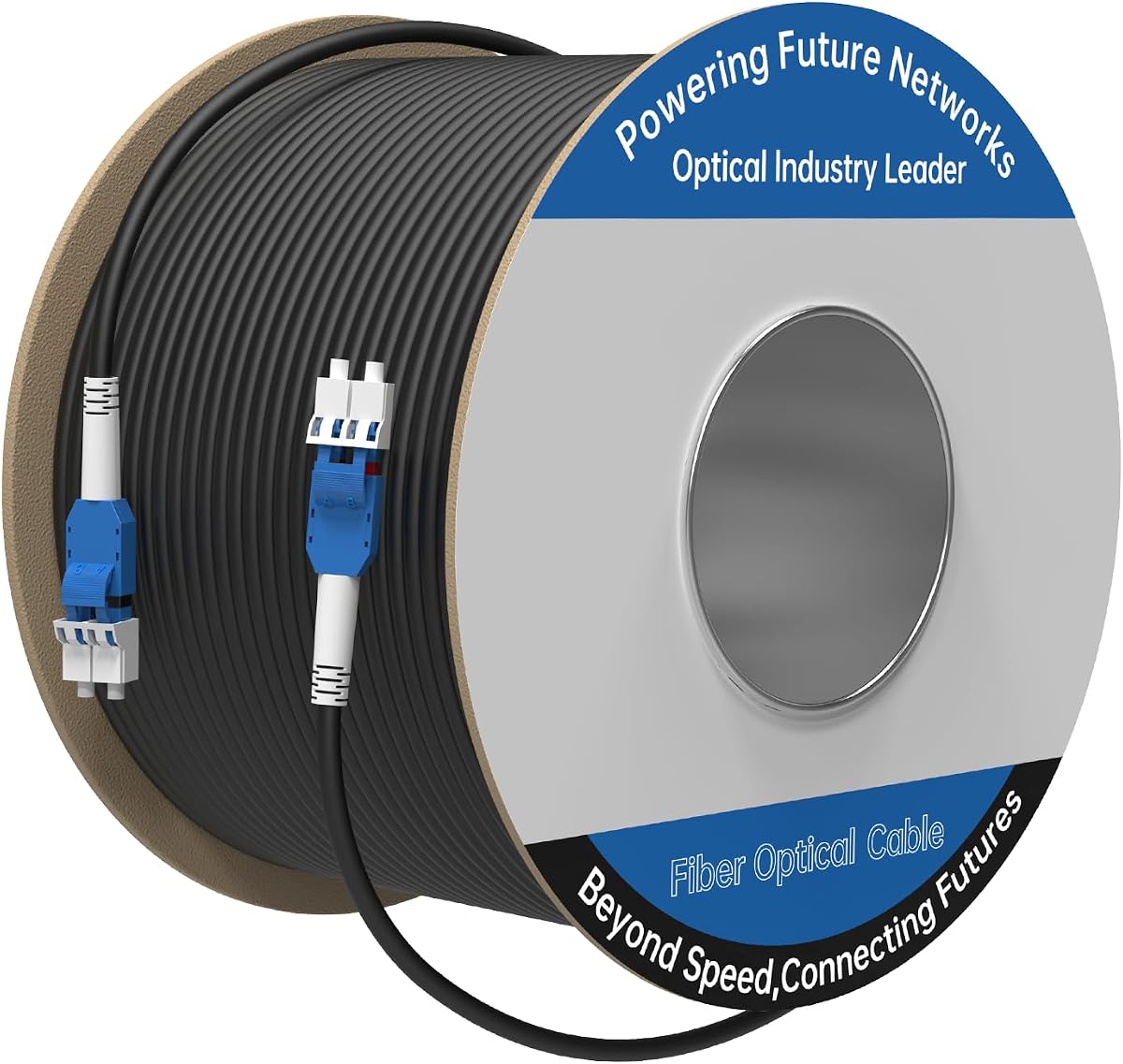
This armored 12-strand distribution cable combines OS2 9/125 singlemode fiber, Corning SMF-28 Ultra optical fiber, and bend-insensitive construction on a 500-foot spool. With no supplied customer rating, its case rests on the stated fiber, mechanical, and installation characteristics.
We may earn a commission when you buy through this link, at no additional cost to you.
Twelve fibers provide exceptional density for a single distribution run, making the cable suitable for campus backbones, data centers, enterprise networks, and audiovisual infrastructure. Corning SMF-28 Ultra fiber is a recognizable component selection for installations that value established fiber performance and consistent splicing behavior.
The armored, riser-rated black cable is listed for indoor and outdoor use, with resistance to moisture, UV exposure, and temperature fluctuations. That combination suits routes that transition between building interiors and exterior pathways, provided the installation method and local standards are satisfied.
This is a premium-capacity choice for network designers who want numerous fibers in a moderate bulk length. It is less compelling when only a point-to-point duplex run is needed, and buyers should confirm bend radius, pulling tension, entry details, termination methods, and compatibility with their active equipment.
A twelve-strand cable provides more parallel paths and spare capacity than the six-strand and duplex options. It can serve multiple destinations while keeping conduit occupancy below that of several smaller cables.
Bend-insensitive construction can make routing around corners and inside transition points more manageable. Installers must still follow the manufacturer's pulling and bend guidance to protect long-term performance.
We may earn a commission when you buy through this link, at no additional cost to you.
The right bulk outdoor cable depends on fiber mode, route length, termination method, fire rating, mechanical exposure, and how much spare capacity the network may need. These factors help separate a basic point-to-point requirement from a future-ready campus backbone.
Multimode fiber uses light to carry data over shorter distances and is commonly paired with less expensive transceivers, especially where equipment supports 850nm or 1300nm wavelengths. Singlemode fiber is designed to support longer distances and can provide a more durable foundation for enterprise, telecom, FTTH, and campus networks. The choice should follow the existing network equipment, the planned link distance, and the desired service life rather than the cable price alone.
A 50-micron core is used by the listed OM3 and OM4 options and by several modern multimode distribution cables, while the 62.5-micron core belongs to legacy OM1 equipment. 9/125-micron describes the singlemode options in this guide. Matching the core category to the transceiver and any existing patch panels eliminates avoidable compatibility problems and makes future maintenance more consistent.
A duplex cable usually carries one bidirectional link, while a six- or twelve-strand distribution cable can support multiple connections, redundancy, or future expansion. Count not only the links required today but also the likely service growth of the site. More strands consume additional pathway space and require larger splice and termination hardware, so unnecessary capacity should be balanced against the cost of a second cable pull.
Riser-rated cable is intended for vertical pathways and selected non-environmental-air spaces, while plenum-rated cable addresses installations where fire-performance requirements are more stringent. Outdoor suitability is a separate attribute from indoor air-space approval. The authority having jurisdiction and the building or facility specification should determine which rating is necessary, and every segment of the route must meet the applicable requirement.
Standard black PVC and aramid yarn can protect a cable during ordinary handling, but direct-burial routes, vehicle areas, and industrial locations may justify steel armor, a TPU jacket, or a thicker cable profile. Mechanical protection does not eliminate the need to control pulling tension, bend radius, sharp edges, and rodent exposure. Choose the strongest construction that matches the route without creating unnecessary conduit-fill or handling problems.
Bulk spools provide long, unterminated cable that can be cut to the exact route length, making them efficient for structured cabling and many custom destinations. Factory-terminated cables arrive with connectors fitted and can reduce field labor, but their length and connector arrangement are fixed. Preterminated options are particularly attractive for a known straight route, while bulk cable offers greater flexibility for complex pathways.
The listed products span 328 feet, 500 feet, 656 feet, and 1,000 feet, but the usable run is rarely the entire package length. Include service loops, vertical drops, patch-panel slack, bend allowances, and termination waste in the route calculation. Check the specified cable or fiber bend radius before pulling, and use a pulling eye, proper guide, and controlled tension on long armored routes.
Unterminated bulk fiber requires compatible connectors, fusion splicing or mechanical termination equipment, suitable enclosures, and testing gear. The listed 200-meter cable includes an LC adapter, while the 100-meter assemblies arrive with LC connectors and Uniboot housings. Confirm connector polish, fiber type, splice hardware, enclosure space, and test requirements before cutting any bulk spool.
Begin with a documented route survey covering conduit fill, pathway bends, environmental-air restrictions, grounding requirements, and every transition between indoor and outdoor spaces. Mark pull points, confirm the cable's fire rating, and inspect the jacket for damage before installation. For bulk spools, plan how the reel will be positioned so the cable pays off in the correct orientation without twisting or kinking.
Install the cable using the specified bend radius, controlled pulling force, and appropriate guides. Avoid sharp edges, excessive sidewall pressure, and repeated crushing. Armored constructions can still be damaged, while a preinstalled pulling eye can simplify long pulls. Keep terminations dry and clean until the fiber is spliced or connectorized, and label both cable ends to support later troubleshooting.
After installation, inspect every exposed section, clean connectors with approved materials, complete the required fusion or mechanical terminations, and test the link with suitable optical equipment. Record insertion loss, return loss, and other results required by the project specification. Secure the cable at required intervals, preserve service loops, and inspect outdoor pathways periodically for movement, moisture intrusion, abrasion, and animal damage.
Bulk cable is usually better when the route requires custom lengths, several branches, or future expansion. It can be cut and terminated to fit the installation, although that requires suitable connectors, tools, enclosures, and testing. A pre-terminated cable is more convenient for a known route because its connectors are already installed, but its fixed length and connector configuration must match the project.
OS2 is a singlemode fiber designed for long-distance transmission, while OM3 and OM4 are multimode categories primarily used for shorter high-speed links. The fiber type must match the transceiver, patch-panel components, and other installed equipment. Changing categories cannot be solved merely by selecting a different connector.
One duplex link normally uses two fibers, one for each transmission direction. More strands are needed for multiple links, redundancy, separate services, or spare capacity. Six- and twelve-strand cables can simplify infrastructure planning when several connections share one pathway, but they also require more termination space and pathway capacity.
It may be physically suitable for an indoor route, but the installation still needs the correct fire and environmental-air rating. Outdoor suitability does not automatically make a cable approved for plenum or other sensitive indoor spaces. Check local code, the building specification, and the requirements of the authority having jurisdiction.
Armor primarily improves resistance to crushing, impact, abrasion, rodents, and pulling stress. It does not make a cable immune to excessive tension, sharp bends, or poor handling. Installation teams should still use suitable pulling equipment, guide shoes, bend-radius controls, and pathway inspection.
Riser-rated cable is designed for suitable vertical pathways, while plenum-rated cable is intended for more demanding building air spaces where smoke and fire-related toxicity matter. The categories reflect different installation environments and should not be treated as interchangeable. Local building codes and project specifications determine the correct selection.
No. Direct burial requires a cable whose listed construction and jacket are approved for that method, and the product details should explicitly support it. Some outdoor-rated cables are intended for conduit or other protected pathways. Confirm the installation method, burial depth, local requirements, and manufacturer guidance before placing any cable underground.
Measure the route, include service loops and termination allowance, and verify the fiber type before cutting. Keep the cable within its bend-radius limits during handling, inspect the jacket, and clean the work area to prevent contamination. The correct connectors, splice hardware, enclosure, and optical test equipment should be prepared before the spool is opened.
The CableWholesale six-strand 50-micron spool stands out as the best overall balance for common multimode building networks, while the six-strand OS2 distribution cable provides a stronger long-distance and expansion option. The two-strand OS2 spool can serve a straightforward duplex route economically, and the 12-strand armored cable is the most ambitious backbone option for dense installations.
Prioritize fiber mode, core diameter, strand count, fire rating, route length, and mechanical protection in that order. Verify that every connected transceiver and termination component is compatible, and distinguish between outdoor, riser, and plenum requirements. Preterminated armored cables can save time, while bulk spools offer greater freedom for custom routing and future growth.
Availability, ratings, specifications, and prices can change, so review the current product listing before buying. Check the latest manufacturer information, confirm the exact quantity and termination type, and compare the final choice against the complete pathway rather than focusing on cable specifications alone.