
Celestron Basic Telescope Eyepiece Smartphone Adapter
4.0Editor score
Universal phone eyepiece connection
Fits 29–45 mm eyepieces
Metal frame with polymer body
Supports most protective cases
Smartphone for astrophotography solutions range from complete smart telescopes that can find and track targets by themselves to adapters that turn a phone camera into an eyepiece camera for an existing telescope. The best choice depends on your equipment, experience, imaging goals, and tolerance for manual setup.
We compared the 10 products in this guide across imaging workflow, target support, phone integration, portability, alignment features, storage, battery life, and included accessories. The list covers automated smart telescopes, traditional refractor packages, precision phone adapters, and a wireless electronic eyepiece.
Each review identifies the product's strongest use case, important limitations, and the buyer it suits best. The selections also show how a one-tap smart telescope differs from a phone-mounted eyepiece system. Product prices and availability can change, so confirm current listing details before buying.
4.0Editor score

4.4Editor score

5.0Editor score
As an Amazon Associate we earn from qualifying purchases.
This side-by-side comparison highlights the difference between all-in-one smart telescopes, entry-level refractor packages, precision phone adapters, and a Wi-Fi electronic eyepiece. Focus on the workflow that matches your experience and the targets you want to photograph.



The ZWO Seestar S30 Pro combines a telescope, imaging camera, tracking system, and phone-controlled workflow in a compact 3.64-pound device. Its 4.4 rating reflects a product that makes astrophotography approachable without requiring the manual target acquisition, calibration, and stacking workflow associated with conventional rigs. Automatic GOTO targeting, live phone viewing, and one-tap capture make it especially appealing for beginners.
We may earn a commission when you buy through this link, at no additional cost to you.
Its dual-camera system records in 4K-quality imagery, while the app provides intelligent modes for the Milky Way, star trails, nebulae, galaxies, the Moon, and the Sun. Automatic mosaics help cover broad scenes, and AI processing reduces noise and separates the sky from the foreground. A built-in light-pollution filter and apochromatic optics are particularly valuable for observers working beneath brighter urban skies.
The main compromises concern workflow boundaries rather than basic quality. The supplied information states that the Seestar is designed for deep-sky, Moon, and Sun imaging but is not intended for planetary observation. Its deep-sky modes also require the device to remain stationary for accurate tracking. Those constraints make it a strong automated solution, though it does not replace every dedicated imaging setup.
Choose the S30 Pro if you want to create astrophotography from a phone-centered setup with minimal setup and no separate telescope. It is particularly well suited to beginners, travelers, and photographers who value automatic stacking and mosaic creation. The included case, tripod, filters, and charging cable make it a particularly cohesive package for weekend observing.
Automatic finding, tracking, stacking, and target selection allow the telescope to handle much of the repetitive work. You can select a target in the sky map, begin an intelligent imaging sequence, and receive processed results in the app.
The integrated light-pollution filter, compact weight, and long-session support make the system more practical than many larger beginner setups. It remains important to use a stable surface and provide a clear view of the target.
We may earn a commission when you buy through this link, at no additional cost to you.
The tridaptor Universal Phone Scope is a precision mounting solution for people who already own a telescope, spotting scope, monocular, binocular, or microscope. Its 4.4 rating reflects a well-regarded adapter that focuses on accurate camera-to-eyepiece alignment. It does not capture celestial objects by itself, but it can turn compatible optics into a smartphone imaging system.
We may earn a commission when you buy through this link, at no additional cost to you.
The most notable feature is its three-axis adjustment. Horizontal and vertical movement centers the phone camera over the eyepiece, while forward-and-back adjustment helps reach the correct eye relief and reduce dark edges or vignetting. An all-metal frame resists flexing, and rubber pads help protect both the phone and the eyepiece from scratches.
The included Bluetooth remote is particularly useful at night because it allows the shutter to be activated without touching the telescope. That reduces vibration that can soften a short-exposure image. Compatibility is broad, including common eyepieces from Vortex, Swarovski, Celestron, Nikon, Zeiss, Kowa, and Leupold, although the manufacturer advises measuring the eyepiece before purchase.
This adapter makes the most sense for a beginner who owns suitable equipment and wants inexpensive, direct phone imaging without buying a complete telescope. Its limitations are predictable: you need a separate optical system, compatible eyepiece dimensions, and sufficient manual alignment skill. Within that category, its precision and rigid design give it a clear advantage over simpler clip-on adapters.
A phone camera lens must sit directly over the eyepiece exit to produce an evenly illuminated image. The independent three-axis controls make it easier to correct both visible vignetting and a camera that appears centered but is actually angled.
Touching the phone can transmit a small shock through the phone holder and telescope. The Bluetooth remote avoids that movement, which is especially helpful for the Moon, bright planets, and magnified terrestrial targets.
We may earn a commission when you buy through this link, at no additional cost to you.
The Celestron Basic Telescope Eyepiece Smartphone Adapter is a straightforward way to begin capturing photographs through an existing optical instrument. It can work with a telescope, spotting scope, binocular, monocular, or microscope, and its 4.0 rating reflects a practical design that prioritizes ease of use over automated controls.
We may earn a commission when you buy through this link, at no additional cost to you.
To use the adapter, place the phone in the holder, center its camera over the eyepiece, and tighten the knobs until the assembly is secure. The frame supports a wide range of recent iPhone, Samsung Galaxy, and Google Pixel models, including many phones while their cases remain attached. Its metal frame and polymer body are designed for regular field use.
Compared with the NexYZ and tridaptor, the basic model offers fewer ways to fine-tune alignment. It does not include the same multi-axis positioning system or a Bluetooth shutter, so exact framing may take more patience. Compatibility is centered on eyepieces measuring 29 to 45 millimeters in diameter, including many telescopes with 1.25-inch eyepieces.
Buy it if you already own a suitable scope and want an uncomplicated, portable adapter for lunar viewing, bright planets, terrestrial wildlife, or other eyepiece targets. It is a sensible first step for casual users, while serious imagers may prefer an adapter with independent three-axis adjustment and remote shutter control.
The basic setup requires no complicated app or electronic alignment procedure. Once the phone is centered and secured, the user can work through the phone's familiar camera controls and share the resulting image directly.
Its compact frame fits readily into a gear bag, while the rigid construction helps maintain alignment at a star party or on a birding trip. A stable tripod remains important because the adapter does not replace proper mount support.
We may earn a commission when you buy through this link, at no additional cost to you.
This ZWO Seestar S30 Pro configuration stands apart through its 128 GB of onboard storage and a long stated battery life of up to six hours. It retains the core appeal of an app-controlled smart telescope: choose a target, let the unit find and track it, and capture processed images through the connected phone or tablet.
We may earn a commission when you buy through this link, at no additional cost to you.
The dual-camera system supports high-resolution imaging of the Moon, galaxies, nebulae, and the Milky Way. Intelligent modes handle auto alignment, image stacking, time-lapse, video, AI noise reduction, and mosaics. Those features are useful for beginners because they reduce the need to build and calibrate a separate imaging train, while raw files can still be saved for later editing.
This listing does not provide a numeric customer rating, so it cannot be judged through the same review history as the rated Seestar model. The product information also states that it is not suitable for planetary viewing and that eyepieces are not compatible. Users should therefore view this primarily as a dedicated smart imaging instrument rather than a general visual telescope.
The supplied package includes the telescope, tripod, carry case, solar filter, USB-C cable, quick guide, safety guidelines, and sticker pack. It is an attractive option for mobile deep-sky imagers who want considerable onboard storage and a complete setup, although the app and a phone or tablet remain required.
The 128 GB configuration gives users more room to retain many sessions on the telescope itself. That is helpful for travel, multi-night activities, and anyone who wants to avoid transferring every image immediately after capture.
Because eyepieces are not compatible, the product focuses on sensor-based smart imaging. Its accessory bundle covers the essentials, but users should still confirm current app compatibility and target availability before an important observing trip.
We may earn a commission when you buy through this link, at no additional cost to you.
The Celestron NexYZ DX balances mechanical precision, phone security, and straightforward operation. With a 4.1 rating, it is a strong choice for owners of a compatible telescope who want to frame and capture views through an eyepiece without buying a complete smart telescope.
We may earn a commission when you buy through this link, at no additional cost to you.
Independent X-, Y-, and Z-axis controls help place the phone's camera directly over the eyepiece. The Z-axis is particularly useful for reaching the correct distance and reducing dark borders, while the tension system secures heavier phones. A spring-loaded slider makes phone changes convenient, which is helpful when switching between devices or imaging and viewing.
The included Bluetooth shutter release is a meaningful advantage for astrophotography because touching the phone can introduce vibration. The adapter also includes two microscope adapters, extending its usefulness beyond astronomy. Compatibility covers eyepieces from 35 to 60 millimeters in diameter, including common 1.25-inch and 2-inch telescope eyepieces.
The principal limitation is that a separate optical system and a compatible eyepiece are required. The 35–60 millimeter range is also narrower than some competing universal designs. For a user who wants dependable alignment, remote-triggered capture, and broad use with an existing Celestron or other standard telescope, this NexYZ model is a well-balanced tool.
Moving the phone left, right, up, and down establishes the correct center, while the forward-and-back control manages image distance. This separation makes troubleshooting dark corners or partial eyepiece views much easier than with a single-point holder.
The strong spring-loaded slider and tension adjustments help the phone remain secure while still allowing quick removal. A compact footprint also makes the adapter easy to carry alongside a portable mount, eyepieces, and a suitable tripod.
We may earn a commission when you buy through this link, at no additional cost to you.
The Celestron NexYZ 3-Axis Phone Adapter is designed for users who want reliable camera-to-eyepiece positioning without a smart telescope's automated targeting. It carries a 4.2 rating and supports smartphones, tablets, telescopes, spotting scopes, binoculars, monoculars, and microscopes.
We may earn a commission when you buy through this link, at no additional cost to you.
Its three directional adjustment knobs control the phone's position over the eyepiece, including a Z-axis adjustment for image distance. A durable metal frame and polymer body protect the setup in the field, while a spring-loaded slider allows fast phone changes. Most current phone shapes can be accommodated, even when a protective case is installed.
This version does not include the Bluetooth remote found in the NexYZ DX listing. That means users must either use a timer, the phone's native remote control, or another available shutter method. Compatible eyepieces span 35 to 60 millimeters in diameter, so buyers should verify their equipment rather than assuming every eyepiece will fit.
The NexYZ 3-Axis is a good middle ground for anyone who understands basic telescope operation and wants more control than a simple clip-on adapter. It can support lunar, planetary, wildlife, and distant-scene imaging, provided the telescope, mount, and eyepiece are stable and compatible.
Mechanical adjustment does not require an app, pairing process, or powered electronics. The phone's native camera remains the imaging interface, which is convenient when a straightforward and dependable setup is preferred.
The two included microscope adapters show how the NexYZ can extend beyond astronomy. That versatility improves its value for households or field observers who also photograph wildlife, distant landscapes, or specimens through compatible optics.
We may earn a commission when you buy through this link, at no additional cost to you.
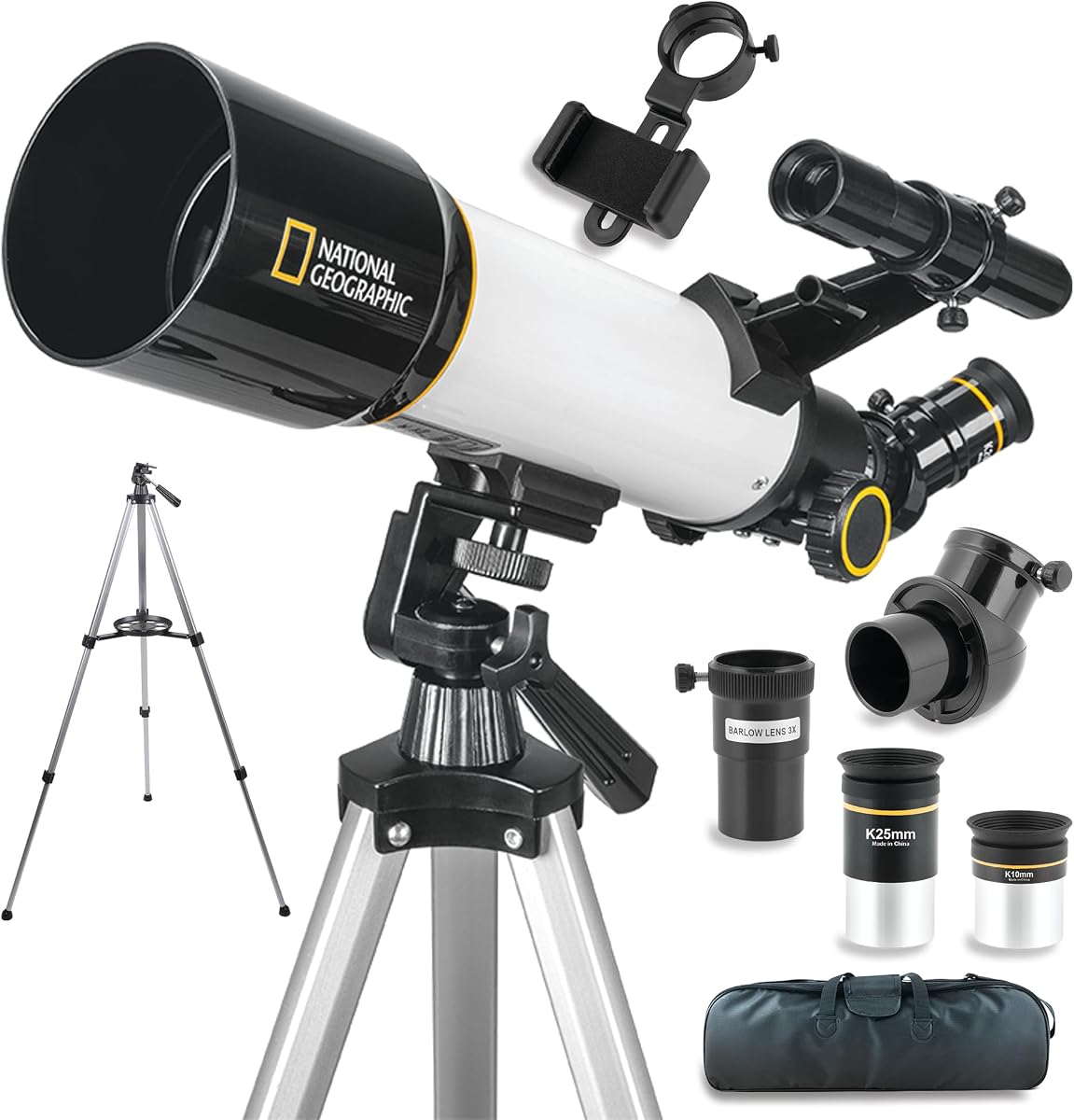
The National Geographic Sky View 70mm Refractor is a traditional all-in-one starter package for visual observing and basic smartphone astrophotography. Its 3.8 rating suggests a straightforward entry product, and the included optical tube, mount, tripod, accessories, and phone adapter give new users a complete setup rather than a single add-on.
We may earn a commission when you buy through this link, at no additional cost to you.
The 70 mm aperture and 400 mm focal length support views of the Moon, planets, and some brighter deep-sky objects such as nebulae and star clusters. Two interchangeable eyepieces and a 3x Barlow lens provide 16x, 40x, 48x, and 120x magnification options. The straight-through viewfinder assists with initial object location and alignment.
Astrophotography is intentionally basic: the included adapter helps a user photograph the Moon or other targets through the phone. There is no automated tracking or stacking system, and the phone must be carefully aligned with the eyepiece. Long faint deep-sky objects will also be more challenging through this modest aperture than through dedicated smart telescopes.
This is a sensible choice for a family, student, or casual beginner who wants to learn visual astronomy and capture brighter targets. The panhandle mount makes object acquisition manageable, while the accessory tray keeps the eyepieces and Barlow nearby. Users focused on deep-sky imaging should choose a more specialized automated system.
The package is centered on observing, with multiple eyepieces, a diagonal, and a viewfinder. This makes it useful for learning how to locate and inspect celestial objects before moving toward more advanced imaging.
The included smartphone adapter removes the need to buy a separate holder for a first lunar photograph. It is still a simple visual telescope rather than a dedicated astrograph, so expectations should remain realistic.
We may earn a commission when you buy through this link, at no additional cost to you.
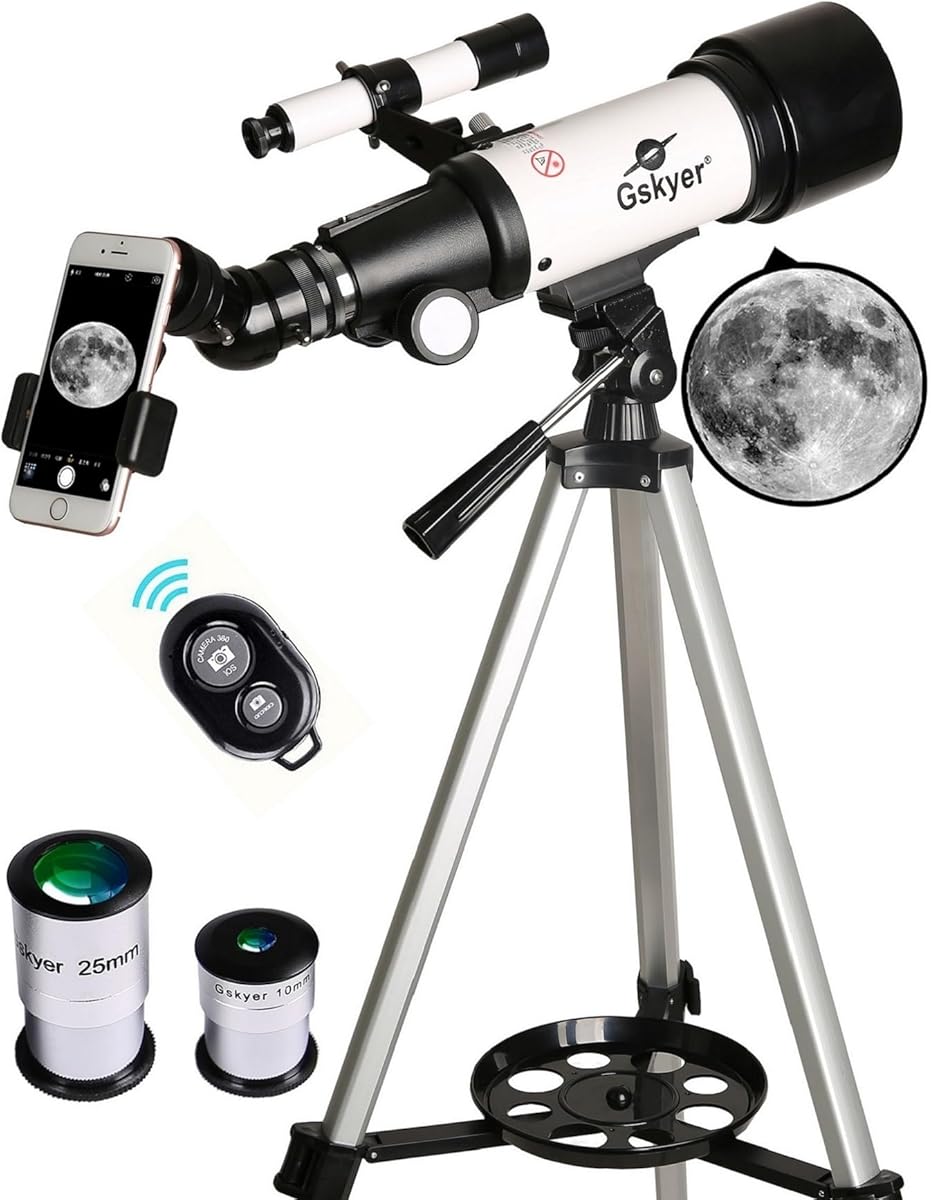
The Gskyer 70mm Refractor combines a compact travel telescope with a phone adapter and wireless remote. Its 4.3 rating is favorable among the conventional refractor options in this guide, making it a credible choice for beginners and families who want astronomy and basic imaging in one package.
We may earn a commission when you buy through this link, at no additional cost to you.
Its 400 mm focal length and fully coated optical glass lens are intended to provide clear views of stars and the Moon. Two replaceable eyepieces and a 3x Barlow lens expand the available magnification range, while a 5×24 finder scope with crosshairs helps locate objects more easily.
The phone adapter and wireless camera remote simplify smartphone use, although the telescope does not automate tracking or stacking. Bright lunar targets and the Moon's phases are the most realistic initial goals. A 70 mm aperture offers less light gathering than the smart telescopes in this list, making faint galaxies and nebulae more difficult to capture well.
Its strongest feature is portability. The adjustable aluminum tripod and carry bag allow the telescope and tripod to fit inside the bag for storage and travel. Choose it for informal observing, Moon photography, and a low-complexity introduction to astrophotography. Buyers seeking automated deep-sky imaging should look to a smart telescope instead.
The included bag protects the optical tube and tripod during storage and transport. That convenience makes the setup more practical for camping, vacations, and family outings than a larger instrument that is awkward to carry.
The crosshair finder helps center larger targets before switching to an eyepiece, while the wireless camera remote reduces the need to touch the phone. These features make a simple session less frustrating, even without automated object finding.
We may earn a commission when you buy through this link, at no additional cost to you.
The Andoer WiFi Electronic Eyepiece provides a digital viewing and recording path without requiring a phone camera to sit directly over an eyepiece. Its 3.4 rating is the lowest among the listed products, but the device offers a distinct alternative for beginners who want wireless live viewing and video through a compatible telescope.
We may earn a commission when you buy through this link, at no additional cost to you.
The eyepiece camera fits a 1.25-inch barrel and uses Wi-Fi to connect with a smartphone or tablet. From the connected device, users can view the scene in real time, capture images, and record video. A built-in 1600 mAh lithium battery supports extended use and recharges through the included Type-C cable.
Its compact, lightweight construction makes it easy to pack in a backpack, which is valuable for travel. The absence of a phone holder simplifies the physical connection, although Wi-Fi introduces an electronic workflow that differs from a conventional eyepiece adapter. Users may need to manage the connection through the device's app or software rather than the phone's standard camera.
Choose this product when wireless sharing, live viewing, and video recording are the priorities and you already own a compatible 1.25-inch telescope. It is less compelling as a dedicated still-image astrograph because the information emphasizes a basic observation method for beginners. A smart telescope offers more automated deep-sky processing, while a precision phone adapter offers direct control over the phone camera.
Because the sensor occupies the telescope's eyepiece position, the phone does not need to be aligned over the optics. That removes one common source of vignetting and makes sharing a live view convenient for groups.
The integrated battery and compact body are useful for mobile observing, while 4K recording provides a practical way to preserve moving or transient views. Keep the device protected from moisture and confirm telescope interface compatibility before a trip.
We may earn a commission when you buy through this link, at no additional cost to you.
The Vaonis Vespera Pro 2 is the most technically advanced product in this guide. Its 5.0 rating, 12.5 MP square sensor, apochromatic flat-field quadruplet optics, and advanced signal-processing tools position it for serious deep-sky imaging while still offering an automated app workflow.
We may earn a commission when you buy through this link, at no additional cost to you.
The square IMX676 sensor provides 1.6 arcseconds per pixel and a stated limiting magnitude of 16. Stray-light baffles, a flat-field apochromatic quadruplet, and BalENS signal enhancement support clean imaging of faint targets and reduction of sky gradients. The 4.18-by-4.18-degree mosaic field can create 50 MP panoramas of broad nebulae and galaxy clusters.
Unlike systems limited to simple one-tap operation, the Vespera Pro 2 permits exposure adjustments from 1 to 30 seconds, gain control from 0 to 30 dB, and FITS or TIFF export for PixInsight or Siril. It can stack captures across dozens of hours and multiple nights. These options create a clear path from automatic operation toward advanced processing, although they also require more deliberate planning.
The package includes an aluminum tripod and hard case, while 225 GB of storage, an 11-hour battery, and support for 30 simultaneous projects support extended use. It is best for an enthusiast who wants both a guided smart-telescope experience and deeper manual control. Buyers focused only on casual Moon photographs may find the capability more than they need.
The 12.5 MP square format balances resolution, field coverage, and pixel characteristics. Combined with the quadruplet optics and stray-light baffles, it gives the system a more specialized foundation for faint deep-sky objects.
Beginners can use the app to automate a target, while more experienced users can adjust exposure, gain, and multi-night stacking. FITS and TIFF export then allows the captured data to continue into professional processing workflows.
We may earn a commission when you buy through this link, at no additional cost to you.
The right smartphone astrophotography system depends on whether you want automated deep-sky imaging, basic phone photos through an existing telescope, or a flexible hybrid workflow. Check optical compatibility, target support, stability, and manual control before making a choice.
Automated smart telescopes handle object finding, tracking, stacking, and often mosaicking through an app. They are the easiest option for beginners and for photographers who want the phone to coordinate the session. Manual adapters give you direct access to the phone camera and can be more flexible, but they require you to locate targets, align the camera, and manage exposure settings yourself.
A larger aperture gathers more light, which generally helps with faint deep-sky objects and shorter imaging sessions. A 70 mm refractor is a capable visual starter, while a multi-element smart telescope can offer stronger performance from a compact package. Focal length also determines field coverage: shorter systems suit broad scenes and mosaics, while longer optics can provide greater magnification for smaller targets.
A phone adapter is useful only if its dimensions and camera position match your device. Look for stated phone-width ranges, case compatibility, and independent horizontal, vertical, and distance adjustments. Smart telescopes instead place their own sensor in a fixed optical train and send images to a phone or tablet. If you want raw control and manual processing, verify the export formats and available imaging controls.
Longer exposures reveal any vibration or tracking error, so a stable tripod and balanced optical train are essential. Automatic trackers help but cannot compensate for an uneven surface, accidental movement, or a badly aligned setup. Phone adapters inherit the steadiness of the telescope's mount. For short lunar or terrestrial images, stability is still important because even slight movement can blur the magnified view.
Not every smart telescope is optimized for every class of object. The ZWO Seestar information specifically supports deep-sky, Moon, and Sun targets but states that it is not intended for planetary observation. Other products are general eyepiece adapters and can capture whatever the connected telescope and eyepiece can show. Check focal ratio, magnification, field of view, and any stated target restrictions before purchasing.
Beginners may value one-tap stacking, AI noise reduction, sky separation, and automatic mosaics. Enthusiasts may need gain and exposure control, FITS or TIFF export, master dark calibration, and multi-night stacking. The Vaonis Vespera Pro 2 offers the deeper manual controls in this list, while the Seestar emphasizes automated imaging modes. Choose based on how much processing you want the app to perform.
Long sessions consume storage and battery power, particularly when capturing raw or large mosaic files. The Seestar 128 GB configuration and Vespera Pro 2's 225 GB reduce the need for frequent transfers, while the latter lists up to 11 hours of battery life. Conversely, the 3.6-pound Seestar and compact Adapters are easier to transport than a conventional imaging tube on a large mount.
Eyepiece adapters must match the eyepiece's outer diameter, and shorter designs may not work with certain adapters. The tridaptor supports a broad range of eyepieces but specifically warns against short models. The included tripod, case, remote, cables, and filters can materially improve convenience, so compare the complete package rather than looking only at the optical specifications.
Begin with a clear view of the sky and a stable setup. For an adapter-based system, confirm that the eyepiece diameter is compatible, attach the phone securely, and center the camera over the optics. Use the included remote or a timer to avoid shaking the telescope, then make small alignment corrections until the image circle is even and free from dark borders.
For a smart telescope, install the required app, connect the device, allow its automatic alignment process to finish, and choose a target from the sky map. Let the telescope acquire the object before starting an imaging sequence. Keep the unit stationary during deep-sky capture, and use the included solar filter whenever imaging the Sun.
After the session, disconnect power only as directed by the manual, close the cover or objective when appropriate, and let equipment return to room temperature before packing it away. Keep lenses dry, clean surfaces with suitable optical-cleaning materials, and protect the phone holder from unnecessary pressure. Store the telescope, tripod, cables, and case in a dry environment.
A smart telescope with Moon support or a refractor with a compatible phone adapter is the simplest route. Use the lowest practical magnification, keep the phone precisely aligned, and activate a timer or remote shutter. Bright lunar detail benefits from a stable mount and careful focus, while a larger aperture can make focusing easier.
Tracking is strongly preferable for deep-sky objects because stars drift across the sensor during longer exposures. A phone adapter inherits the tracking capability of the telescope on which it is mounted. A smartphone alone cannot track the sky, and a short-exposure image of the Moon may be possible without sophisticated tracking, though stability remains important.
Not necessarily. You should check the adapter's stated phone-width range, camera clearance, and case compatibility, as well as the required eyepiece diameter. The tridaptor supports most phones from 2.36 to 3.44 inches wide, while the Celestron adapters are described as fitting a wide range of recent iPhone, Samsung Galaxy, and Google Pixel models.
Smart telescopes are usually better for beginners because they automate finding, tracking, stacking, and sometimes mosaicking. Traditional telescopes offer greater optical and mounting flexibility, and a good phone adapter can produce excellent lunar and planetary images. A smart telescope is generally more convenient, while a traditional system rewards users who want direct control.
It depends on the product. The ZWO Seestar S30 Pro information specifically states that it is designed for deep-sky, Moon, and Sun targets and is not intended for planetary observation. Phone adapters do not impose the same listed restriction, so a suitable telescope and eyepiece can be used for planetary viewing and imaging, with stable alignment and appropriate magnification.
Prioritize independent three-axis adjustment, a rigid frame, a secure phone clamp, and a remote shutter or timer workflow. Confirm that the adapter supports your phone dimensions and your telescope's eyepiece diameter. The Z-axis adjustment is also valuable because it helps achieve proper eye relief and reduces vignetting.
Automated smart telescopes often perform much of the stacking and noise reduction in their apps or internal workflow. Manual adapters send images directly to the phone, where the native camera app or editing software can provide basic adjustments. Advanced users may want files such as FITS or TIFF for external processing, which is why export options are important.
Use a stable tripod, avoid setting the telescope in wind or on uneven ground, and keep the device and cables away from moisture. Do not touch the phone after framing it, and use a timer or remote. After imaging, protect the objective, let the equipment acclimate before closing a case, and store everything in a dry, dust-resistant location.
The ZWO Seestar S30 Pro stands out as the most approachable all-in-one option, combining automatic finding, tracking, stacking, mosaics, and phone control in a portable body. The Celestron Basic Phone Adapter is the simplest budget choice for someone who already owns a suitable telescope, while the tridaptor and NexYZ adapters provide greater precision for careful alignment.
Prioritize the workflow that matches your experience. New observers generally benefit more from automation and guided target selection, while experienced photographers may want manual exposure, gain, export, and multi-night controls. The Vaonis Vespera Pro 2 is the premium selection for advanced users, and the included National Geographic and Gskeyer refractors are best treated as accessible visual telescopes with basic phone-imaging support.
Before ordering, verify telescope and eyepiece compatibility, target restrictions, required apps, storage needs, and the accessories included with the current listing. Product prices and availability can change, so check the latest details and customer feedback at the time of purchase.