
Ideal Electrical SureTrace Pro Circuit Tracer (61-950)
4.5Editor score
Tracing through 600-volt systems
AC amperage measurement capability
Dual rotating OLED displays
One-person CertainCircuit tracing
Explore the best electrical wire tracers for circuits, data cables, vehicles, and buried wiring, with feature comparisons and expert buying guidance.
Electrical wire tracers help technicians identify circuits, follow hidden cables, diagnose broken conductors, and distinguish individual wires without unnecessary cutting or guessing. The right instrument depends on whether you are tracing household power, low-voltage data lines, automotive wiring, or buried cables, so features like voltage support, tone output, sensitivity controls, and accessible probes matter.
This guide compares ten wire tracers using the supplied product specifications, ratings, intended applications, and stated limitations. It covers professional breaker-finder kits, analog tone generators, low-voltage automotive testers, and underground cable locators, with particular attention to the environments each model is designed to handle and the barriers it may not penetrate reliably.
Each review explains the strongest use case, notable capabilities, and practical trade-offs for the corresponding product. The top selections highlight exceptional circuit-tracing performance, professional-grade diagnostics, and value for common low-voltage tasks. Product availability and pricing can change, so readers should confirm current specifications, safety details, and accessories before making a purchase.
4.5Editor score

4.7Editor score

4.4Editor score
The comparison below highlights the intended wiring category, tracing method, voltage capability, and key display or audio features of each model, making it easier to match a tracer to a specific diagnostic task.




The Klein Tools ET450 Advanced Circuit Breaker Finder and Wire Tracer Kit earns a 4.7 rating and stands out as the most versatile general-purpose selection in this guide. It is designed to trace energized or non-energized breakers, fuses, and wires, giving electricians a practical way to identify circuits across a broader range of working conditions.
We may earn a commission when you buy through this link, at no additional cost to you.
Its adjustable sensitivity is one of the most valuable characteristics. The receiver can be tuned to identify a target through materials including drywall, cement block, shielded cable, or underground when the manual's relevant instructions are followed. Audible and visual signal-strength feedback helps the user narrow down the conductor, while the built-in flashlight and non-contact voltage function improve visibility and basic safety awareness.
The transmitter also displays external AC and DC voltage indicators for 12, 48, 120, 240, and 480 volts. That information can help distinguish the type and approximate level of the circuit before further work. The included blade and ground prongs, alligator clips, long and short lead adapters, AC plug leads, batteries, and carrying case create a ready-to-use package.
This is a strong recommendation for residential electricians, remodelers, facility technicians, and serious homeowners who need more than a simple low-voltage tone generator. It is less appropriate for someone who only needs automotive continuity checks, and users should consult the manual before relying on underground or shielded-cable performance. For broad circuit-tracing needs, the ET450 is the most complete choice here.
Receiver sensitivity should be adjusted to suit the target and surrounding material. This flexibility helps distinguish a clear target from weaker signals, although the manual's guidance remains important when tracing underground or through shielded cable.
The external voltage indicators provide a useful first look at the connected circuit. Technicians can use that context alongside the receiver's audible and visual indications instead of treating the tracer as the only source of electrical information.
We may earn a commission when you buy through this link, at no additional cost to you.
The Klein Tools VDV500-820 earns a 4.7 rating and is a strong choice for technicians who need detailed tone-based tracing across voice, data, coax, video, and other low-voltage systems. It combines an analog generator and probe with continuity and polarity functions, making it more capable than a basic signal injector.
We may earn a commission when you buy through this link, at no additional cost to you.
Five tone cadences allow the user to select a distinctive signal when multiple cables or paths are present. The stated tracing reach extends to 1,000 feet, while the rugged angled Bed of Nails clips provide a secure way to attach the generator to an accessible wire. RJ11 support offers quick connection to telephone and data jacks, while RJ45 tracing uses center pins 4 and 5.
The probe's 3.5 mm headphone jack is valuable in mechanical rooms, network closets, or other noisy spaces because it can make the tone easier to hear. It is especially helpful when distinct cadences need to be compared. However, the product is designed for open-ended, non-energized wiring below 60 volts, and it cannot trace through drywall or another solid barrier.
Network installers, low-voltage specialists, and home technology installers should give this kit serious consideration. It is less suitable for identifying energized household branch circuits or finding a conductor buried in soil. For accessible low-voltage runs where tone variety, range, and continuity checks are priorities, the VDV500-820 offers a particularly well-rounded toolkit.
Changing tone cadence is valuable when several accessible cables could carry a similar signal. The user can compare the sound at each endpoint to narrow down the correct path with less ambiguity.
RJ11 and RJ45 connection options reduce setup time for common telephone and data wiring. The included angled clips and alligator-style attachment options help maintain a stable connection during the trace.
We may earn a commission when you buy through this link, at no additional cost to you.
The Underground Wire Locator earns a 4.4 rating and targets a specific but important task: finding non-energized cables hidden in soil, walls, or outdoor landscaping. It is designed for sprinkler wires, invisible fence lines, communication lines, and buried wall cables where blind digging could lead to disruption or unnecessary work.
We may earn a commission when you buy through this link, at no additional cost to you.
Its stated tracking range reaches 1,000 feet, with detection up to three feet deep in open, muddy ground. Performance falls to roughly one or two feet near steel pipes, iron pipes, and PVC pipes because the surrounding material attenuates the signal. A black alligator clip can be attached to a metal screwdriver placed in moist soil to improve reception when the target signal is weak.
The design supports single-core and dual-core wires but is not intended for multi-core, bundled, or stranded cables because crosstalk can produce misleading results. A built-in LED flashlight helps in dark spaces, and the independent headphone jack allows quiet tracing in busy outdoor environments. The transmitter also checks positive and negative polarity on a 1-to-30-volt battery.
This locator suits landscapers, irrigation technicians, and homeowners dealing with buried low-voltage lines. It should not be selected for tracing an energized household circuit, and the core limitation is conductor configuration. When the target is an appropriate single or dual-core cable, the kit provides a useful combination of range, illumination, and quiet listening.
Open muddy soil offers the best stated depth, while nearby metal or PVC piping can reduce the effective range. Setting expectations according to the installation environment avoids interpreting a weaker signal as proof that the wire is absent.
The moist-soil screwdriver technique described by the manufacturer can strengthen reception when the cable signal is weak. It is a practical supplement for difficult outdoor conditions rather than a substitute for a properly connected target.
We may earn a commission when you buy through this link, at no additional cost to you.
Ideal Electrical's SureTrace Plus earns a 4.4 rating and delivers a professional diagnostic package for systems up to 600 volts AC or DC, including three-phase installations. It can locate breakers, conductors, fuses, dead shorts, and splice errors, giving it broader relevance than a simple wire-and-tone kit.
We may earn a commission when you buy through this link, at no additional cost to you.
Two high-visibility displays improve readability in confined spaces and at awkward angles. The main display rotates through 180 degrees, while the TightSight bottom display helps users view information close to a panel or obstruction. Analog and digital signal strength, sensitivity level, and battery level appear on screen, and a mute button provides quiet operation where audible indications would be disruptive.
CertainCircuit technology supports one-person tracing by visibly indicating when the correct circuit has been de-energized at the panel and the other end of the run. The transmitter also provides DC polarity and eight voltage levels, while the receiver includes a built-in NCVT, work light, and continuity function. An ETL Certified CAT III rating further distinguishes it as professional diagnostic equipment.
The SureTrace Plus is best for electricians and facilities teams that regularly diagnose commercial or industrial wiring. Beginners may need to consult the downloadable 3D instructions before mastering every feature, and the package is more specialized than a basic tone tracer. For broad voltage support, fault-finding features, and readable displays, it is a strong all-around professional option.
The rotating main screen and bottom-facing TightSight display make the instrument more usable around panels, cabinets, and tightly grouped conductors. They reduce the need to crouch, tilt, or repeatedly reposition the receiver.
Built-in continuity, NCVT, and voltage-related functions reduce the number of separate instruments required for common diagnostics. That consolidation is especially useful for mobile technicians carrying a limited tool bag.
We may earn a commission when you buy through this link, at no additional cost to you.
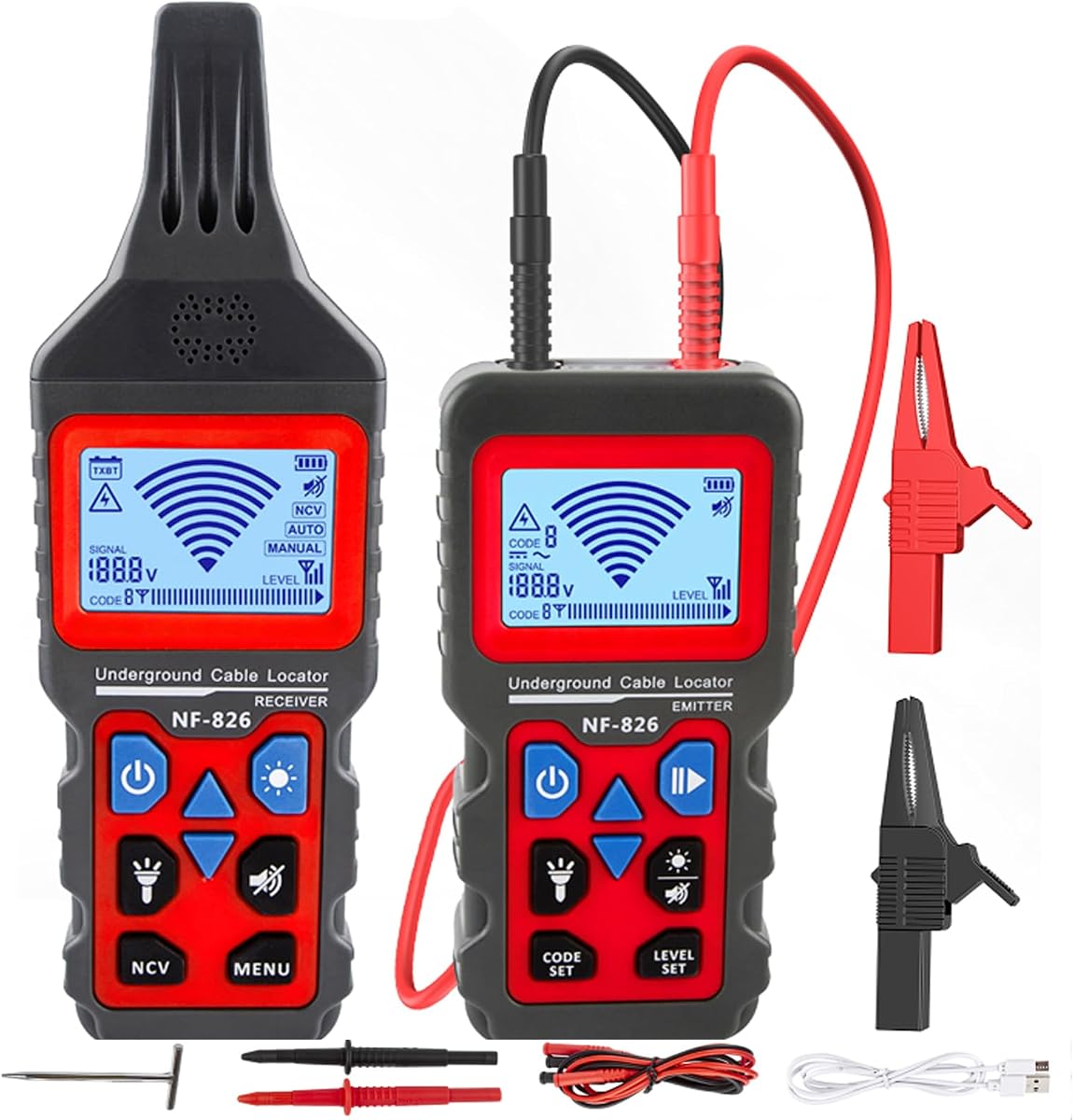
The NOYAFA NF-826 earns a 4.2 rating and combines underground cable location, breakpoint finding, and general wire tracing in one portable system. Its stated reach extends to 2,000 feet of cable length and approximately three to four feet in depth, making it relevant for maintenance work involving buried communication, network, safety, or heating lines.
We may earn a commission when you buy through this link, at no additional cost to you.
The digital circuit can locate single-core and multi-core cables as well as metal pipes. Manual or automatic sensitivity, automatic frequency sweeping, mute operation, a flashlight, and a backlight help users adapt the instrument to the job. The transmitter includes a self-check display, while the receiver can linearly measure AC and DC voltage from 12 to 400 volts.
Its breakpoint function is useful for finding short-circuit faults in underfloor heating lines, but the user must first know which core is shorted. Additional transmitters can help extend or distinguish signals when required. The built-in 1,400 mAh lithium battery provides a stated six-to-ten-hour operating time and supports convenient charging.
The NF-826 suits low-current system installers, network technicians, electricians, and DIY users dealing with buried cables or pipes. It is not the simplest choice for identifying energized branch circuits, and the breakpoint-testing caveat requires careful workflow. Its versatility across cable location, pipe location, and voltage measurement makes it a compelling maintenance tool.
The tracer can narrow a buried fault without immediately excavating the entire cable path. Technicians can identify the affected core first, then use the breakpoint function to focus the search on the relevant section.
Automatic frequency sweeping and manual sensitivity control provide different ways to work around changing signal conditions. A visible LCD, backlight, and self-check function help users evaluate the instrument's operating status.
We may earn a commission when you buy through this link, at no additional cost to you.
The TEMPO Communications 701K-G earns a 4.5 rating and is tailored to voice, data, and video wiring rather than household breaker identification. Its 77HP-G generator and 200EP-G probe amplifier form a professional analog tone system for identifying wires, following circuits, monitoring voltage, and checking breaks.
We may earn a commission when you buy through this link, at no additional cost to you.
Distinct warbling tones are designed to remain recognizable in noisy environments. An LED tone-proximity indicator brightens as the probe approaches the correct pair, giving visual confirmation when it is difficult to hear the signal. The separate LED work light illuminates behind furniture, inside equipment racks, and in other dim areas.
The package includes a modular plug, alligator test leads, RJ11 and RJ45 connections, a socket adapter, and a nylon carrying case. The tracer can follow accessible wiring through walls, floors, and ceilings made from non-conductive materials such as wood or drywall. This makes it useful for installers working with communication and network infrastructure.
TEMPO is a natural choice for telecom, network, and low-voltage professionals who want clear audio and visual cues. It should not be treated as a replacement for a live-circuit breaker finder, and its tracing depends on the tone remaining detectable along the route. For communication wiring specifically, the 701K-G offers a focused and well-equipped package.
The combination of a proximity LED and distinct audible warble supports faster confirmation of the correct pair. This dual feedback is useful when a technician cannot keep the probe in the user's line of sight or when ambient noise masks quieter signals.
Alligator leads, modular plugs, RJ11 and RJ45 parts, and a socket adapter cover common communication-wiring connections. The case also helps protect and organize the equipment between calls.
We may earn a commission when you buy through this link, at no additional cost to you.
The VDIAGTOOL V210 earns a 4.2 rating and focuses on finding open connections, shorts, leaks, and broken wires in low-voltage systems. Its stated operating range is 6 to 42 volts DC, making it suitable for automotive work, trailers, boats, landscaping lighting, smart-home sensors, and other de-energized circuits.
We may earn a commission when you buy through this link, at no additional cost to you.
Transmitter and receiver LEDs indicate open or short conditions, while a changing buzzer tone helps guide the user toward the fault. Adjustable sensitivity and a flexible seven-inch probe make it easier to examine wiring behind panels or inside appliances. The tool can also be used while flexing wires or connectors to reveal an intermittent change in the receiver tone.
Signal quality can be affected by resistance, shielding, propagation, and circuit complexity. Capacitive coupling may also cause a bundled target to bleed into adjacent wires. Moving nearby conductors away from the target and selecting the highest receiver setting that still produces a clear tone can reduce crosstalk and improve isolation.
This is a detailed diagnostic option for automotive technicians and handy owners working on low-voltage circuits, but it is strictly not for 110- or 220-volt AC household mains. Circuits must be de-energized before wall tracing. For finding hidden breaks in vehicle harnesses, garden cables, or appliance wiring, the V210 offers useful controls and clear fault-focused feedback.
A change in receiver tone while a wire or connector is flexed can indicate an unstable connection. The process supports progressive troubleshooting of wiring harnesses in appliances, vehicles, and outdoor equipment.
Separate the target from nearby conductors where possible and adjust sensitivity carefully. This method of isolation is essential because a strong signal in a neighboring wire can otherwise be mistaken for the intended circuit.
We may earn a commission when you buy through this link, at no additional cost to you.
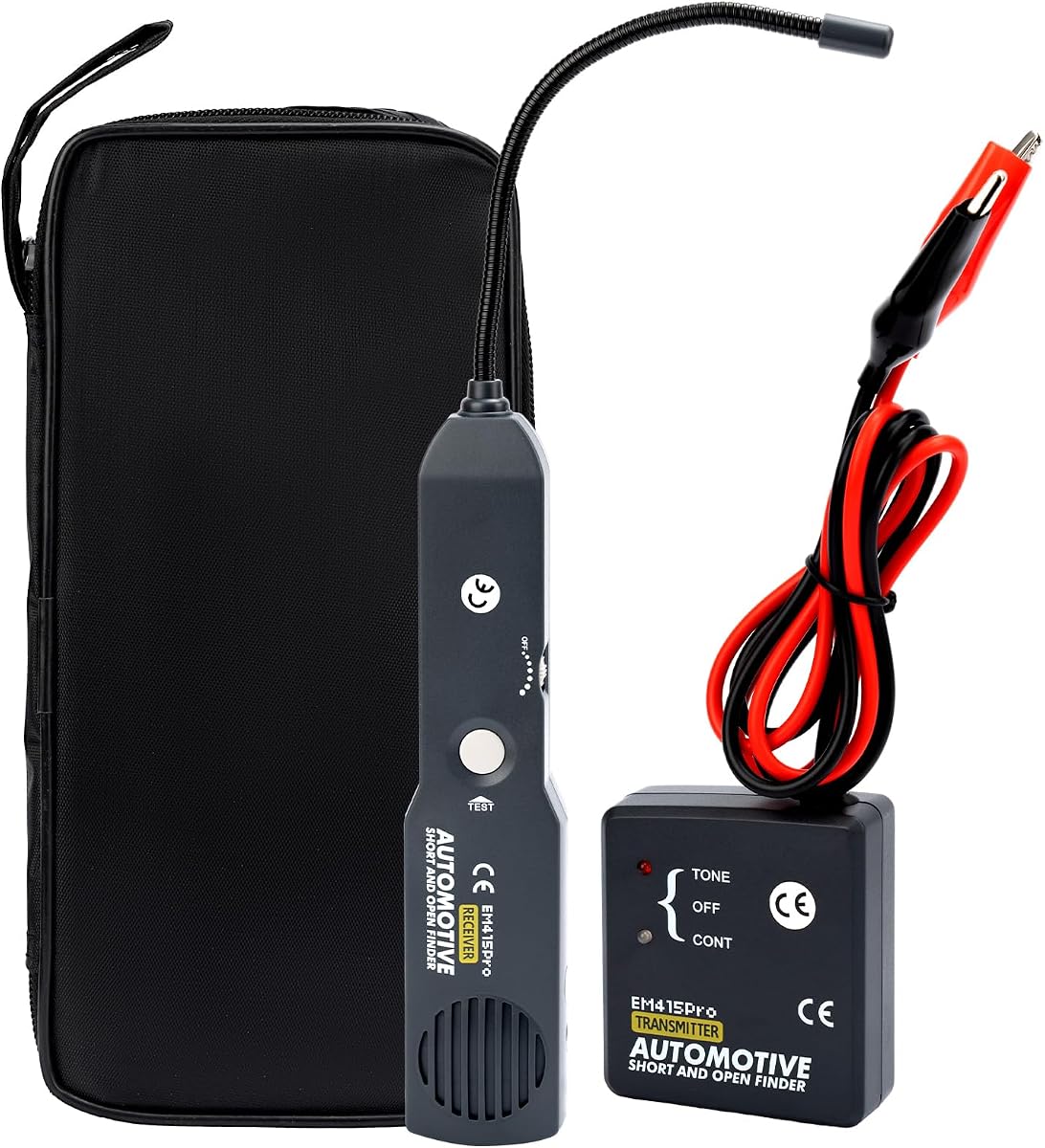
The EM415Pro Automotive Wire Tracer earns a 4.2 rating and offers a straightforward way to identify open wires, short circuits, and circuit paths in 6-to-42-volt DC systems. Its transmitter and receiver system uses audible feedback to guide automotive technicians toward a target without cutting into or damaging wire insulation.
We may earn a commission when you buy through this link, at no additional cost to you.
The tracer can follow hidden wiring behind panels, beneath carpets, and through accessible harness areas. A seven-inch flexible probe bends around dashboards, fuse boxes, connectors, and wire bundles, improving access in areas where a rigid probe would be difficult to position. The stated use cases include cars, trailers, trucks, and other low-voltage diagnostic work.
Non-contact detection is a central convenience because the instrument can help follow an existing path without piercing a conductor. The product's simplicity makes it approachable for users who need a straightforward signal rather than a large display or extensive configuration controls. Detailed performance figures are not provided, so the audible response and local circuit conditions will be important in practice.
The EM415Pro is a practical option for vehicle and trailer electrical troubleshooting, especially for technicians who value a flexible probe and simple setup. It is not designed for household AC wiring, and users should remain within its stated DC voltage range. For straightforward automotive path tracing and basic open or short diagnosis, it is one of the most approachable products in the list.
The flexible seven-inch probe can be shaped around connectors and tight dashboard areas. This makes it easier to place the sensing point near a target without dismantling large sections of the vehicle interior.
The transmitter-and-receiver approach follows an applied signal through accessible wiring. This non-contact method helps preserve conductors while narrowing down the path that needs further diagnosis.
We may earn a commission when you buy through this link, at no additional cost to you.
The Klein Tools VDV500-705 earns a 4.4 rating and delivers the essentials of analog wire tracing at a value-oriented level. It is designed for open-ended, non-active low-voltage wires below 60 volts, making it appropriate for common Ethernet, telephone, speaker, coax, video, and data connections.
We may earn a commission when you buy through this link, at no additional cost to you.
Beyond tone generation, the toner and probe can perform a pin-to-pin wire map test. The included RJ45-to-RJ45 cable supports common network connections, while alligator clips provide a convenient way to attach to unterminated conductors. A work light in the probe improves visibility in dark spaces, and adjustable volume lets users set a comfortable audio level.
Signal performance improves when wires are separated and proper grounding is used. Like most accessible-run tone tracers, the tool is strongest when the conductor can be contacted at both relevant points. It does not provide live circuit identification or the ability to find a conductor through a solid barrier.
This is the best budget choice for homeowners, installers, and network technicians who need reliable basic tracing and wire mapping without buying a full diagnostic package. It is not a substitute for a breaker finder or automotive circuit tester. For accessible low-voltage cable identification, the VDV500-705 provides a focused, practical set of features.
The pin-to-pin mapping function goes beyond simply hearing a tone. It helps users confirm conductor correspondence at the far end, which is useful for network installation and cable troubleshooting.
Separating nearby wires and establishing the recommended ground connection can strengthen the signal. A clean, accessible connection makes the tonal difference easier to recognize at the destination.
We may earn a commission when you buy through this link, at no additional cost to you.
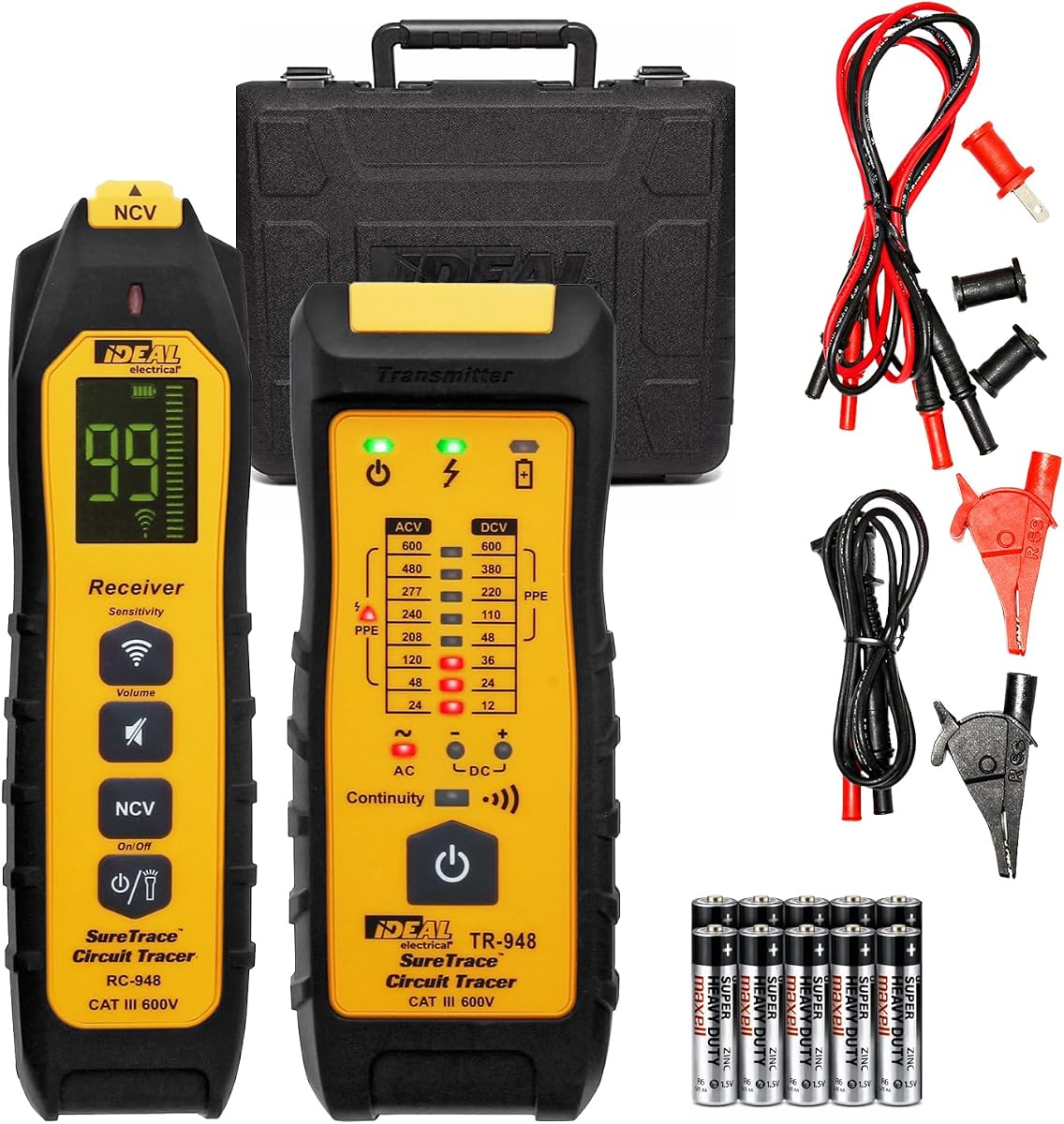
The Ideal Electrical SureTrace Pro 61-950 earns a 4.5 rating and is the most feature-rich selection in the guide. It detects breakers, conductors, fuses, dead shorts, and splice errors across systems up to 600 volts AC or DC, including three-phase installations, while remaining an ETL Certified CAT III instrument.
We may earn a commission when you buy through this link, at no additional cost to you.
Its standout feature is the patent-pending rechargeable inductive and sensing clamp, which measures AC amperage up to 600 amps while also supporting tracing. The receiver and transmitter provide continuity, voltage, DC polarity, and receptacle-wiring checks, allowing the tool to cover several jobs that might otherwise require separate instruments.
Two 90-degree rotating OLED displays improve visibility in tight spaces and at difficult angles, including the TightSight bottom display. The receiver presents analog and digital signal strength, sensitivity, and battery information, while adjustable volume and mute controls support quiet operation. CertainCircuit technology visibly indicates when the correct circuit has been de-energized at both ends, supporting one-person tracing.
This premium model is intended for electricians, facilities teams, and industrial technicians who need an all-in-one diagnostic platform rather than a basic tracer. It has more controls and functions than a general homeowner requires, but that complexity is justified when one instrument must handle 600-volt systems, amperage, continuity, and fault location. The SureTrace Pro is the most capable choice in this comparison.
The inductive and sensing clamp adds AC amperage measurement to the tracing workflow. This combination can reduce the number of separate diagnostic tools required on service and maintenance calls.
Two rotating OLED displays provide flexible viewing in confined workspaces. The bottom-facing screen makes key information accessible when the receiver is held close to a panel, enclosure, or cable bundle.
We may earn a commission when you buy through this link, at no additional cost to you.
The right wire tracer depends on the electrical system, the conductor configuration, the barriers involved, and the level of diagnostics required. Begin with the wiring you need to trace, then consider voltage limits, signal methods, navigation features, and safety controls.
Voltage compatibility is the first filter because a tracer that cannot safely connect to the target circuit is unsuitable. Professional circuit tracers may support energized AC/DC systems up to several hundred volts, while tone generators and underground locators commonly focus on low-voltage, non-energized wiring. Automotive-oriented models commonly specify a narrower DC range and must not be used on household mains.
Look for explicit AC and DC limits, polarity indicators, and non-contact voltage functions. Treat those specifications as hard boundaries, not approximate targets. De-energize circuits before tracing when the instructions require it, and use a properly rated instrument whenever energized identification is necessary.
Breaker finders use an induced signal to identify energized or de-energized branch circuits. Analog tone generators are better for accessible low-voltage runs, while underground locators search for buried conductors and sometimes metal pipes. Automotive testers diagnose opens and shorts in DC wiring through transmitter and receiver feedback. Choosing by application prevents buying a capable tool for the wrong task.
Also note whether a model traces by audio, visual proximity, resistance change, or a combination. Some include continuity, polarity, and voltage measurements, while others concentrate on locating a single conductor. A tracer with a broader feature set can be useful for professionals but unnecessarily complicated for a basic home networking job.
Signal performance changes with drywall, concrete, shielding, soil, moisture, and nearby metal or plastic pipes. Some advanced circuit tracers can penetrate common building materials, while most analog tone generators require an accessible wire. Underground tools may specify depth under open soil but perform differently around pipes or dense ground.
Read the stated limitations carefully. A long cable-length rating does not necessarily mean the tracer can identify a target at that distance through a barrier. For buried lines, conductor count also matters because bundled or multi-core targets can produce crosstalk that weakens isolation.
Adjustable sensitivity and volume are important when working around nearby conductors or in noisy environments. Digital signal-strength displays can help users move toward a target more systematically, while a mute function permits quiet operation. Distinct tone cadences make it easier to distinguish among multiple cables or paired systems.
Audio output is most effective with a headphone jack in HVAC rooms, network closets, vehicles, and active worksites. Visual proximity indicators and work lights add value in dark spaces, but they should complement rather than replace a clear connection and grounding setup.
The included leads determine how quickly a tracer can connect to the target. Alligator clips suit unterminated conductors, modular plugs suit common communication ports, and RJ11 or RJ45 adapters simplify network work. Probe length and flexibility matter when the receiver must reach behind panels, inside racks, or around dense vehicle harnesses.
A complete case is useful for contractors who move between sites, while spare batteries or a charging arrangement help avoid interrupted work. Confirm that the transmitter, receiver, leads, adapters, manual, and storage solution are actually included rather than assuming every pictured accessory comes in the package.
Analog-only feedback can be sufficient for a straightforward tone trace, while digital screens are valuable for showing signal strength, sensitivity, battery status, voltage, and fault information. Rotating or bottom-facing displays improve readability where the receiver is crowded, mounted close to a panel, or viewed from an awkward angle.
Look for clear LED labeling, understandable fault indications, and written guidance covering the intended use. Some professional models also provide downloadable 3D instructions or an application with scenario-based guidance. These resources are particularly helpful for less common tasks such as three-phase tracing or amperage measurement.
A wire tracer may be carried in a crowded tool bag, used outdoors, or subjected to drops on active job sites. Rugged overmolded construction, protected displays, secure connector storage, and a compact case can improve durability and make the instrument easier to manage. A flexible probe may also be more valuable than extra software if the work is mainly automotive or appliance repair.
Battery life and charging behavior are important for all-day use. Understated products may specify a rechargeable system, a stated runtime, or automatic shutdown, while others use replaceable batteries. Choose based on the availability and convenience of power in your normal work environment.
Begin by identifying the circuit, conductor type, expected voltage, and likely path. De-energize the circuit whenever the product instructions require a disconnected or non-energized target. Inspect the transmitter, receiver, leads, and connectors, install fresh or charged batteries, and perform any self-test or continuity check recommended by the manual before touching the wire.
Connect the transmitter to the target using the appropriate clip, lead, plug, or probe. Keep the signal setup as clean and stable as possible, separate nearby conductors when practical, and establish the recommended ground connection. On the receiver, begin with moderate sensitivity, then increase it while watching the audio or visual response; do not interpret maximum signal strength as proof of the correct conductor without confirming the endpoint.
Trace slowly, move the probe in small increments, and compare results at every accessible point. For fault finders, note whether the tone changes at a connector or when a wire is flexed. Afterward, disconnect the transmitter, switch the instrument off, remove replaceable batteries if the manufacturer advises it, wipe the casing and leads, inspect connectors for damage, and store the complete set in its case away from moisture and extreme heat.
Only a tracer explicitly designed for energized circuit tracing should be connected to a live circuit. The Klein Tools ET450 and Ideal SureTrace models support energized identification within their stated voltage limits, while most analog tone generators and underground locators are intended for non-energized wires. Always verify the specifications and use appropriate electrical safety practices.
The difference may come from resistance, shielding, poor grounding, a crowded bundle, or a barrier that attenuates the signal. Separating nearby conductors, improving the ground connection, adjusting sensitivity, and moving the receiver closer can help. If the target is multi-core or bundled, cross-signal may make precise identification impossible without additional testing.
Some advanced circuit tracers are designed to detect signals through drywall, cement block, shielded cable, and other materials under specified conditions. Basic analog tone generators generally require access to the target conductor and are not designed to penetrate solid barriers. The manufacturer's instructions should be checked before interpreting a failed trace.
A breaker finder identifies an electrical branch circuit, often in a powered building system. A tone generator injects a distinctive signal into an accessible low-voltage conductor and uses a probe to follow that signal to another endpoint. Tone generators are common in network, telephone, coax, and data wiring rather than whole-house breaker identification.
The Underground Wire Locator and NOYAFA NF-826 are designed for buried low-voltage lines in applications such as irrigation, invisible fencing, and buried communications. Their effectiveness depends on conductor type, soil conditions, depth, and nearby pipes. A locator designed for single and dual-core wires may not isolate a multi-core or stranded target reliably.
No. The VDIAGTOOL V210 and EM415Pro are specified for low-voltage DC systems and are explicitly unsuitable for 110- or 220-volt AC household mains. De-energize a household circuit before connecting any low-voltage tracer, and select a CAT-rated professional circuit tracer when energized identification is required.
Separate the target from adjacent conductors as much as possible, use the recommended grounding method, and adjust receiver sensitivity carefully. Unique tone cadences can help on tone-based systems, while digital signal strength can guide a professional circuit tracer. Confirm the result at an accessible endpoint because capacitive coupling can make a neighboring wire appear active.
Keep the device dry, clean the probe and leads after use, and inspect cables for cracked insulation or loose connections. Store replaceable batteries separately when the manual recommends removing them, and charge rechargeable models according to the manufacturer's instructions. Periodic self-tests or continuity checks help confirm that the transmitter and receiver remain ready for the next job.
The Klein Tools ET450 is the strongest general recommendation for its ability to trace energized and non-energized wiring, support different voltage levels, and provide audible and visual guidance. The Ideal SureTrace Pro 61-950 takes specialized diagnostics further with 600-volt capability, amperage measurement, rotating OLED screens, and one-person circuit identification.
For value-focused low-voltage work, the Klein Tools VDV500-705 provides an approachable tone generator, pin-to-pin mapping, and common network connections. Buyers working below ground should choose the Underground Wire Locator or NOYAFA NF-826 based on conductor type, while automotive technicians can compare the VDIAGTOOL V210 and EM415Pro for 6-to-42-volt DC fault-finding work.
Prioritize the voltage category, wiring configuration, and barriers involved before comparing convenience features. Confirm the current specifications, included accessories, safety instructions, and availability before purchasing, because product configurations and prices can change. A tracer that precisely matches the actual job will deliver more dependable results than a general tool selected only by headline features.