
Anbernic RG476H
4.4Editor score
120Hz 4.7-inch display
Hall effect controls
Android 13 ecosystem
A handheld emulation console brings classic PC, arcade, and console libraries to a portable screen, but the best model depends on how you play. Display quality, control accuracy, game compatibility, storage, battery life, and connection options can vary dramatically across devices in the same broad category.
We compared ten handhelds based on their published specifications, included software support, display technology, controls, portability, connectivity, and user rating. The list covers Linux-focused systems with large preloaded libraries, Android handhelds that support third-party emulators, and a compact clamshell design made for short sessions.
Each review identifies the console that best fits a particular need, from a budget-friendly library to a premium touchscreen or unusually portable option. Ratings and product details reflect the supplied listings, while prices and availability can change, so readers should verify current offers before purchasing.
4.4Editor score

4.8Editor score

4.6Editor score
As an Amazon Associate we earn from qualifying purchases.
This side-by-side comparison highlights the principal differences among ten portable emulation systems, including operating system, screen, library, battery, and connectivity options. It is designed to make the strongest use cases clear without obscuring the important trade-offs.


The RG56PRO is a large-screen Linux handheld with a 4.0 rating and an emphasis on immediate playability. Its most prominent feature is the fully laminated 5.5-inch IPS display at 1280 by 720, which offers more visible detail than the smaller screens used by many competing handhelds.
We may earn a commission when you buy through this link, at no additional cost to you.
A 128GB TF card comes preloaded with more than 31,000 classic and fifth-generation 3D games, while the open-source Linux interface makes browsing relatively direct. The RK3562 quad-core processor, active cooling system, hall effect shoulder buttons, dual 3D joysticks, vibration, RGB lighting, Wi-Fi, and HDMI output create a feature-rich package for a player who values both library size and physical controls.
The main compromise is size. A 5.5-inch screen is visually satisfying but less discreet than a 2.8-inch or 4-inch model, and the listed battery life of up to eight hours is not guaranteed because it depends on brightness, wireless use, vibration, RGB lighting, and the game being played. The supplied charging guidance also calls for a 5V power source that does not exceed 5V.
This is a strong recommendation for someone who wants a large screen, full shoulder controls, a broad ready-to-play collection, and flexible Linux software. People who prioritize a pocketable design or expect identical battery life in every scenario should look toward a smaller model. For a roomy retro-focused device, the RG56PRO makes a compelling case.
The 1280 by 720 IPS panel is among the largest in this comparison, and full lamination helps the picture feel crisp. Its anti-glare finish also makes the larger screen more practical during travel or in rooms with uneven lighting.
Hall effect L1, L2, R1, and R2 buttons, dual analog sticks, vibration, and RGB lighting target more demanding classics. Wi-Fi supports compatible multiplayer experiences, while HDMI expands the experience to a television or monitor.
We may earn a commission when you buy through this link, at no additional cost to you.
The Anbernic RG40XX H is a compact 4-inch Linux handheld rated 4.0, offering a conventional horizontal layout that should feel familiar to many players. It weighs about 200 grams and includes a 64GB TF card with more than 5,000 preloaded games, making it a straightforward option for users who want a portable library rather than a large display.
We may earn a commission when you buy through this link, at no additional cost to you.
Its 640 by 480 IPS screen uses OCA full-fit lamination and supports adjustable RGB joystick lighting with several animated effects. Internally, a quad-core ARM Cortex-A53 CPU and quad-core PowerVR SGX544MP GPU provide the processing foundation, while 1GB of RAM supports system responsiveness. Connectivity includes Wi-Fi, Bluetooth, 2.4GHz wireless controller support, HD output, and wired controller options.
The 3200mAh battery is smaller than those in several larger premium models, although the listing advertises up to eight hours of continuous play. The modest screen resolution can also make some higher-resolution retro formats look less sharp than on a 720p or OLED handheld. Most importantly, the advertised 5,000-game collection is substantially smaller than the libraries advertised by several Linux competitors.
The RG40XX H is a good match for travelers who value light weight, a familiar shape, and immediate access to a sizeable preloaded library. It is less compelling for buyers who want a high-resolution screen, a very large game collection, or the most advanced connectivity. Within the traditional horizontal Linux handheld format, however, it remains a balanced, practical choice.
At roughly 200 grams, the RG40XX H is easy to carry and avoids the bulk associated with large-screen models. Its conventional grip and full-size control layout also make it approachable for players accustomed to older game systems.
Wi-Fi, Bluetooth, 2.4GHz controller support, and HD output provide several ways to extend play beyond the built-in screen. The RGB joystick lighting and vibration motor add visual and tactile variety to supported titles.
We may earn a commission when you buy through this link, at no additional cost to you.
The RF40H is a square-screen Linux handheld with a 3.9 rating and a strong emphasis on library size. More than 20 emulators and over 20,000 preinstalled classic games are included, giving it one of the most generous advertised collections among the more affordable options.
We may earn a commission when you buy through this link, at no additional cost to you.
Its unusual 4-inch 720 by 720 IPS panel provides a near-square canvas that can suit vertical and traditionally proportioned retro titles. Tempered glass adds everyday protection, while Wi-Fi enables compatible online battles and a 3.5mm headphone jack supports private listening. The package includes the console, a 64GB TF card, a Type-C cable, an organizer bag, a screen film, and a manual.
The 4000mAh battery is listed at six to eight hours, which is competitive for a compact device. Its 64GB card is included for storage rather than preinstalled in the console, and the product should not be considered a suitable choice for children under 12. The lower 3.9 rating also suggests that some customers may have found aspects of the overall experience less compelling.
The RF40H is a practical recommendation for anyone who wants a broad game collection, a distinctive display, and a simple Linux platform. It is less suitable for buyers who want a premium OLED panel, broad Android app support, or a high-resolution widescreen. Its greatest attraction is the amount of software available immediately.
The 720 by 720 IPS display is unusual among the handhelds in this guide and offers substantial pixel density. Its square shape is particularly useful for classic vertical and arcade layouts, although widescreen content will not fill it in the same way as a traditional 16:9 panel.
A large preinstalled game collection and a 64GB card reduce the initial setup required. The included organizer, screen film, cable, and manual also make the package convenient to carry, gift, and begin using.
We may earn a commission when you buy through this link, at no additional cost to you.
The Retroid Pocket 4 Pro combines a 4.6 rating with one of the strongest performance specifications in this guide. Its MediaTek Dimensity 1100 has four Cortex-A78 cores running at 2.6GHz, a G77 MC9 GPU, and 8GB of LPDDR4X memory, creating plenty of headroom for demanding retro formats and Android software.
We may earn a commission when you buy through this link, at no additional cost to you.
The 4.7-inch touchscreen is backed by 128GB of UFS 3.1 storage, and a microSD slot provides expansion. Video can leave the handheld through HDMI at 720p or USB Type-C at 1080p. Wi-Fi 6, Bluetooth 5.2, a 5000mAh battery, and active fan cooling round out a package that is both portable and relatively restrained at 251 grams.
The principal disadvantage is the software library. The listing does not advertise preloaded games, so users need to obtain emulators, ROMs, and content through their preferred sources. That makes the device less convenient for someone expecting a completely ready-to-play product. It also rewards users who want control over their setup and are comfortable with Android-based configuration.
The Pocket 4 Pro is an excellent fit for a technically engaged buyer who wants speed, a sharp touchscreen, modern connectivity, and a capable processor. It is less suitable for a child, casual buyer, or gift recipient who wants thousands of games installed automatically. For a high-performance Android handheld, however, it remains one of the strongest options here.
The Dimensity 1100 and 8GB of LPDDR4X memory place this model well above basic Linux systems. That extra headroom is useful for more demanding emulated formats, multitasking, and Android applications.
HDMI and USB Type-C display options make it practical to play on a larger television or monitor. Wi-Fi 6 and Bluetooth 5.2 also simplify controller, accessory, and network connections.
We may earn a commission when you buy through this link, at no additional cost to you.
The Anbernic RG476H is a feature-rich Android 13 handheld with a 4.4 rating. Its 4.7-inch LTPS in-cell display offers 1280 by 960 resolution, OCA full lamination, multitouch, and a maximum refresh rate of 120Hz, making it one of the sharpest and potentially smoothest displays in this selection.
We may earn a commission when you buy through this link, at no additional cost to you.
Power comes from a Unisoc T820 processor with a quad-core Mali-G57 GPU and 8GB of LPDDR4X memory, paired with 128GB of UFS 2.2 storage. A high-speed fan and heat pipe manage sustained performance, while hall effect triggers and a large-angle 3D hall effect joystick improve control consistency. The feature set extends to a gyroscope, vibration, wireless updates, streaming, screen mirroring, and AI functions.
The device does not include a game card or preinstalled games. It provides a built-in frontend, access to up to 30 listed popular emulator and Android games, compatibility with the RixelHK downloader, and the ability to add games to corresponding emulators. That distinction matters: buyers seeking instant nostalgia may prefer a preloaded Linux system, while experienced Android users gain more control here.
The 5000mAh battery is advertised for up to six hours of use. The RG476H is best suited to enthusiasts who value a high-refresh screen, modern controls, active cooling, and AI-assisted features. It is less convenient for beginners, and its emphasis on advanced functionality makes it more of a premium feature console than a simple plug-and-play retro device.
The combination of 1280 by 960 resolution, full lamination, and up to 120Hz gives the RG476H an advantage for scrolling menus and playing titles that benefit from a higher refresh rate. Multitouch support also improves the Android experience.
Hall effect controls, a gyroscope, active cooling, and a vibration motor support more immersive play. AI tools can provide game recognition, guides, translation, chat, text-to-image generation, and image processing.
We may earn a commission when you buy through this link, at no additional cost to you.
The Miyoo Mini Flip stands apart with a 2.8-inch IPS screen and a three-stage folding body. It carries a 4.2 rating and is designed for players who want a retro gaming device that can fit in a pocket, travel bag, or even serve as a compact desktop companion.
We may earn a commission when you buy through this link, at no additional cost to you.
The screen provides 750 by 560 resolution with three-times pixel-perfect scaling for 3:2 content and two-times scaling for 4:3 games. The system includes an approachable operating mode as well as a custom firmware environment offering Onion, Allium, MinUI, Spruce, and Koriki, although those additional systems must be downloaded and installed separately. Wi-Fi, vibration, and real-time clock support add practical retro functions.
Its 2500mAh battery offers about four hours of play, the shortest listed runtime in this group. The 2.8-inch screen also has the lowest resolution and smallest viewing area, which may frustrate players who prefer modern pixel density. The distinct folding design, however, offsets some of that limitation by making the device far easier to carry than conventional rectangles.
Choose the Mini Flip for commuting, short breaks, travel, or a novelty retro setup that prioritizes compactness. It is not the strongest option for long sessions or large-screen immersion, but it delivers a distinctive portable experience. For anyone searching for the smallest capable-looking console in the guide, it is a particularly interesting choice.
The folding mechanism changes the shape of the device depending on how it is being used. It can sit on a desk, fold for storage, or be held in a compact configuration during a commute.
The included beginner-oriented system and access to several established custom firmware frontends give new and experienced users different paths. Pixel-perfect scaling options are particularly valuable for preserving the intended proportions of older games.
We may earn a commission when you buy through this link, at no additional cost to you.
The Anbernic RG477V is the most overtly performance-focused model here, with a Dimensity 8300 processor, 8GB of LPDDR5 memory, and 128GB of UFS storage. It runs Android 14 and carries a 4.1 rating, placing it among the more advanced handhelds for users who want modern software and demanding emulation capabilities.
We may earn a commission when you buy through this link, at no additional cost to you.
Its 4.7-inch LTPS in-cell touchscreen supports 1280 by 960 resolution, multitouch, and refresh rates up to 120Hz. The 5500mAh battery is among the largest in this comparison, with playtime listed at up to six hours. Connectivity is a major strength: Wi-Fi 6E, Bluetooth 5.3, multiple Bluetooth controller support, streaming, and direct 1080p USB Type-C display output.
Like the RG476H, the RG477V does not include a game card or preloaded games. Users must download appropriate content themselves, and the listing specifically notes compatibility with RixelHK. This makes the device more involved than a ready-to-play Linux console, but it also provides greater control over the software and storage.
The RG477V suits technically confident players who want high refresh rates, efficient performance, and extensive modern connectivity. It is less appropriate for a first-time buyer seeking instant game access or for someone who primarily wants a simple retro interface. Within premium Android handhelds, its processor and memory make it a serious performance option.
The Dimensity 8300 combines large and efficient CPU cores with a Mali-G615 GPU, while 8GB of LPDDR5 memory supports demanding applications. This gives the device more capability than basic Linux alternatives when emulating demanding formats.
Wi-Fi 6E, Bluetooth 5.3, streaming, and 1080p Type-C output make external displays and wireless accessories easier to integrate. Support for several Bluetooth controllers broadens the options for multiplayer play.
We may earn a commission when you buy through this link, at no additional cost to you.
The R46H is a 4.2-inch Linux handheld with a 4.2 rating and a 4:3-style display. Its 1024 by 768 IPS panel provides substantially more pixel density than many entry-level models, while the included 128GB TF card and advertised collection of more than 20,000 games create a generous package for retro fans.
We may earn a commission when you buy through this link, at no additional cost to you.
Supported emulators include PS1, PSP, N64, MAME, GBA, FC, and SFC. The RK3326 quad-core processor is positioned as a stable platform for arcade, racing, action, and adventure titles, and Wi-Fi multiplayer expands the possibilities for compatible games. Ergonomic dual joysticks and responsive controls are designed to make the device comfortable for extended sessions.
The processor is older and less ambitious than the Dimensity-based Android models, so demanding emulation may not benefit from the same performance headroom. The square 1024 by 768 screen works well for many older formats but does not provide the widescreen proportions some players prefer. The listing also does not provide a specific battery-capacity or runtime claim, making endurance harder to compare directly.
The R46H is a strong recommendation for someone who wants a substantial preloaded library, a sharp IPS screen, and broad classic emulator support without moving into the Android setup process. It is less ideal for users who need the highest processing power or want a wide 16:9 canvas. As a mid-size Linux library device, it offers a convincing balance.
The 1024 by 768 IPS panel offers a substantial step up in detail compared with 640 by 480 screens. Its near-square format is well suited to many arcade, action, and older console games that were not originally designed for widescreen displays.
The 128GB TF card and more than 20,000 preloaded classics minimize the need for initial configuration. Support for major retro families and arcade systems gives the device broad appeal for nostalgia-driven buyers.
We may earn a commission when you buy through this link, at no additional cost to you.
The Retroid Pocket Classic has the highest supplied rating in this guide at 4.8. Its defining feature is a 3.92-inch 1240 by 1080 AMOLED-style OLED touchscreen running at 60fps, offering deep blacks, vivid color, and high pixel density in a particularly useful 4:3-like format.
We may earn a commission when you buy through this link, at no additional cost to you.
Android 14 provides the foundation, including full Google Play Store support for adding and updating applications. The console includes 6GB of RAM and 128GB of internal storage, with a microSD card slot for expansion. Wi-Fi 5, Bluetooth 5.1, USB-C television output, and a 5000mAh battery round out the feature set, while the vertical body is designed for compact gaming sessions.
No games are preloaded, and the listing does not describe a bundled game card. Buyers must install emulators and add their own game files, making this unsuitable for anyone expecting a fully populated library with no setup. The OLED also carries a higher technical specification than many Linux systems, but visual quality alone does not resolve software-management demands.
Despite that caveat, the Pocket Classic is an outstanding choice for a buyer who values an exceptional display, modern Android flexibility, and a distinctive portable design. It is particularly appealing to retro enthusiasts who want sharper presentation than a conventional IPS screen. With the highest rating and strong overall feature balance, it is the strongest all-around recommendation in this guide.
The unusual 1240 by 1080 OLED combines a retro-friendly proportion with unusually high density. Deep blacks and strong color make sprites and high-contrast artwork stand out, particularly on older 2D games.
Android 14 and Google Play Store access simplify the installation and updating of applications. Wi-Fi, Bluetooth, expandable storage, and USB-C output make the device useful well beyond offline emulation.
We may earn a commission when you buy through this link, at no additional cost to you.
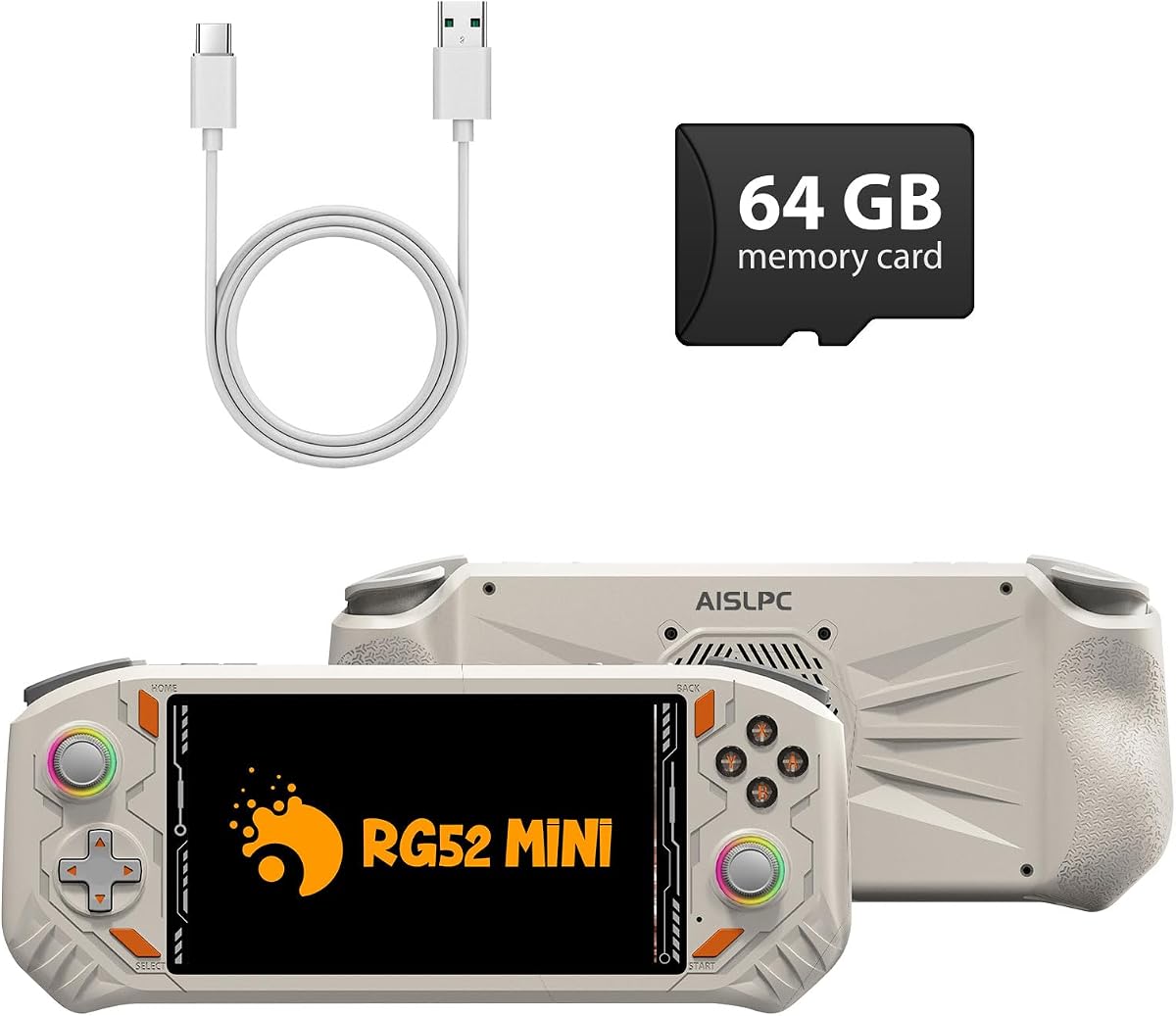
The RG52MINI is a 5.5-inch Linux handheld with a 4.1 rating and an unusual dual-system approach. It provides EmuELEC and RGBOX environments, giving users a choice between a familiar living-room-style interface and an app-based route to a larger downloadable retro collection.
We may earn a commission when you buy through this link, at no additional cost to you.
The fully laminated 5.5-inch IPS display has a 720 by 1280 resolution and an anti-glare finish. Underneath it, an RK3562 quad-core Cortex-A53 processor at 2.0GHz and 2GB plus 4GB of memory support a variety of emulators. The listing highlights more than 22,000 RGBOX games, 2.4GHz Wi-Fi local multiplayer, HDMI output, hall effect triggers, RGB joystick lighting, and vibration.
The advertised RGBOX catalog is accessed through the RGBOX app and Wi-Fi downloader, so the software is not necessarily stored directly on the console at purchase. The 5.5-inch screen is visually impressive but makes the device one of the bulkiest in the comparison. Its 5000mAh battery is listed for up to eight hours, though actual runtime will vary by settings and game.
The RG52MINI is ideal for someone who wants a large display, a broad downloadable catalog, and two distinct Linux interfaces in one device. It is less appropriate for users who require fully offline libraries, prefer a small body, or want to avoid configuring a downloader. Its dual-system design gives it a clear identity within the handheld emulation category.
EmuELEC provides a television-friendly home screen, while RGBOX offers a separate app-based path to downloadable content. The result is flexibility for users who want both console-style browsing and a broader managed library.
The 720 by 1280 laminated panel, HDMI output, and Type-C display output make the handheld easy to pair with larger displays. Storage can be expanded through a TF card slot up to 1TB, providing substantial room for larger collections.
We may earn a commission when you buy through this link, at no additional cost to you.
The right handheld emulation console depends on your preferred games, tolerance for setup, display expectations, and portability needs. Comparing software readiness, controls, connectivity, and battery specifications can prevent an expensive mismatch.
Linux systems in this guide often provide a more direct retro environment, and several include large game collections on a TF card. Android handhelds offer broader app compatibility, modern interfaces, and access to third-party downloaders, but they generally require the user to install emulators and add game files. Consider whether you want something that starts with a populated library or a flexible device you will configure yourself.
Screen size has a major effect on comfort and portability. The 5.5-inch RG56PRO and RG52MINI favor large, detailed views, while the 4-inch models balance visibility and compact dimensions. The Miyoo Mini Flip is the most pocketable. Resolution also matters: 720-class panels reveal more detail, square screens suit many arcade and traditional 4:3 games, and the Retroid Pocket Classic's OLED provides the strongest contrast in the group.
A large advertised library does not guarantee that every title or emulator performs well. Review the processor, supported emulator list, and operating system together. The RG476H and RG477V have the strongest performance-oriented hardware, while the RG56PRO, RG52MINI, R46H, and RF40H emphasize Linux compatibility and substantial preloaded collections.
Traditional gamepads suit arcade, action, and classic console games, while touchscreens can be helpful for Android menus and point-based software. Hall effect shoulder buttons and triggers, dual 3D joysticks, and vibration are desirable for more demanding games. Consider hand size as well: a large display can feel substantial, and the compact Mini Flip uses a different layout that may not suit every grip preference.
Advertised runtime is usually a maximum rather than a guarantee. Brightness, wireless connections, RGB lighting, vibration, processor load, and the selected game all affect how long a battery lasts. Active cooling systems on the Retroid Pocket 4 Pro and Anbernic RG476H can help sustain performance, but they also add complexity. Larger batteries, such as the RG477V's 5500mAh cell, may support longer sessions despite differences in efficiency.
Wi-Fi can support local or online multiplayer, streaming, screen mirroring, and software downloads, depending on the system. Bluetooth improves accessory and controller support, while HDMI or USB Type-C display output can transform a handheld into a living-room-style device. The RG477V and Retroid Pocket Classic include Type-C output, while the RG56PRO and RG52MINI use HDMI for larger-screen play.
Storage capacity only matters if the games are available and easy to access. Some systems include a 64GB or 128GB TF card with thousands of titles, while Android devices generally provide internal storage without preloaded games. MicroSD expansion is useful for large collections, and some models allow storage expansion up to 1TB. Check whether the advertised game library is stored on the device or downloaded through an app.
Weight, dimensions, grip security, and control spacing can be more important than peak specifications. The Miyoo Mini Flip is designed around extreme compactness, the RG40XX H weighs about 200 grams, and the Retroid Pocket 4 Pro measures 251 grams. Larger 5.5-inch devices often feel more substantial but may be less comfortable on a commute. Include the supplied case or organizer when traveling to protect the screen and controls.
Begin by fully reading the device's included instructions and checking the charging requirements before the first use. Charge with the supplied cable and an appropriate power source, particularly on models that specify a 5V limit. If the console uses a TF card, handle it by its edges, confirm that the file system is compatible, and insert it only when the device is powered off. Android handhelds also need their emulators, game files, and frontends configured before the library will appear.
Choose a front end that suits your display and preferred game formats, then test the controls, display scaling, audio, and save functions before traveling. For wireless multiplayer, pair controllers in advance and confirm that the selected games support the required local or online mode. HDMI and USB Type-C output should be connected while the handheld is powered off or following the manufacturer's instructions, and compatible televisions may require an input-source change.
Keep the screen and controls away from moisture, abrasive surfaces, and extreme heat. Store the console in its case or organizer, avoid leaving a card partly inserted, and use gentle pressure when changing storage. Lower brightness, disable unused RGB lighting, and switch off wireless functions when they are not needed to conserve battery. A soft dry cloth is sufficient for routine cleaning; liquid cleaners should not be applied directly to the device.
The RF40H, RG56PRO, R46H, and RG40XX H are approachable Linux options because they include preloaded game collections and straightforward menus. Android models such as the Retroid Pocket 4 Pro and Anbernic RG477V offer more flexibility but require installing emulators and adding games. A beginner should prioritize a device that matches their comfort with software setup.
The listings advertise large preinstalled collections, but users should verify the source and status of any included content. The RG476V and RG477V explicitly ship without preloaded games, while the RG52MINI's larger RGBOX catalog is accessed through a downloader. Buyers should use game files they are legally entitled to use.
Linux handhelds are usually designed specifically around retro emulation and often include a preloaded library or familiar game-focused frontends. Android handhelds can run emulators through a broader app ecosystem and may support streaming, utilities, and modern touch interfaces. They generally require more initial configuration and offer greater flexibility afterward.
Most models provide some form of external video output. The RG56PRO and RG52MINI use HDMI, while the Retroid Pocket Classic, Retroid Pocket 4 Pro, RG476H, and RG477V support USB Type-C display output at different listed resolutions. Cable compatibility and supported display modes should be confirmed before purchasing an accessory.
The Miyoo Mini Flip is the most compact because of its 2.8-inch screen and folding design. The RG40XX H is also notably light at about 200 grams, while the Retroid Pocket 4 Pro weighs 251 grams. Larger 5.5-inch models prioritize screen size over pocket convenience.
No. A larger display can make sprites and controls easier to see, but aspect ratio and resolution also matter. Square or near-square screens suit many arcade and classic 4:3 games, while widescreen systems support modern ports and certain fifth-generation titles. The best choice depends on the games you intend to play.
The listed maximum runtimes range from about four hours on the Miyoo Mini Flip to as much as eight hours on selected large-screen Linux systems. Real runtime varies with brightness, game complexity, wireless connections, RGB lighting, vibration, and cooling activity. Treat published figures as best-case conditions rather than guaranteed session lengths.
Hall effect controls can provide consistent shoulder and trigger input, which is useful in games that rely on pressure-sensitive actions. Active cooling helps maintain performance during demanding sessions by limiting heat buildup. Neither feature is essential for every player, but both can be valuable in a frequently used, broader emulation library.
The Retroid Pocket Classic stands out as the strongest all-round choice because of its exceptional OLED display, modern Android platform, strong rating, and flexible storage. The Retroid Pocket 4 Pro is ideal for users who prioritize processing power, while the Anbernic RG476H leads in high-refresh visuals, hall effect controls, active cooling, and built-in AI assistance.
For immediate access to a large collection, the RG56PRO, RF40H, R46H, and RG52MINI deserve close attention. Choose the RG56PRO for a large screen and broad Linux library, the RF40H or R46H for a compact square display, and the RG52MINI for two operating environments. The Miyoo Mini Flip serves a different purpose as the most pocketable and visually distinctive option.
Before making a final decision, verify the emulator support, included storage, required setup, physical dimensions, and current output options. Product prices, promotions, and availability can change frequently, so checking the current listing ensures that the selected handheld still matches your preferred library, play style, and budget.
