5000W Power Inverter with 10000W Peak
4.4Editor score
5000W continuous output
10000W surge capacity
Wireless remote control
150-foot remote range
Our 10000W Inverter guide compares power quality, battery compatibility, charging features, surge capacity, outputs, and protections.
A 10000W inverter can turn battery power into household electricity, but the largest advertised capacity is only part of the buying decision. Output waveform, surge handling, battery voltage, cooling, safety features, and installation requirements can matter more than the headline wattage.
We compared ten inverters that include 10000W models, 10000W surge configurations, and closely related systems designed for demanding mobile or off-grid use. The guide distinguishes continuous output from startup capacity and evaluates pure sine wave, modified sine wave, hybrid solar, and vehicle-oriented designs.
Each review shows what a particular model is best suited for, from budget camping equipment to high-capacity home energy systems. Ratings and configurations can change, and prices fluctuate, so readers should verify the latest listing, compatibility details, and installation requirements before purchasing.
Choosing the right 10000W inverter starts with matching the electrical system to the job. A unit may advertise 10000W while operating on 12V or 48V, producing a modified or pure waveform, or delivering less continuous capacity than its model name suggests.
This comparison focuses on the supplied specifications, including continuous and surge power, AC output options, solar-charging functions, remote controls, display options, safety protections, and supported battery types. It also separates basic power converters from integrated inverter chargers designed for permanent energy systems.
Every entry below represents a distinct approach to high-capacity DC-to-AC conversion. The recommendations reflect the strengths and limitations of each design, helping readers identify whether they need a portable inverter, a vehicle installation, a split-phase system, or a battery-free grid-tied arrangement.
4.4Editor score

5.0Editor score

4.5Editor score
The table below compares output type, usable capacity, battery architecture, monitoring options, and major system features across all ten inverters, making the differences between portable converters and integrated solar inverter chargers easier to understand.



The Wagan EL3748 is a true high-capacity portable inverter with 10,000 watts of continuous output and a 20,000-watt surge peak. Its 4.2 rating reflects a capable design, particularly for users who need substantial modified sine wave power from a 12-volt battery bank.
We may earn a commission when you buy through this link, at no additional cost to you.
Its most useful features include four 120-volt AC outlets, a high-output terminal block, an included remote control, and front-panel input and output indicators. Overload, overvoltage, overheat, short-circuit, reverse-polarity, low-battery, and automatic low-battery shutdown protections support safer operation in RV, vehicle, boat, and off-grid environments.
The important trade-off is its modified sine wave. That format is practical for many tools, motors, pumps, and less sensitive appliances, but users with audio equipment, medical devices, variable-speed compressors, or other electronics that dislike a stepped waveform may prefer a pure sine model. Its 10,000W continuous rating also calls for a substantial battery configuration rather than an ordinary starter battery.
This is a sensible option for high-load mobile users who prioritize real continuous capacity over waveform purity. It is less suitable for sensitive electronics or a compact installation, but for a workshop, campground, or vehicle-based power hub where heavy loads matter, the EL3748 provides a convincing mix of capacity and control.
The 10,000-watt continuous rating is the defining advantage here. Unlike models whose 10,000W figure applies only to startup surge, this inverter is designed to sustain demanding appliances and tools while providing 20,000 watts for motor startup.
A comprehensive set of electrical protections reduces common installation risks, while the included remote lets users activate the unit without walking directly to the enclosure. The terminal block also provides a path for high-current hardwired connections.
We may earn a commission when you buy through this link, at no additional cost to you.
This upgraded pure sine wave inverter combines a 10,000W configuration with 12-volt battery input and 220-volt AC output. Its 5.0 rating and 95% stated conversion efficiency make it the most broadly appealing all-around option in this comparison.
We may earn a commission when you buy through this link, at no additional cost to you.
The LCD provides visibility into battery power, input voltage, AC output voltage, output power, operating state, and fault conditions. Soft start, automatic power-off behavior, and protections for overvoltage, overload, overcurrent, undervoltage, overtemperature, and short circuits make it suitable for RV, vehicle, camping, emergency, and solar applications.
Its listing spans multiple power and voltage configurations, which is useful for comparing the product family but requires care. The featured variation is 10,000W, 12V DC to 220V AC, not a conventional North American 120-volt configuration. Buyers should confirm the exact variation and all equipment requirements before ordering.
For users seeking clean output, efficient conversion, and detailed monitoring across portable or solar setups, this is the strongest general recommendation. It also makes more sense for sensitive electronics than a modified sine model, provided the selected voltage configuration matches the planned system.
Pure sine wave output is the major reason to choose this model over basic modified sine converters. It is a better match for sensitive electronics, modern appliances, and systems where a smoother waveform is desirable.
The LCD consolidates voltage, power, operating state, and warning information into one interface. This gives installers and users a clearer picture of system performance than a collection of simple indicator lights.
We may earn a commission when you buy through this link, at no additional cost to you.
The SUNGOLDPOWER SPH10048P is an all-in-one 10,000W pure sine wave solar inverter for 48-volt systems. It combines dual MPPT solar tracking, charging up to 200 amperes, and selectable 120/240-volt split-phase or 120-volt single-phase output.
We may earn a commission when you buy through this link, at no additional cost to you.
Beyond raw capacity, the model supports hybrid, utility-priority, solar-priority, and solar-only charging, along with several corresponding output priorities. It works with AGM, sealed, gel, flooded, and lithium batteries, includes a user battery mode, and supports CAN, USB, and RS485 communication with compatible SUNGOLDPOWER batteries.
The 20,000-watt maximum peak and 6-horsepower loaded motor capacity support demanding loads, but the 48-volt architecture and extensive wiring requirements make this more involved than a vehicle inverter. Grid-interactive and battery charging functions also call for careful system design rather than a casual plug-in installation.
This is the premium choice for a serious home or off-grid solar installation that values integration and operating flexibility. It suits installers and technically confident users who need dual-array solar tracking, split-phase capability, and sophisticated charging priorities in one enclosure.
Two built-in MPPTs can manage separate solar arrays and help capture energy from panels that face different directions. Integrating tracking, charging, and inversion reduces the number of major components in a permanent energy system.
Programmable charging and discharging periods support time-of-use strategies, while four charging modes and four output priorities provide control over how grid, solar, and battery power interact.
We may earn a commission when you buy through this link, at no additional cost to you.
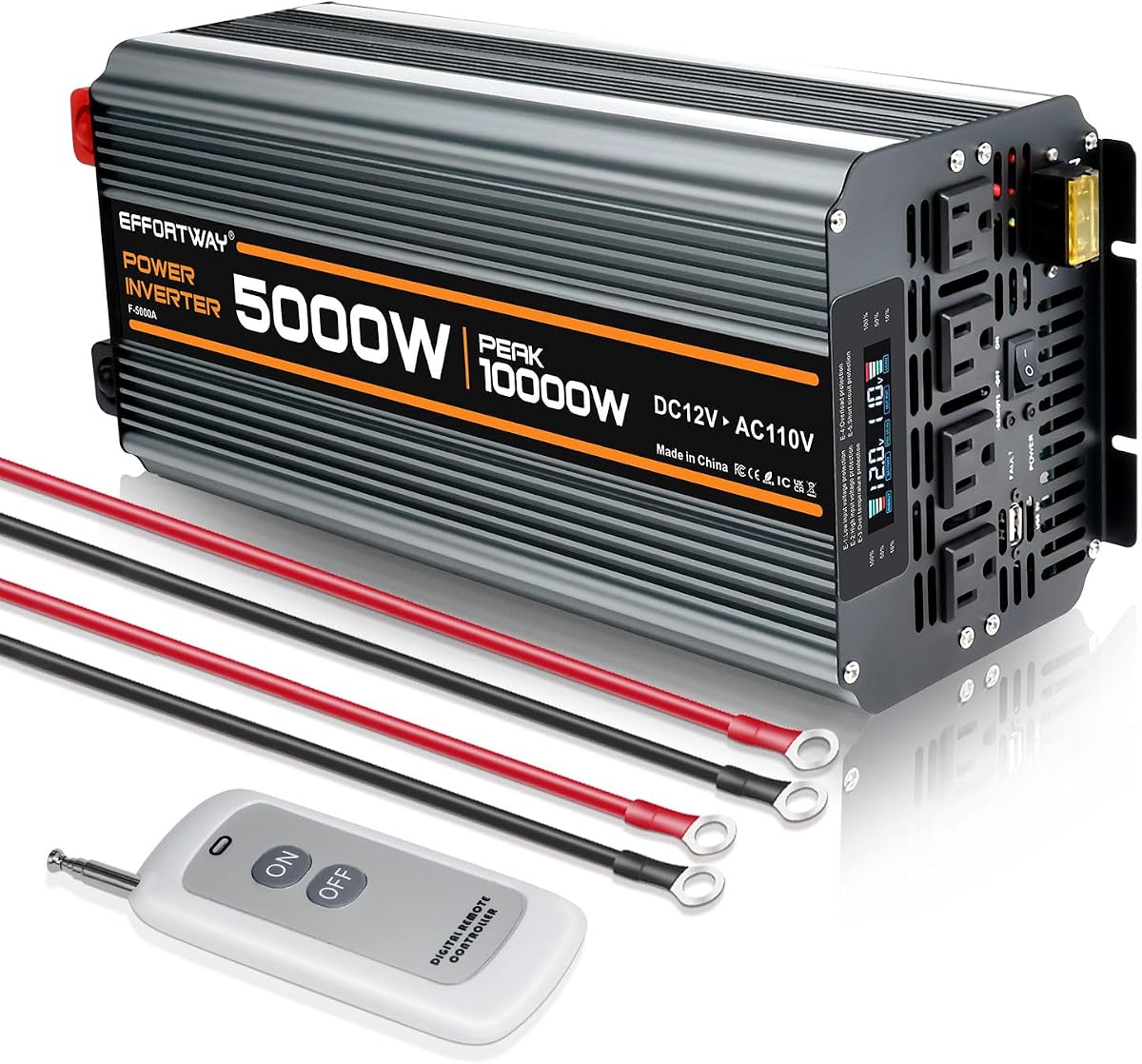
This compact inverter provides 5,000 watts of continuous 110/120-volt output and a 10,000-watt peak for load startup. That distinction makes it a practical choice for readers searching the category but seeking a less demanding system than a true 10,000W continuous model.
We may earn a commission when you buy through this link, at no additional cost to you.
The LCD displays input and output voltage, battery capacity, load capacity, and error codes. A wireless controller works from up to 150 feet away, four AC outlets and one USB port provide convenient connections, and the supplied battery cables simplify direct setup.
Its 4.4 rating reflects a well-equipped budget product, although the modified sine output and 5,000W continuous limit narrow its use. It is not appropriate for a collection of sensitive electronics or for sustained loads at the 10,000-watt level despite that being the surge figure.
The best candidates are RV travelers, campers, and mobile-office users who need a useful startup allowance for pumps or tools but do not require full 10,000W continuous capacity. The included protection, remote, and troubleshooting guidance make it particularly approachable for newer inverter users.
The 10,000-watt peak provides extra headroom when motors or compressors start. The 5,000-watt continuous specification is easier to interpret because it is separated clearly from surge capacity.
A 150-foot wireless remote is especially useful in an RV or vehicle where the inverter is mounted away from living space. The screen provides the operating information needed to identify common battery, voltage, heat, or overload problems.
We may earn a commission when you buy through this link, at no additional cost to you.
The SUNGOLDPOWER SPH10048 is a 10,000W, 48-volt pure sine wave solar inverter charger designed for expandable systems. Its headline strength is support for parallel operation with up to six units, allowing installations to grow as power requirements increase.
We may earn a commission when you buy through this link, at no additional cost to you.
Two integrated MPPT controllers, 200-amp maximum battery charging, a 500-volt maximum open-circuit solar voltage, and selectable 120/240-volt split-phase or 120-volt single-phase output give it the tools needed for a substantial renewable-energy installation.
Compared with the SPH10048P, this listing makes parallel support especially prominent. That does not make it suitable for every buyer, however. A 48-volt battery bank, high-current conductors, solar protection, correct grid integration, and proper commissioning all require more planning than a portable setup.
Choose this model when future expansion is important and the installation is already designed around 48 volts. It is best suited to capable DIY system builders or professional installers who value the combination of high output, integrated solar control, and modular scale.
Parallel operation provides a path to larger capacity without abandoning the entire inverter architecture. Up to six compatible units can be combined according to the manufacturer's configuration and system-design requirements.
Separate MPPT channels can optimize two solar arrays, including panels with different orientations. This is valuable for larger roofs or sites where a single tracker would not capture the available energy effectively.
We may earn a commission when you buy through this link, at no additional cost to you.
The AIMS 10000W 12V is a modified sine wave inverter with 10,000 watts of continuous output and 20,000 watts of surge capability. Its 4.0 rating reflects a straightforward high-power design aimed at demanding tools, motors, pumps, and appliances.
We may earn a commission when you buy through this link, at no additional cost to you.
Pulse width modulation soft start and phase correction are intended to support stable operation with motor-driven loads. Four AC outlets, a terminal block, and front-panel voltage and amperage meters make the unit easy to monitor after installation.
The description explicitly notes that it is not intended for standard vehicle use and requires a robust battery configuration for continuous 10,000W output. That makes it a stationary or semi-permanent option rather than a casual accessory for a car socket.
Its modified sine waveform remains the main limitation, particularly for sensitive or speed-controlled electronics. For a workshop or off-grid installation powered by substantial lead-acid or other appropriately engineered storage, it delivers a useful combination of continuous capacity, surge headroom, and basic monitoring.
PWM soft start helps reduce the abrupt power demand associated with starting motors and other inductive loads. This makes the inverter more suitable for pumps, compressors, and workshop tools than a basic converter without start control.
Front-panel voltage and amperage meters offer immediate information about battery condition and power consumption. That visibility is particularly important when a large battery bank must support a sustained high load.
We may earn a commission when you buy through this link, at no additional cost to you.
The OLTEANP model carries a 5,000W name but its supplied specification states 3,000 watts of continuous output with a 10,000-watt startup peak. Its 4.6 rating and extensive connectivity make it appealing for portable use when those limits are understood.
We may earn a commission when you buy through this link, at no additional cost to you.
Pure sine wave output, four AC outlets, a high-current hardwired terminal, a 5-volt USB port, and a 30-watt USB-C port cover many charging and appliance needs. Compatibility with LiFePO4, AGM, gel, and lead-acid batteries broadens its integration options.
The most important caveat is that the 5,000W in the product title should not be interpreted as continuous output. The stated 3,000W continuous rating also makes the 10,000W peak useful mainly for startup rather than prolonged high-load operation.
This converter fits mobile kitchens, vans, trucks, emergency kits, and modest off-grid systems where pure output and many ports matter more than sustained 10,000W capacity. Buyers should look for a different model when the application requires high continuous power rather than a large startup allowance.
Four household outlets, a hardwired output terminal, and both USB-A and USB-C charging create a convenient all-in-one power panel. It is easier to use for everyday travel equipment without carrying several separate adapters.
Pure sine wave output supports cleaner AC delivery than modified models, while the dual LCD arrangement provides local and remote visibility. The result is a practical portable package for smaller loads despite the prominent surge specification.
We may earn a commission when you buy through this link, at no additional cost to you.
The TOPBULL 5000W inverter provides 5,000 watts of continuous AC output and a 10,000-watt peak, giving it a useful startup allowance for compatible 12-volt systems. Its 4.6 rating reflects a solid feature set and broad application potential.
We may earn a commission when you buy through this link, at no additional cost to you.
Pure sine wave output is joined by four 20-amp outlets, two USB fast-charging ports, a 30-watt USB-C port, and three AC terminal blocks. A color display shows voltage, power, and operating status, while the remote controller works from up to 200 feet away.
Its protection list includes low- and high-voltage, overload, short-circuit, overheat, reverse-polarity, grounding, overcurrent, leakage, and battery protection. Those features are useful, but 12-volt operation and the 5,000W continuous limit mean the unit cannot substitute for a full 10,000W continuous system.
This is a strong option for RV travel, vehicle-based work, camping, mobile offices, and smaller solar installations. Choose it for clean output, extensive ports, and remote operation; move to a 48-volt or larger-capacity design when sustained heavy loads are the priority.
Ten listed protection functions cover common electrical faults and battery-system risks. The controlled cooling system and temperature management also help the inverter operate consistently in demanding conditions.
A 200-foot remote range allows users to switch the inverter without accessing a tightly mounted enclosure. Real-time voltage, power, and status information on the color display supports more informed load management.
We may earn a commission when you buy through this link, at no additional cost to you.
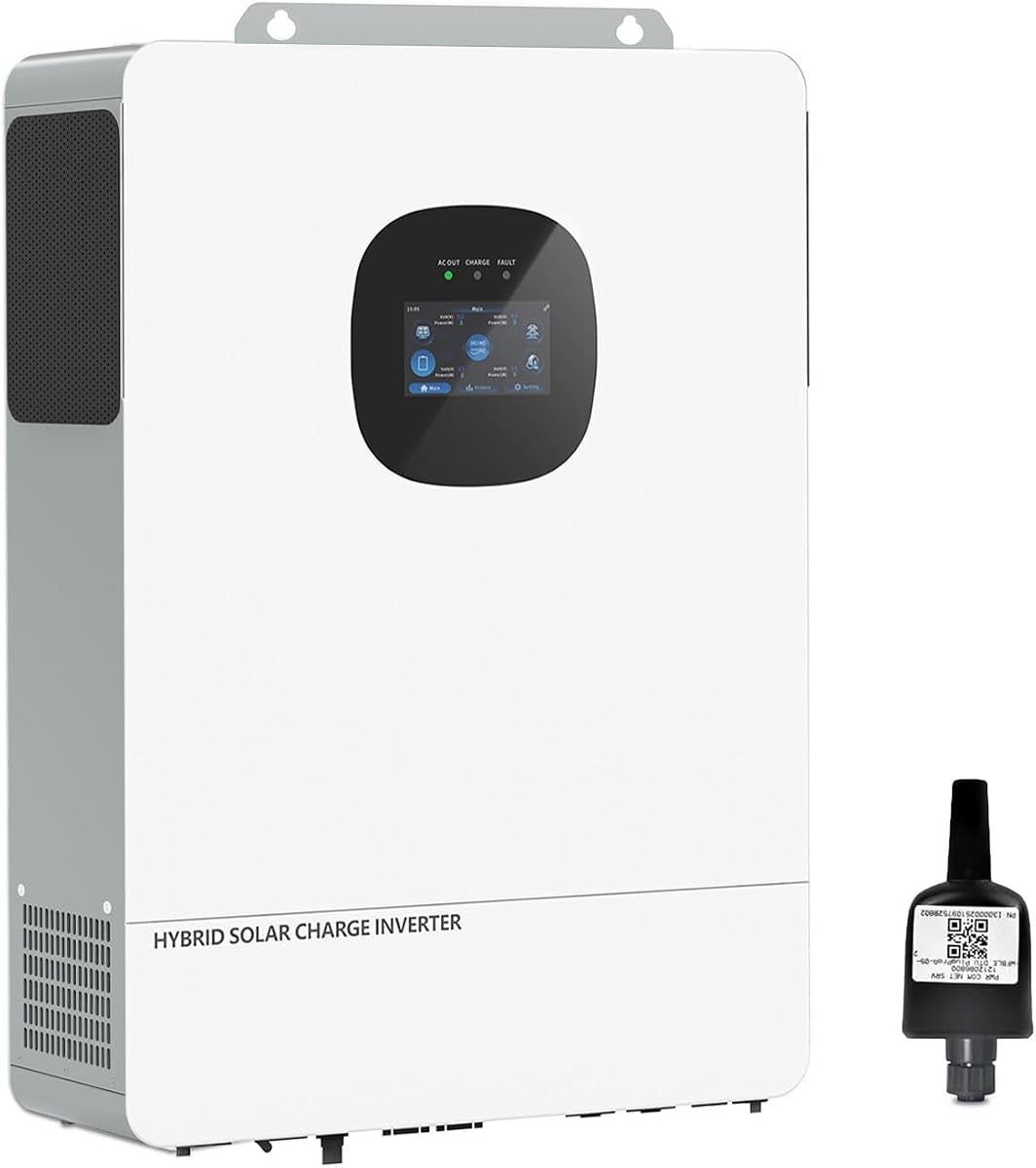
The POWLAND 10000W is a grid-tied hybrid solar inverter with a battery-free design, 120/240-volt split-phase output, and an integrated 250-amp MPPT controller. Its 5.0 rating makes it a compelling option for users who want solar and grid integration without requiring batteries for every operating mode.
We may earn a commission when you buy through this link, at no additional cost to you.
The system can supply household loads from the grid, blend grid, solar, and battery power, and send eligible surplus energy back to the grid when configured for that function. It accepts 48-volt lithium or lead-acid batteries when energy storage is desired, while a maximum solar input range of 90 to 485 volts supports substantial arrays.
The most important consideration is installation. Grid interaction, optional current-sensor monitoring, anti-backflow configuration, and permanent electrical connections are not casual plug-and-play tasks. The stated 15% low-light gain and battery-cost reduction should also be treated as application-dependent rather than guaranteed outcomes.
This model is best for homeowners, larger RV-park-style installations, or technically experienced builders seeking a high-capacity hybrid with flexible battery use. It stands apart from ordinary portable converters by prioritizing renewable harvesting and grid interaction.
The battery-free architecture allows the inverter to use available solar and grid power without requiring a storage bank. Batteries remain an option for backup and energy-shifting applications when the system is designed to use them.
The integrated 250-amp MPPT controller is designed for large solar input, while the LCD and LED indicators provide operating status. The optional current sensor adds information for managing grid export and system behavior.
We may earn a commission when you buy through this link, at no additional cost to you.
The HumsiENK is a 48-volt hybrid solar inverter with 10,000 watts of continuous pure sine wave output, 12,000 watts of surge capacity, and native 120/240-volt split-phase support. Its 4.7 rating reflects a feature-rich approach to home backup and off-grid power.
We may earn a commission when you buy through this link, at no additional cost to you.
It combines the inverter with a 12,000-watt MPPT solar charger and a 220-amp battery charger, using two independent MPPT channels. Four charging modes, time-of-use scheduling, battery-free solar-and-grid operation, and an under-10-millisecond UPS transfer make it particularly relevant to backup users.
Expansion to six units, 60kW total output, plus Wi-Fi, Bluetooth, USB, RS485, and CAN communication creates a flexible platform. The trade-off is complexity: a 48-volt system with substantial current, possible 240-volt loads, parallel operation, and grid interconnection should be specified and installed carefully.
This is a strong candidate for a well-planned whole-home backup, workshop, or off-grid property that values split-phase output and rapid transfer. It is less appropriate for a simple camping setup, and users should verify local electrical requirements before committing to a permanent installation.
The stated under-10-millisecond transfer is designed to minimize interruption to computers, routers, and other sensitive devices. A lithium battery system with an appropriate transfer specification should be confirmed before relying on this behavior.
Mobile-app monitoring, local communication ports, battery-management integration, time-of-use scheduling, and six-unit parallel support create a flexible platform for growing energy systems. The breadth of features also means careful configuration is important.
We may earn a commission when you buy through this link, at no additional cost to you.
The correct inverter depends on load behavior, battery architecture, output quality, and installation setting. Reviewing these factors before comparing models helps prevent a purchase based only on headline wattage.
Choose based on sustained load requirements and keep the largest startup surge below the inverter's allowance.
Pure sine output is the safer general choice; modified sine may suit simple tools and basic loads.
Match inverter input to the existing battery system, and calculate current and cable gauge before installation.
Verify voltage, frequency, phase, and connector types against the devices and building involved.
Choose an integrated charger only when solar control or grid interaction is part of the planned system.
Select local or remote monitoring based on where the unit is mounted and how often it will be checked.
Treat protection features and cooling as important, but pair them with proper wiring, fusing, grounding, and ventilation.
Match portability to the intended environment and plan permanent wiring before bringing a large system home.
Before connecting anything, identify the inverter's exact configuration, input battery voltage, output voltage, continuous rating, surge rating, and required cable gauge. Install the unit in a dry, ventilated location where cooling airflow is unobstructed. Use properly rated battery cables with secure connections, protective fusing or breakers, and correct polarity. For grid-interactive or split-phase models, follow the manufacturer's installation requirements and obtain any necessary electrical inspection or approval.
Connect the battery first, then the DC side, and only afterward attach AC loads. Switch on the inverter and confirm that input voltage, output voltage, and battery status appear as expected before adding equipment. Introduce larger loads one at a time, allowing motors and compressors to start without several high-surge devices activating simultaneously. Use the local display or remote to watch voltage, power, fault codes, battery condition, and temperature during the first few cycles.
Care for the system by keeping terminals clean and dry, checking cable insulation, maintaining free space around cooling vents, and reconnecting any protection device that trips only after investigating the cause. Charge and store lithium, AGM, gel, or flooded batteries according to their manufacturer's instructions. For solar installations, inspect MPPT and wiring periodically, and update settings when battery chemistry, load patterns, grid conditions, or operating schedules change.
No. An inverter's wattage describes how much AC power it can produce, while a battery bank's capacity describes how much energy it stores. Batteries also have a maximum safe discharge rate, so a large bank with insufficient output current may not support a 10000W load. Conversely, a single high-capacity battery may not provide enough energy for extended operation.
It may be possible, but the air conditioner's running watts and compressor startup surge must both fit within the inverter's limits. A unit with 10000W continuous output and 20000W surge capability offers more startup headroom than a 5000W continuous model with a 10000W peak. Also check the required input voltage, run time, battery-bank capability, and whether the connected appliance needs a pure sine wave.
Pure sine wave output follows a smooth waveform similar to standard utility power and is generally compatible with a wider range of electronics and motors. Modified sine wave output uses a stepped waveform that may work well for many simple resistive and motor loads. It can cause noise, heat, restricted speed control, or operational issues in some sensitive devices, so those appliances should be checked before use.
The answer depends on battery voltage, inverter efficiency, load level, and how long the system must operate. A 12-volt system at 10000W demands a very high current, so extensive parallel battery capacity and short, heavy cables may be necessary. A 48-volt system carries much less current at the same power. Calculate expected energy use, account for conversion losses, and verify the battery bank's continuous discharge capability.
Only if the system is intended to charge batteries from solar panels. A basic inverter converts stored DC power to AC but may not regulate photovoltaic input. Integrated solar inverter chargers, such as several of the SUNGOLDPOWER, POWLAND, and HumsiENK models, include MPPT control within the unit. A separate controller may be needed for a conventional converter, and its voltage and current ratings must match the array and battery bank.
Only models specifically designed for grid interaction or hybrid operation should be considered. The POWLAND and HumsiENK products include grid-tied or hybrid functions, while portable converters are generally intended for isolated loads. Grid-connected installation may require utility approval, correct interconnection equipment, anti-backflow configuration, grounding, and compliance with local electrical codes.
It is the maximum short-duration surge the inverter can provide during startup, not the level it can sustain indefinitely. Pumps, compressors, and power tools may briefly draw several times their normal running power. A 5000W continuous inverter with a 10000W peak may therefore start a suitable motor but cannot run 10000W of continuous household equipment.
Check connections, cable condition, cooling airflow, displayed voltage, and fault status before each substantial use and on a regular schedule during sustained operation. Permanent solar or home-backup systems benefit from periodic professional inspection, especially when connections carry high current. Investigate overload, overheating, voltage alarms, or repeated shutdowns rather than resetting the system and ignoring the underlying cause.
The upgraded pure sine inverter is the strongest all-around recommendation for readers who value clean output, 95% stated efficiency, detailed monitoring, and several configuration options. The 5000W wireless remote inverter is the budget-conscious alternative, clearly separating 5000W continuous output from 10000W peak surge, while the SUNGOLDPOWER SPH10048P is the premium choice for a sophisticated 48-volt solar installation.
Prioritize the requirements that cannot be changed after installation: continuous versus surge capacity, waveform quality, battery voltage, output phase, grounding, cooling, and the amount of current the system must carry. A model with fewer headline features can still be the better choice when it matches the load and installation more closely. For permanent split-phase or grid-connected systems, design support and correct commissioning are as important as the inverter itself.
Finally, confirm the exact product variation, current specifications, included accessories, warranty terms, and installation requirements at the time of purchase. Ratings, configurations, promotions, and prices change, so the current listing is the best source for final purchasing details. The right 10000W inverter is the one that safely supports the intended loads without relying on a misleading surge figure.
