
145A MIG Welder, 110V 3-in-1
4.4Editor score
145A maximum output
7.5-pound portable design
Three welding processes
Smart voltage adjustment
Extensive accessory kit
Our Mig Welder guide compares ten leading models for output, welding processes, portability, controls, included accessories, safety features, and ideal use.
A MIG welder is a versatile addition to any garage, workshop, or field toolkit, but the right machine depends on your materials, project size, experience level, and available power. Good models simplify setup, provide dependable control, and offer enough output for the jobs you actually plan to tackle.
This guide compares ten MIG welders based on stated output, supported welding processes, voltage options, wire compatibility, portability, displays, safety features, and included accessories. It covers compact gasless models, dual-voltage multiprocess machines, portable inverter welders, and more advanced systems for professional fabrication.
Each review highlights the best use for that machine and any important limitations, including separately sold torches or other accessories. Ratings reflect the supplied customer feedback, while specifications and feature details are based on the listed product information. Product details and availability can change.
4.4Editor score
4.6Editor score

4.4Editor score
The comparison below organizes all ten machines by process capability, maximum output, power requirements, portability, and notable included equipment, making it easier to identify the model that fits a particular project and workspace.


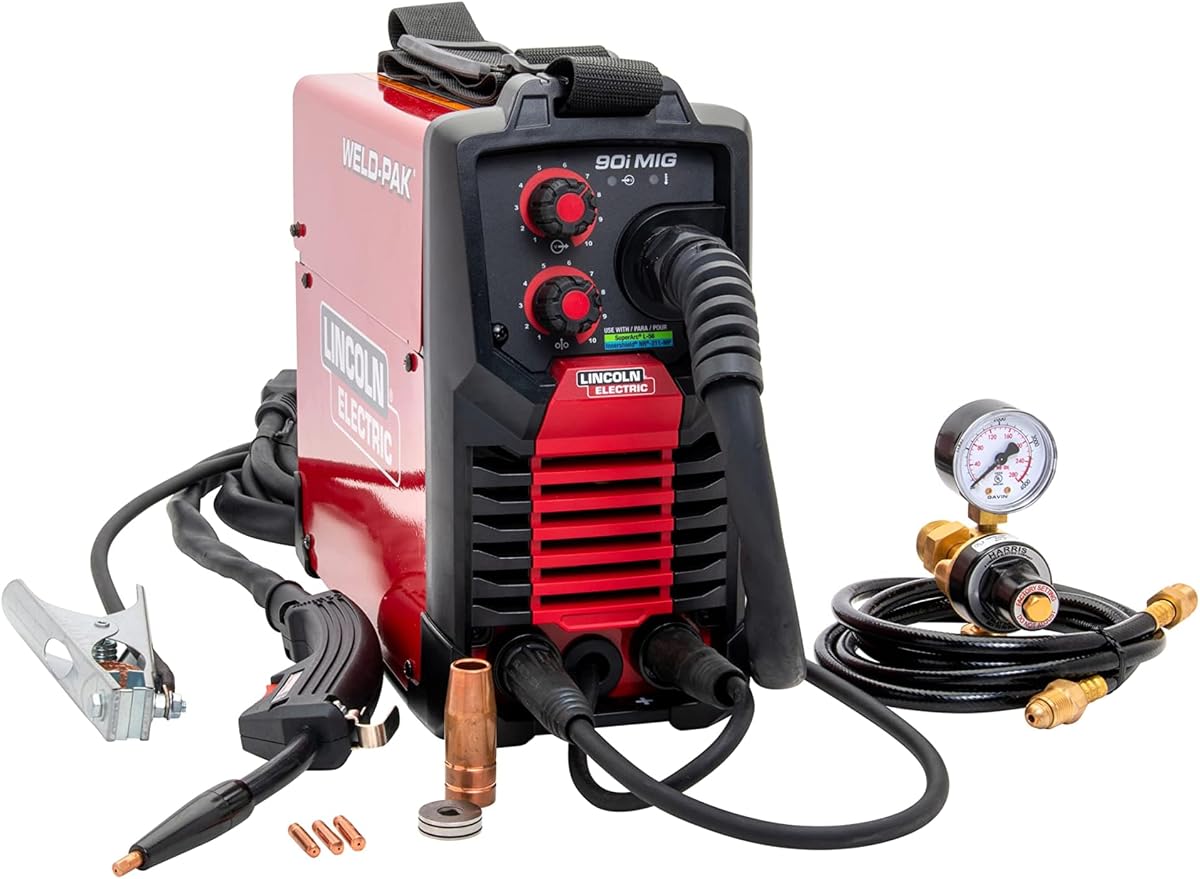
The Lincoln Electric 90i MIG and Flux Core Wire Feed Weld-PAK combines a straightforward inverter design with the portability needed for maintenance work and small fabrication jobs. It holds a 4.6 customer rating, the highest listed score in this guide. Its appeal comes from a focused feature set rather than an attempt to perform every welding or cutting process.
We may earn a commission when you buy through this link, at no additional cost to you.
Two primary controls handle wire speed and voltage, giving users direct influence over the weld without navigating a complicated digital interface. The listed capacity reaches 1/4 inch with flux-cored wire and 3/16 inch with solid MIG wire, making it appropriate for repair brackets, light frame work, exhaust components, and other compact jobs. The inverter format is also described as providing smoother weld characteristics than traditional power sources.
Portability is a major strength. The machine weighs 15 pounds and comes with a shoulder strap, while the metal case helps protect it during transport and storage. That combination makes it more practical for field technicians, homeowners with scattered projects, or anyone whose workshop is not the only place the welder will be used. It includes a welding gun, nozzle, contact tip, work cable, and clamp.
This is a compelling choice for small jobs, beginners who value understandable controls, and users who want a proven machine without a large control panel. It is not the strongest selection for thick structural fabrication, 220V shop use, or multiprocess work requiring TIG and plasma cutting. For repair work and light-duty MIG needs, however, the 90i remains an unusually focused and easy-to-transport option.
The stated wire and thickness limits align well with household repairs, hobby fabrication, and field maintenance. It is particularly useful when the work involves thinner material and straightforward setup rather than extended production welding.
Wire-speed and voltage knobs reduce the learning curve for new users. Experienced operators still retain direct control over the two primary settings that most strongly affect MIG bead behavior.
We may earn a commission when you buy through this link, at no additional cost to you.
This 145A three-in-one MIG welder is built around portability, accessible controls, and an unusually complete accessory package. Its 4.4 rating reflects a well-received balance of compact size and useful output. At 7.5 pounds, it is one of the easiest machines in the guide to carry between a garage, yard, or outdoor work area.
We may earn a commission when you buy through this link, at no additional cost to you.
The machine supports MIG, Stick, and Lift TIG functions with an adjustable output from 30 to 145 amps. Its smart control system lets users choose wire diameter or amperage and automatically adjusts voltage and wire speed, while also suggesting a suitable metal thickness. The digital screen displays real-time amperage and wire diameter, reducing the need to remove a welding helmet to check basic settings.
The package is a meaningful part of the appeal. It includes a MIG torch, ground clamp, electrode holder, welding rods, flux-core wire, contact tips, wrench, safety goggles, gloves, hammer, and manual. That arrangement reduces the number of separate items required for a first project. It is also backed by 24-hour customer support and a stated 30-day money-back guarantee.
The important limitation is that no TIG torch is included, so Lift TIG readiness does not mean the package is immediately complete for TIG work. Its 110V-only design also makes it less suitable for demanding shop production than dual-voltage models. For a beginner, weekend maker, or homeowner who values mobility and a broad starter bundle, it is one of the strongest choices here.
At 7.5 pounds, this machine can be moved easily between work areas without needing a cart. The compact format is especially attractive for outdoor repairs and temporary project setups.
Automatic voltage and wire-speed matching reduces guesswork, while manual fine-tuning remains available. The digital readout makes it easier to understand what the machine is doing as settings change.
We may earn a commission when you buy through this link, at no additional cost to you.
The Millermatic 211 PRO is the most sophisticated machine in this group, with features aimed at users who want more control, repeatable setup, and support for a broader mix of production work. It has a 4.4 customer rating. Unlike compact starter welders, its feature set is built around monitoring, memory, dual voltage, and advanced wire handling.
We may earn a commission when you buy through this link, at no additional cost to you.
Dyna-Pulse MIG supports mild steel, stainless steel, aluminum with a spool gun, and flux-cored wire. BeadVision provides real-time bead monitoring, while Auto-Set simplifies parameter selection and Smooth-Start is intended to reduce spatter during arc initiation. Program Memory allows frequently used settings to be saved and recalled, which is particularly useful for repeat jobs or multiple operators who want consistent results.
Power flexibility is another major advantage. It can switch between 120V and 240V without tools, allowing it to function in a home garage or a higher-powered shop environment. The angled cast-aluminum drive system, Quick Select drive roll, and support for .024- to .035-inch wire add installation and configuration flexibility. The machine also automatically detects a spool gun for aluminum welding, although that gun is not listed as included.
This model is best for serious hobbyists, advanced fabricators, and small professional shops that value information and repeatable settings. It is less attractive for a first-time buyer who wants a simple two-knob machine or for anyone who only needs occasional lightweight repair work. Its depth becomes an advantage when the operator is willing to learn the controls and select the right consumables.
BeadVision gives operators immediate feedback that conventional machines may not provide. That visibility can help a user recognize changes in bead formation and make deliberate adjustments.
Program Memory reduces repeated setup when the same material, wire, and joint configuration are used again. Dual voltage further expands where the machine can be deployed.
We may earn a commission when you buy through this link, at no additional cost to you.
The BESTMIG FLUX-135 combines a 135-amp inverter platform with a substantial accessory package that includes an auto-darkening helmet and leather gloves. Its 4.5 rating places it among the stronger customer-rated machines in this selection. The focus is clear: give beginners useful protective equipment and intuitive controls without requiring a large collection of separate purchases.
We may earn a commission when you buy through this link, at no additional cost to you.
Its three-process design covers MIG, Lift TIG, and Stick welding. The product information states that it can handle materials up to 1/8 inch thick and accepts gasless flux-cored wire from 0.030 to 0.040 inch. Automatic settings adjust parameters based on the selected current, and the full-color LED display provides real-time information while integrated wire feeding adjusts voltage and feed speed.
Included items cover several essential jobs: a ground clamp, electrode holder, welding torch, auto-darkening helmet that can convert to goggles, and leather gloves. The helmet and gloves add meaningful value for a new operator because they help the user approach the first project with appropriate basic protection. The ground clamp and electrode holder also support immediate use of the available processes.
The machine is well suited to home workshops, DIY projects, and factory settings as described by the manufacturer. A TIG torch is not included, and the 110V-only power supply may limit heavier fabrication compared with dual-voltage alternatives. Even so, the combination of output, accessories, and beginner-oriented automation makes this a strong all-around pick for a new owner.
The included auto-darkening helmet and leather gloves reduce the need for immediate extra purchases. The convertible helmet offers flexibility for different tasks, while the gloves support handling during setup and welding.
Automatic adjustment based on current settings can reduce early hesitation. The color display provides clearer parameter feedback than a minimal knob-only interface.
We may earn a commission when you buy through this link, at no additional cost to you.
The YESWELDER 160A offers a balanced combination of output, dual voltage, and four-in-one process support. Its 4.5 rating reflects strong feedback, and the listed versatility makes it suitable for automotive, construction, fabrication, and general DIY work. It is a natural middle ground between compact 110V welders and larger multiprocess shop systems.
We may earn a commission when you buy through this link, at no additional cost to you.
Flux Core MIG, Gas MIG, Stick, and Lift TIG are supported, although a separate lift TIG torch is required. The machine accepts 2-pound and 10-pound spools of .030- and .035-inch solid wire, plus flux-core wire. It also works with 6010, 6011, 6013, and 7018 electrodes in Stick mode, giving users more material and consumable options.
Its control system serves both experience levels. Synergic mode selects recommended voltage and wire-feed speed when the user chooses a thickness or adjusts amperage, while manual mode provides independent control for experienced users. A digital display improves visibility, and the stated protections include compensation for voltage fluctuation plus over-current, overload, and overheating safeguards.
Dual voltage allows the welder to work in a 110V garage or a 220V shop without replacing the entire machine. At 19.4 pounds, however, it is heavier than the most compact models. For buyers who want meaningful process flexibility and balanced performance without moving to a full plasma-cutting system, this is one of the most complete options in the guide.
Synergic mode streamlines common setups, while independent voltage and feed controls support deliberate fine-tuning. That dual approach makes the machine adaptable as the user's skills develop.
Switching between 110V and 220V expands the available work locations. The 19.4-pound weight remains manageable for garage-based work, though it is less travel-friendly than the lightest units.
We may earn a commission when you buy through this link, at no additional cost to you.
The YESWELDER 165A stands out for its upgraded detachable torch and a broad set of wire sizes. It carries a 4.4 rating and builds on a familiar four-in-one format with dual voltage. The detachable MIG-165DS PRO torch is the defining feature, simplifying installation and making torch maintenance more convenient.
We may earn a commission when you buy through this link, at no additional cost to you.
The welder supports Gasless Flux Core MIG, Gas MIG, Stick, and Lift TIG, with a separate torch needed for the last mode. It is compatible with 2-pound and 10-pound spools of .023-, .030-, and .035-inch wire. Synergic MIG automatically matches recommended voltage to the selected wire-feed speed, while manual mode gives experienced operators independent adjustment.
Stick performance can be refined with adjustable Hot Start, Arc Force, VRD, and Anti-Stick functions. These settings can help manage arc initiation and behavior under different conditions. The digital display gives users immediate feedback, and the protection package covers voltage fluctuation, over-current, overload, and overheating.
At 18 pounds, the unit is lighter than many 160- to 165-amp multiprocess competitors. It is a good fit for mobile repair work, automotive applications, and users who want flexibility without the weight of a shop-scale unit. The detachable torch is particularly useful when storing the machine in a crowded vehicle or replacing a torch assembly after damage.
Separating the torch makes setup, storage, and replacement easier. It is a practical design for users who move the machine frequently or maintain several cable and torch arrangements.
Support for three wire diameters expands access to common stock. Adjustable Stick features add another layer of control for users who alternate between MIG and electrode work.
We may earn a commission when you buy through this link, at no additional cost to you.
The YESWELDER MCT-520 is a six-mode welding and cutting platform built for users who want to consolidate several shop tools. Its 4.2 rating is the lowest among the products listed here, but the breadth of its functions is substantial. Gas MIG, flux-core MIG, plasma cutting, HF TIG, MMA, and spool-gun aluminum welding cover a wide range of workshop needs.
We may earn a commission when you buy through this link, at no additional cost to you.
The large LED display is designed to be read while wearing heavy gloves, and the physical controls avoid touchscreen dependence. Welding output ranges from 20 to 200 amps, while plasma output ranges from 20 to 50 amps. The listed cutting capability reaches 5/16 inch for a clean cut and 5/8 inch for a maximum sever, depending on conditions and power.
Advanced controls include MIG inductance, TIG heat adjustment, and MMA Arc Force. It is also foot-pedal ready for hands-free TIG amperage control. A smart parameter-matching system adjusts wire-feed speed based on selected voltage, and the manufacturer provides step-by-step setup tutorials for users becoming familiar with the machine.
The machine is most appropriate for home workshops, garages, farm equipment maintenance, outdoor work, and on-site fabrication. A spool gun and foot pedal are sold separately, so the full advertised feature set requires additions. Its lower rating may reflect the complexity or other customer experiences, but for buyers who actively need cutting as well as welding, the consolidation is compelling.
Combining plasma cutting with MIG, TIG, and MMA functions can simplify shop setup. It also opens separate cutting workflows that a conventional MIG-only unit cannot perform.
The oversized display and physical dials prioritize quick recognition and adjustment. This approach is more practical during active fabrication than a menu-heavy touchscreen interface.
We may earn a commission when you buy through this link, at no additional cost to you.
The TOOLIOM 110/220V five-in-one is a broad multiprocess kit that combines MIG, flux core, plasma cutting, TIG, and Stick welding. Its 4.5 rating indicates generally favorable customer feedback. The machine is designed to serve both weekend projects and recurring fabrication work, with output reaching 200 amps in TIG mode.
We may earn a commission when you buy through this link, at no additional cost to you.
MIG operation includes synergic and manual modes. In synergic mode, voltage follows the selected wire speed, while manual mode gives experienced users independent control. A gas-check function allows gas flow to be verified before striking an arc. The product also supports a separately sold spool gun for aluminum work and includes 1 pound of flux-core wire and a pair of welding gloves.
Its plasma section produces 20 to 50 amps of adjustable output. Listed cutting limits are 5/16 inch on 110V and 25/64 inch on 220V, with stated maximum sever capacities of 25/64 inch and 19/32 inch respectively. The material list includes stainless steel, alloy steel, mild steel, copper, and aluminum. The HF TIG function supports non-contact arc initiation.
The digital panel provides real-time current and setting information, while the product works with a Tooliom foot pedal. When the pedal is connected, its information does not appear on the screen, although the pedal remains functional. For buyers who want cutting and welding in one machine and appreciate both guided and manual controls, this is a versatile DIY-oriented package.
The gas-check function helps users confirm gas flow before beginning a MIG job. This can make setup more methodical and reduce avoidable start-up problems.
Synergic MIG simplifies common tasks, while manual mode preserves independent control. The combination supports quick learning without taking fine-tuning capability away from experienced users.
We may earn a commission when you buy through this link, at no additional cost to you.
The YESWELDER 140A provides four major welding processes, dual voltage, and both guided and manual controls in a straightforward package. Its 4.3 rating is solid without leading the group. Gas MIG, gasless flux-core MIG, Lift TIG, and Stick make it suitable for a varied collection of household and fabrication tasks.
We may earn a commission when you buy through this link, at no additional cost to you.
Maximum output is listed at 140 amps. Synergic MIG adjusts voltage automatically as the user changes wire-feed speed, which ranges from 80 to 600 inches per minute. An additional fine-tuning range of minus 3 to plus 3 volts allows adjustment without fully abandoning the assisted mode. Manual MIG independently controls wire speed and voltage for users who know their preferred settings.
A digital display provides real-time current information, while the protection system includes automatic compensation for voltage fluctuation and safeguards against over-current, overload, and overheating. The machine is positioned for automotive repair, construction, fabrication, and home projects, including work with carbon steel and stainless steel.
The required lift TIG torch is a separate purchase, and the product notes that the adapter and ground clamp are stored inside the machine rather than packaged externally. Buyers should account for that detail when comparing the full kit with machines that place every accessory in the box. Otherwise, this is a capable and approachable dual-voltage option.
Automatic voltage matching makes setup manageable, while the plus-or-minus three-volt adjustment provides room to correct bead behavior. Experienced users do not need to leave assisted mode for every adjustment.
The ability to run on 110V or 220V makes the welder suitable for both residential and more capable shop environments. It is a useful compromise for users who do not need one fixed installation location.
We may earn a commission when you buy through this link, at no additional cost to you.
The YESWELDER FLUX-135PRO pairs a 135-amp flux-core welder with the LYG-L600A auto-darkening helmet. Its 4.5 rating makes it one of the better-reviewed products in this roundup. The helmet is the distinguishing feature, adding advanced eye protection and true-color visibility to an otherwise portable three-process package.
We may earn a commission when you buy through this link, at no additional cost to you.
The welder supports Gasless Flux Core MIG, Stick, and Lift TIG. A 10-25 lift TIG torch must be purchased separately. It is designed for mild-steel workpieces up to 2/5 inch thick and accepts 2-pound spools of .030- and .035-inch wire. Hot Start and Arc Force can be adjusted for Stick work.
Synergic control automatically matches voltage to the wire-feed speed, with a fine-tuning range of minus 3 to plus 3 volts. The listed feed-speed range is 120 to 420 inches per minute for .030-inch wire and 120 to 308 inches per minute for .035-inch wire. A digital display shows real-time current, and the machine weighs 11.4 pounds.
The helmet includes a blue-light-blocking outer lens, a wide 3.5 to 13 shade range, modes for TIG, MIG, MMA, and grinding, and compatibility with magnifying lenses. Two arc sensors deliver a listed darkening speed of 1/30,000 second, with adjustable sensitivity and delay. It is solar powered with a replaceable CR2450 battery. This is an attractive package for a new welder who wants a capable machine and helmet together.
The included helmet provides true-color viewing, broad shade coverage, and fast automatic darkening. Those features can improve comfort and visibility during repeated welding sessions.
At 11.4 pounds, the FLUX-135PRO balances useful output with easy transport. Synergic control reduces setup difficulty, while adjustable Stick options provide additional flexibility.
We may earn a commission when you buy through this link, at no additional cost to you.
The right MIG welder should match your workpiece thickness, available power, typical materials, workspace, and tolerance for learning new controls. Output ratings alone do not tell the whole story, so the following factors deserve careful consideration before purchase.
Maximum amperage indicates the machine's stated welding capacity, but it should be evaluated alongside the material thickness and process you plan to use. A machine intended for light repair and household fabrication may offer sufficient output without reaching the capacity of a shop-oriented multiprocess system. Users planning sustained production work should also consider thermal management and duty cycle, although those details are not consistently stated across the listed products.
A 110V-only welder is convenient for a standard household outlet and works well for mobile or occasional projects. Dual-voltage machines provide greater placement flexibility by operating on either 110V or 220V, depending on the site. Shops with dedicated higher-capacity circuits may benefit from the additional power available on 220V, while beginners may find a single-voltage machine easier to bring into service.
A MIG-focused machine may use gasless flux-core wire, which is convenient because shielding gas is not required. Four-in-one and five-in-one models add Gas MIG, Stick, and Lift TIG, while larger combinations add plasma cutting and aluminum spool-gun capability. More modes increase versatility, but they also add complexity and may require separate torches, gas, pedals, or spool guns.
Wire diameter determines which spools you can use, so check the machine before buying existing wire. The listed products support combinations of .023-, .030-, .035-, and .040-inch wire, with many accepting both 2-pound and 10-pound spools. Gasless flux-core wire supports mild steel and stainless steel in several models, while solid-wire Gas MIG is better suited to controlled indoor fabrication with appropriate shielding gas.
Simple knob-based controls are easy to understand and quick to adjust once the operator learns them. Synergic modes automatically match voltage to wire-feed speed or material settings, reducing guesswork for beginners. More advanced machines add displays, bead monitoring, program memory, inductance, Arc Force, and other parameters. The best interface is the one that provides useful feedback without making routine adjustments unnecessarily complicated.
Weight, handle design, case protection, and torch arrangement determine how easily a welder can move between a garage, yard, and job site. The lightest model in the guide weighs 7.5 pounds, while some multiprocess alternatives are much heavier. A detachable torch can make storage more convenient, and a protective metal case helps guard a portable machine from impact and debris.
An accessory bundle can determine how quickly a new owner can begin. Ground clamps, electrode holders, MIG torches, wire, rods, gloves, helmets, and connection hardware are included with some products, while Lift TIG torches, spool guns, and foot pedals are sold separately. Review the contents carefully because Lift TIG and aluminum support may be advertised even when essential accessories are not included.
A reliable welder should include protections against thermal overload, over-current, over-voltage, and unstable input power. Some models also add adjustable Hot Start, Arc Force, Anti-Stick, and voltage regulation. These features support both machine longevity and more consistent arc behavior. Personal protective equipment remains necessary, and a properly rated helmet, gloves, clothing, and ventilation should be part of every welding plan.
Begin by reading the manual for the specific machine, then inspect the welder, cable insulation, torch, work clamp, wire, and shield before energizing it. Match the wire diameter and process to the material, confirm that the spool is installed with the correct tension, and connect the work clamp directly to the workpiece. A clean metal surface gives the arc a stable path and reduces troubleshooting problems.
Select the appropriate process and begin with the machine's assisted settings if you are new to MIG welding. Set the correct polarity for the installed consumables, choose the wire diameter, and allow the machine to establish the recommended voltage and feed speed. Make small adjustments while observing bead width, penetration, spatter, and wire placement. Keep the leading edge of the torch slightly angled and maintain a consistent travel speed.
After each project, remove the power source from the outlet and allow the machine to cool. Clean the torch nozzle and contact tip, inspect consumables for wear, and remove excess spatter with an appropriate wire brush or tool. Keep the welder dry and protected from metal chips, and follow the manufacturer guidance for storage, service, and replacement parts.
It depends on the wire and process. Gasless flux-core MIG is designed to operate without external shielding gas, making it convenient for outdoor work and simpler setups. Gas MIG with solid wire requires suitable shielding gas for many common applications. Always verify that the welder supports the wire type you intend to use.
For many hobby and repair projects, yes. Several 110V models in this guide offer output around 135 to 145 amps and are suitable for common steel fabrication needs. The limits become more important for thicker material, sustained work, and demanding repair schedules. Check the listed material-thickness capacity before assuming a machine is appropriate.
Gasless MIG uses flux-cored wire that supplies its own shielding components, which makes it suitable for outdoor and temporary work. Gas MIG normally uses solid wire and an external shielding-gas cylinder. Gas MIG generally provides a cleaner, more controlled process for indoor work, but it adds equipment and gas handling requirements.
No. Several machines support Lift TIG but list the torch as a separate accessory. The BESTMIG FLUX-135 and compact 145A model explicitly exclude TIG torches, while the YESWELDER models also require compatible separately purchased torches. Check the included-accessories list before planning a TIG project.
Synergic control is helpful when you are learning because the machine automatically matches several settings. Manual control gives experienced operators independent adjustment of voltage and wire-feed speed. A machine offering both modes is often the most versatile because users can start with assistance and become more precise over time.
Only multiprocess models with a dedicated plasma-cutting function can perform that type of cut. The YESWELDER MCT-520 and TOOLIOM five-in-one include plasma cutting, while conventional MIG-only or three-in-one machines cannot substitute their welding arc for a plasma cutter.
Use a properly rated auto-darkening or shade helmet, flame-resistant clothing, welding gloves, and closed-toe protective footwear. Work in a ventilated area, especially when using gas MIG or materials that produce harmful fumes. Keep combustible materials away from the work area and never operate the machine without properly rated protection.
Only if the machine supports aluminum welding and the correct torch or spool-gun arrangement is available. Several models list spool-gun compatibility, but the spool gun is sold separately. Solid wire, suitable shielding gas, and correct contact-tip sizing are also necessary, so check the full accessory and consumable requirements.
The Lincoln Electric 90i is the most focused choice for portable small-job work, while the compact 145A three-in-one model stands out for its weight, starter accessories, and beginner-friendly controls. The Millermatic 211 PRO serves advanced users who value bead monitoring, program memory, dual voltage, and greater process depth.
Prioritize the factors that affect your daily work: available power, material thickness, wire compatibility, whether you need TIG or cutting, and how often the machine must be moved. A larger feature list is not automatically better. If you mostly need reliable gasless MIG work, a focused three-process machine may serve you better than a larger multiprocess platform.
Before purchasing, verify the current specifications, included accessories, warranty terms, and component requirements directly on the product listing. Ratings and product configurations can evolve, and accessories such as TIG torches, spool guns, foot pedals, wire, and protective equipment may affect the final setup.